

Key Takeaway
Crypto volatility is no longer shaped by emotion alone.
In 2026, an increasing share of market turbulence emerges from the interaction between AI-assisted trading bots, automated risk controls, liquidity shifts, and liquidation mechanics. Price moves often accelerate not because traders panic, but because algorithms react — simultaneously, mechanically, and at machine speed. Understanding modern crypto markets now requires more than tracking news or indicators.
It requires understanding system behavior.
Table of Contents
Why This Article Matters
Crypto volatility is not new.
What is new is how volatility behaves. Traders across exchanges increasingly report the same experience. Violent price movements emerge rapidly, often without a clear narrative trigger. Large wicks, cascading liquidations, and sharp reversals now unfold faster than many participants can interpret, let alone react. This raises a deeper structural question. Are crypto markets still primarily driven by human behavior, or are they increasingly shaped by algorithms reacting to each other?
A Market That Moves Before the Explanation
In earlier market cycles, major price movements were often linked to identifiable events. Regulatory announcements, exchange disruptions, macroeconomic developments, or protocol upgrades typically provided context. Even when volatility was extreme, traders could usually connect price action to a story. In 2026, that relationship appears less consistent. Traders regularly observe sudden volatility spikes, sharp intraday reversals, liquidation cascades, and momentum bursts that do not align with obvious headlines. The explanation often appears after the move. Markets no longer wait for interpretation. They react instantly to liquidity conditions, positioning imbalances, volatility thresholds, and automated risk adjustments.
Recent Developments in AI Crypto Trading Bots
Crypto trading bots have evolved from simple automation scripts into adaptive, AI-assisted systems deeply integrated into trading workflows. Modern bots commonly incorporate volatility detection, order book analytics, adaptive position sizing, dynamic stop management, cross-exchange execution, and AI-assisted optimization. Importantly, many bots now do more than execute rules. They interpret context. For a deeper breakdown of how these systems function, adapt, and differ across platforms, see AI Crypto Trading Bots: Complete Guide (2026).
From Automation Tool to Decision Engine
Earlier generations of bots followed deterministic logic. If price crossed a threshold, the bot executed a predefined action. Today’s AI-assisted bots increasingly operate as decision engines. When triggered, they evaluate volatility conditions, liquidity depth, momentum structure, risk exposure, and market regime signals before determining an action. Instead of executing a single instruction, the system selects from multiple possible responses. This introduces flexibility but also complexity. Strategy behavior becomes dynamic. Risk exposure becomes conditional. Outcomes become less transparent.
When Bots Become Market Participants
At small scale, bots are tools. At large scale, bots collectively function as market participants. They influence liquidity flows, alter order book structure, cluster stop losses, accelerate momentum, and amplify reactions during stress events. In extreme conditions, algorithms respond to signals generated by other algorithms. Price action becomes partially system-driven rather than purely sentiment-driven. Markets increasingly reflect interactions between automated systems.
The Mechanics Behind Bot-Driven Volatility
Understanding how bots influence volatility requires examining several structural mechanisms.
Strategy Synchronization
Many bots monitor similar signals such as volatility thresholds, funding rates, and widely used technical indicators. When thousands of bots react simultaneously, entries cluster, stops align, and exits synchronize. Price acceleration becomes mechanical rather than emotional.
Liquidity Vacuum Effects
AI-driven systems frequently reposition or remove orders faster than human traders. During volatility spikes, bots may widen spreads, pull resting liquidity, or rapidly reprice risk. Temporary reductions in market depth create liquidity vacuum conditions where even modest orders can produce exaggerated price swings.
Liquidation Cascades
Crypto markets remain heavily leveraged. Bots managing leveraged positions often include automated de-risking mechanisms. When combined with exchange liquidation engines, small price movements can trigger forced selling. That selling deepens declines, triggering further liquidations. The resulting cascade amplifies volatility in a non-linear manner.
Feedback Loops
Bots detect momentum, execute trades, reinforce price movement, and trigger additional bot reactions. Price action becomes partially self-referential. Movements are driven not only by new information but by system responses to prior system activity.
Why Markets Move Without News
In algorithmically dense environments, price movements increasingly reflect internal structural dynamics. Position imbalances, liquidity shifts, automated de-risking, volatility targeting, and correlation shocks can drive significant moves without requiring a clear external catalyst. Not every move is news-driven. Some moves are mechanics-driven.
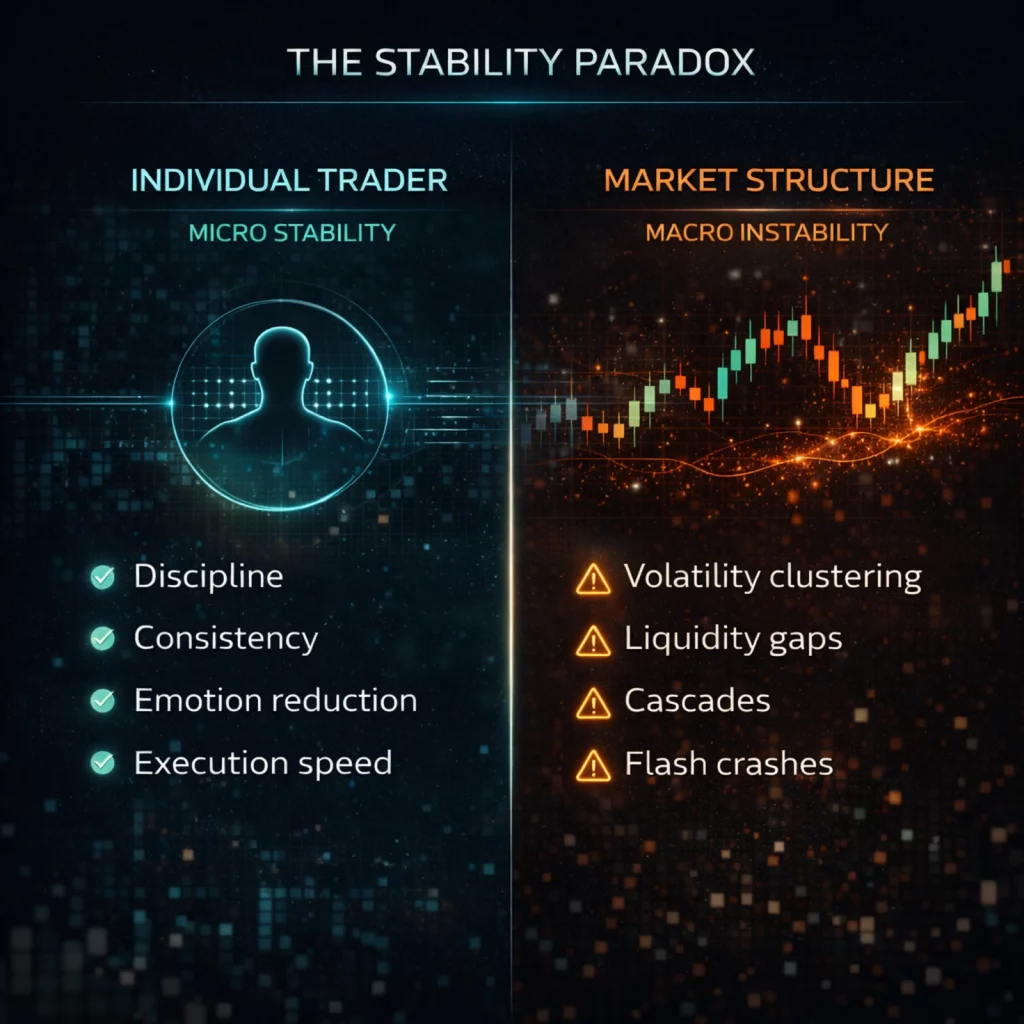
The Stability Paradox
AI crypto trading bots introduce a striking contradiction. At the individual level, automation often improves discipline, consistency, and reaction speed. At the systemic level, synchronized automation can contribute to volatility clustering, liquidity gaps, cascading reactions, and flash crash dynamics. This tension between machine discipline and human discretion is explored further in AI Crypto Trading vs Manual Trading.
Bots reduce human error locally yet may amplify instability collectively. This is not necessarily a malfunction. It is an emergent property of automation convergence.
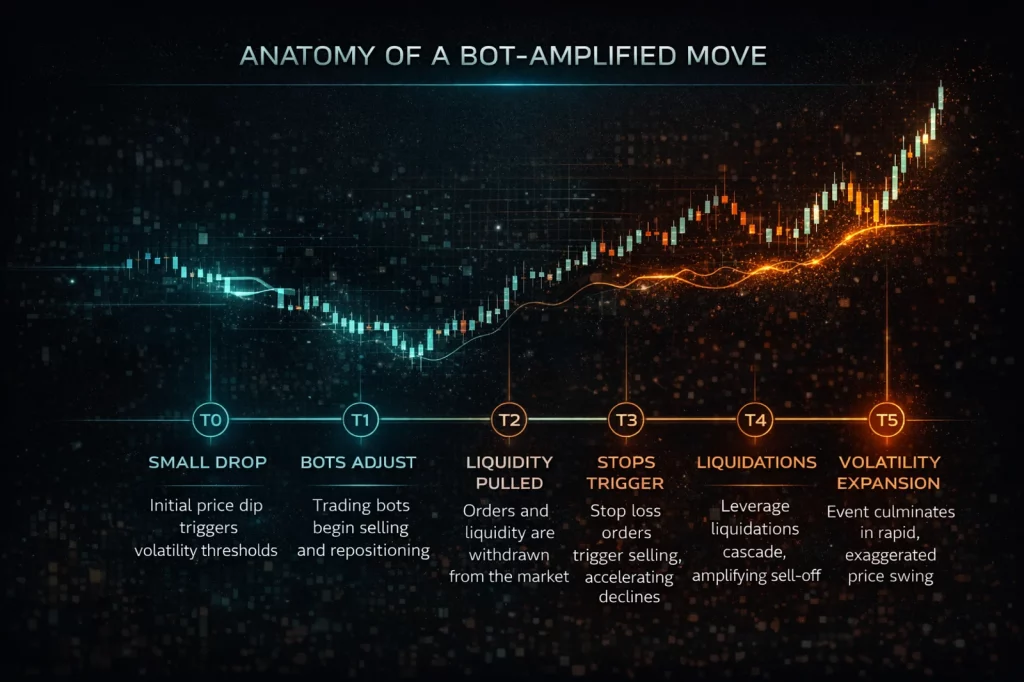
Example Scenario: Anatomy of a Bot-Amplified Move
Consider a typical high-volatility event. A sudden price drop triggers volatility thresholds. Bots begin adjusting positions. Resting liquidity is pulled from order books. Stop losses activate. Liquidation engines engage leveraged positions. Bots detect momentum and accelerate reactions. Within minutes, a modest initial move becomes a sharp cascade. No major news release is required.
Practical Implications for Traders
The key takeaway for traders is not that bots are inherently beneficial or dangerous. The essential insight is that bots change how risk manifests. Automation does not eliminate uncertainty. It transforms exposure. Understanding leverage dynamics, liquidation mechanics, and systemic instability is essential, as explained in AI Crypto Trading Risks & Regulation. Successful bot usage requires monitoring, stress testing, parameter evaluation, and regime awareness.
Practical Implications for Platforms
Bot providers and trading platforms face increasing pressure to communicate transparently. Execution behavior, slippage dynamics, strategy limitations, and risk scenarios must be clearly explained. Competitive differentiation is gradually shifting from feature lists toward robustness, stability, and risk architecture.
The Illusion of Passive Automation
Despite popular marketing narratives, trading bots are rarely passive income systems. They require oversight, adjustment, and evaluation. Automation redistributes responsibility rather than removing it. The trader’s role shifts from executing trades to supervising systems.
What This Analysis Does Not Claim
This analysis does not claim that bots cause volatility, that automation is inherently harmful, or that human traders are becoming irrelevant. Instead, it suggests something more nuanced. AI-assisted trading bots increasingly influence how volatility forms, propagates, and accelerates. Understanding that distinction is crucial.
A Structural Evolution
AI crypto trading bots are not a temporary trend.
They represent a structural layer within modern crypto markets. As adoption scales, algorithmic interactions intensify, feedback loops strengthen, and volatility behavior evolves. Markets are gradually transitioning from human-dominant environments toward hybrid ecosystems shaped by both human strategy design and machine interaction.
Source & Research Context
This analysis is based on observable structural developments across crypto markets, including:
- Market microstructure behavior during volatility events
- The evolution of AI-assisted crypto trading bots
- Liquidity dynamics and order book reactions
- Exchange liquidation mechanisms
- Cross-market comparisons with algorithmic trading environments
Rather than attributing volatility to isolated causes, this article examines broader systemic patterns emerging from the growing interaction between automated trading systems and leveraged market structures.
Arti-Trends focuses on identifying long-term technological and behavioral shifts shaping AI, automation, and digital asset markets.