
Artificial intelligence is entering a phase where competitive advantage is no longer defined primarily by model quality or prompt engineering, but by execution autonomy, orchestration architecture, and governance discipline. In 2026, enterprises are shifting from AI tools that assist human decision-making toward agentic AI systems capable of planning, reasoning, and executing multi-step workflows independently. This transition signals not incremental enhancement, but structural transformation in how digital work is performed.
This architectural shift is reshaping enterprise software at multiple levels. Workflow automation, compliance monitoring, financial reconciliation, procurement processes, and operational coordination are increasingly delegated to autonomous AI agents. Investors, executives, and regulators are therefore confronting a central question: does the agentic AI cycle represent sustainable productivity expansion, or the early formation of accountability and control risks embedded within autonomous systems?
AI is no longer constrained by output generation alone. It is increasingly constrained by governance, execution reliability, and institutional trust.
Table of Contents
ToggleKey Takeaways
The rise of Agentic AI 2026 marks a structural shift from assistive AI tools toward autonomous AI systems capable of executing complex business workflows. Competitive advantage is increasingly tied to orchestration capability, integration depth, and governance frameworks rather than model quality alone.
Enterprise adoption is accelerating across finance, legal, and operations, where AI agents reduce administrative friction and compress decision cycles. However, autonomy introduces new layers of operational and regulatory risk. Accountability, traceability, and execution control are emerging as core strategic variables.
For investors and businesses, the agentic AI shift is redefining software valuation logic, workforce structures, and competitive dynamics. The long-term winners will combine execution autonomy with disciplined oversight.
The Structural Shift Toward Autonomous AI Systems
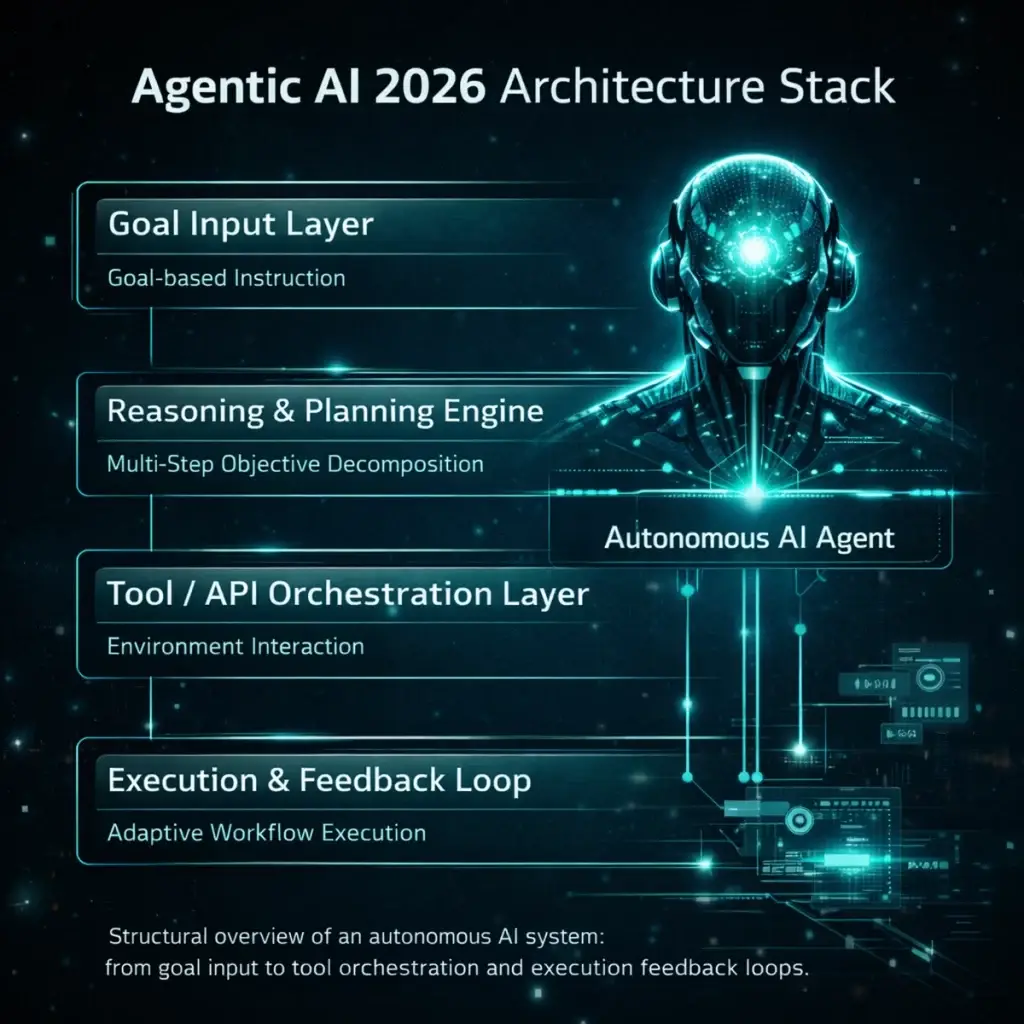
The projected expansion of agentic AI systems represents one of the most consequential architectural transitions since the rise of cloud computing. Unlike earlier AI waves focused on chat interfaces or productivity enhancements, agentic AI introduces systems that maintain context, decompose objectives, call external tools, and persist across multi-step tasks.
What distinguishes the 2026 cycle is not simply improved reasoning models, but the embedding of autonomy into enterprise workflows. AI agents are no longer limited to drafting emails or summarizing documents. They can:
Monitor financial anomalies
Trigger ERP actions
Escalate compliance exceptions
Execute portfolio rebalancing logic
Manage procurement workflows
This evolution shifts cost structures from human-driven oversight toward system-driven orchestration. It also changes organizational design. Teams increasingly supervise AI systems rather than manually performing repetitive execution tasks.
Several ecosystem leaders are accelerating this transition, including OpenAI, Anthropic, Microsoft, and Google. Yet agentic AI is not defined by any single vendor. It is defined by architectural layering: memory systems, tool integration, API orchestration, and permission boundaries.
The agentic AI shift is as much about system design as it is about intelligence.
Why Enterprises Are Accelerating Adoption
Agentic AI adoption is best understood through operational economics rather than technological novelty. Enterprises face persistent margin pressure, regulatory complexity, and labor constraints. Autonomous AI systems promise continuous execution without proportional headcount expansion.
In finance departments, AI agents reconcile invoices, detect discrepancies, and prepare compliance drafts before human review. In legal environments, agents flag risk clauses and cross-reference regulatory changes. In operations, AI systems classify maintenance notifications, estimate downtime impact, and escalate boundary cases.
Underinvestment in execution automation increasingly carries asymmetric downside risk. If competitors reduce administrative cost structures through AI agents while maintaining accuracy, lagging firms face margin compression and slower response cycles.
There is also a signaling dimension. Firms deploying AI agents project technological leadership and operational modernity, reinforcing investor confidence. As with previous digital transitions, visible adoption can influence valuation narratives before financial benefits fully materialize.
The agentic AI race is therefore both defensive and strategic.
Market Impact: Agentic AI as a Valuation Multiplier
Autonomous AI systems are beginning to influence valuation frameworks across enterprise software and infrastructure markets. Platforms that enable orchestration layers, workflow automation, API connectivity, and governance tooling may experience premium multiple expansion relative to static productivity tools.
However, autonomy-driven valuation narratives introduce complexity. Execution systems must demonstrate reliability, auditability, and regulatory alignment. Failure events can create disproportionate reputational and legal exposure compared to traditional software errors.
A divergence may emerge between:
Infrastructure and orchestration providers
Application-layer AI tools
Governance and compliance platforms
Investors increasingly differentiate between generative novelty and operational durability. Agentic AI platforms that demonstrate measurable cost compression, error reduction, and cycle-time acceleration may justify structural re-rating. Those relying on marketing narratives without enterprise-grade safeguards may face volatility.
Narrative momentum can persist. Execution risk eventually demands validation.
pared for the consequences when it does.
Governance and Accountability: The Core Structural Risk
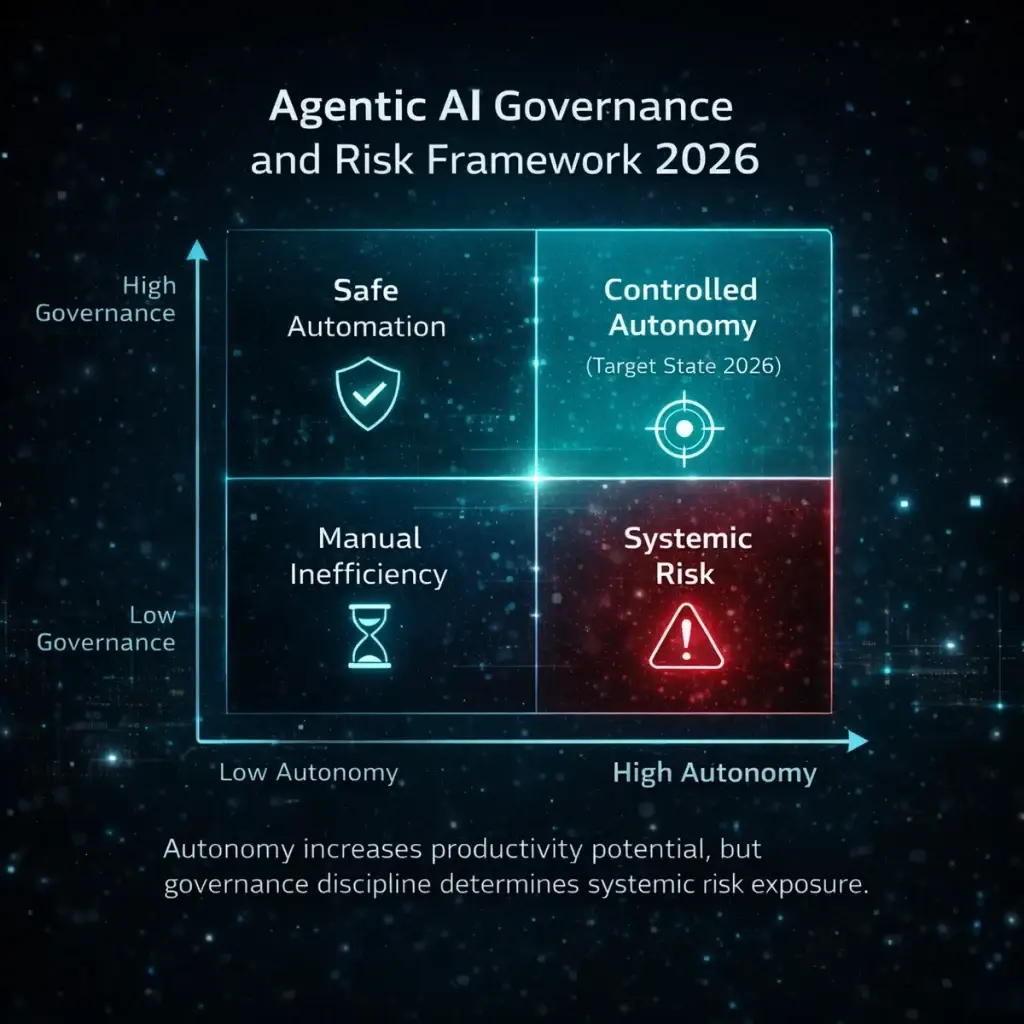
Autonomy alters responsibility.
When AI generates suggestions, humans decide. When AI executes decisions, accountability becomes diffused.
Key risk dimensions include:
Decision traceability
Role-based execution limits
Audit log integrity
Override mechanisms
Regulatory compliance mapping
In finance or healthcare contexts, even small execution errors can propagate rapidly. Autonomous systems amplify both efficiency and error velocity.
The central governance challenge is not whether AI agents make mistakes. It is how institutions design systems that constrain, monitor, and correct those mistakes.
The most resilient deployments incorporate:
Human-in-the-loop escalation layers
Tiered permission hierarchies
Continuous logging and anomaly detection
Kill-switch protocols
Without these controls, execution autonomy becomes systemic fragility.
Innovation Pressure and Competitive Dynamics
The agentic AI cycle intensifies competitive pressure across enterprise software markets. As orchestration frameworks mature, differentiation shifts toward integration depth, domain specialization, and reliability engineering rather than raw model capability.
Large firms with access to proprietary datasets, secure infrastructure, and compliance expertise may gain disproportionate advantage. Smaller firms, while agile, often depend on hyperscaler APIs and infrastructure layers, reshaping bargaining dynamics.
Autonomy also compresses product cycles. Once AI agents manage workflows, expectations for responsiveness, personalization, and error tolerance rise sharply. Competitive advantage becomes multidimensional: intelligence, resilience, governance, and integration.
The AI race is shifting from generation superiority toward execution credibility.
Emerging Risks Beneath the Agentic Expansion
Structural transitions of this magnitude introduce fragility. One risk centers on over-automation. If organizations delegate critical decisions prematurely, systemic exposure may increase rather than decrease.
A second risk involves governance lag. Regulatory frameworks evolve slower than technological capability. In highly regulated sectors, premature autonomy could create compliance gaps.
A third risk concerns workforce displacement dynamics. Rapid automation without strategic reskilling can destabilize internal knowledge structures and morale.
Historical precedent suggests that technological autonomy phases often produce alternating cycles of enthusiasm and recalibration. Sustainable adoption depends on disciplined implementation rather than aggressive expansion.
The greatest vulnerability may not be model failure, but oversight failure.
Scenario Outlook: Three Structural Paths
One potential outcome is sustained productivity absorption. In this scenario, AI agents meaningfully reduce operational friction while maintaining governance integrity, supporting margin expansion and durable enterprise value creation.
A second outcome involves autonomy overshoot. Organizations over-delegate critical decisions, leading to reputational incidents, regulatory intervention, and tightened controls.
A third outcome features controlled rationalization. Firms deploy AI agents selectively, optimize governance frameworks, and prioritize high-ROI domains while maintaining human oversight in sensitive areas.
These trajectories are not mutually exclusive. Adoption cycles often progress through sequential recalibration phases.
Practical Implications for Investors and Businesses
For investors, the agentic AI shift reinforces the need to distinguish between interface innovation and execution infrastructure. Monitoring enterprise adoption rates, workflow penetration depth, governance tooling integration, and measurable cost savings becomes essential.
For businesses, AI strategy must evolve beyond experimentation. Leadership teams should evaluate:
Where execution autonomy creates genuine economic value
Which workflows require human override
How auditability and compliance are embedded
How vendor dependency affects long-term resilience
Agentic AI is not merely a productivity tool upgrade. It is an organizational architecture redesign.
Conclusion
The Agentic AI 2026 transition represents a structural reconfiguration of enterprise software. Autonomy is redefining how digital work is executed, how accountability is distributed, and how competitive advantage is sustained.
AI is no longer limited by what it can generate, but by how responsibly and reliably it can act.
The companies that thrive will not be those that automate the fastest, but those that balance autonomy with governance discipline.
The shift from tools to autonomous systems has begun. The defining question of 2026 is not whether AI can act — but whether institutions are pre