
AI investing is the long-term practice of allocating capital to companies, funds, and digital assets whose value creation is directly driven by artificial intelligence—across compute infrastructure, AI software platforms, autonomous systems, and emerging decentralized AI networks. It includes AI stocks, AI ETFs, AI-related crypto assets, and early-stage startups. The upside can be significant, but AI investing also requires discipline: separating durable adoption from hype, understanding regulatory and technology risk, and building exposure that can survive fast innovation cycles.
Artificial intelligence is no longer “the next big thing.” In 2026, it is quietly becoming the operating layer of the global economy—powering enterprise automation, scientific discovery, cybersecurity, logistics, finance, and consumer software.
That shift has created a new investment reality: AI is not a single sector. It is a stack—from chips and cloud infrastructure, to model platforms, to robotics and autonomous systems, to decentralized compute networks. And because each layer behaves differently, AI investing is not the same as general tech investing.
Here’s the challenge most investors run into:
AI headlines move fast, valuations swing hard, and the market often rewards narratives before fundamentals catch up. Some of the biggest winners of this decade will be AI-driven. Some of the most painful drawdowns will also happen in AI.
This guide is designed to make the landscape clear—without hype and without stock-picking.
Inside, you’ll learn:
- what AI investing actually means in 2026 (and what it does not mean)
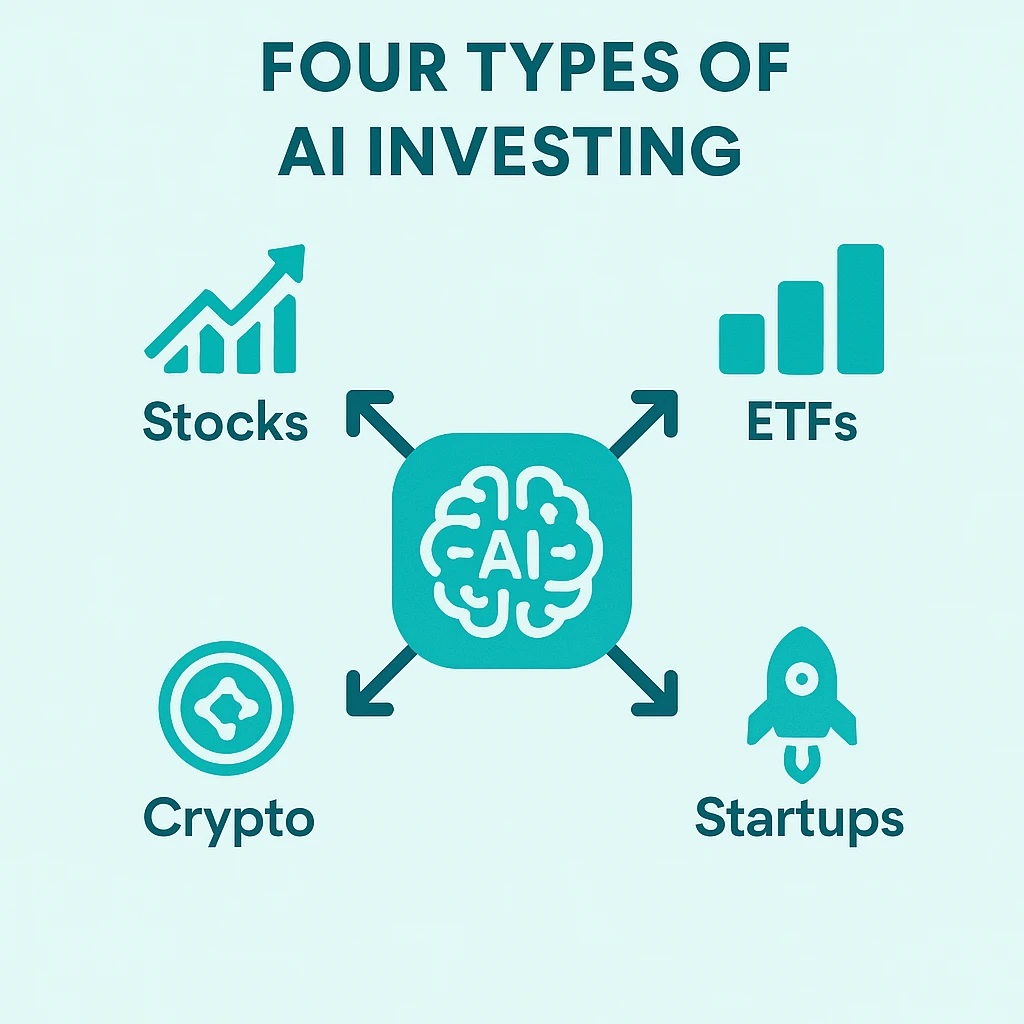
- the four core categories of AI exposure: stocks, ETFs, crypto networks, and startups
- how to think in layers (infrastructure vs platforms vs applications)
- how to build a strategy that matches your risk tolerance and time horizon
- the risks that matter most: hype cycles, regulation, competitive disruption, and capital intensity
By the end, you won’t just have “AI exposure.”
You’ll have an allocation framework you can defend—even when the narrative changes.
Arti-Trends covers AI investing as a research-driven framework—not financial advice. We focus on market structure, adoption, and risk—so you can make informed decisions within your own portfolio plan.
What AI Investing Is — And What It Is Not
AI investing is the long-term practice of allocating capital to companies, funds, and digital assets whose value creation is directly driven by artificial intelligence. In practical terms, this means exposure to the infrastructure that powers AI (compute, chips, cloud), the platforms that distribute AI into real workflows (enterprise software, copilots, analytics), and the systems that apply AI in the physical world (robotics, autonomy, industrial automation).
Equally important is understanding what AI investing is not.
It is not buying anything that merely mentions AI in marketing materials. Many companies will add AI features without building durable competitive advantage. It is not chasing headlines, model launches, or short-term hype cycles as if they automatically translate into long-term value. And it is not identical to general technology investing, because AI markets are shaped by distinct forces: capital intensity, rapid innovation cycles, winner-take-most dynamics, and regulatory pressure that can quickly reshape entire segments.
AI investing also needs to be clearly separated from AI trading.
Investing is fundamentally about ownership and compounding. It focuses on building exposure to businesses and networks that benefit from AI adoption over multiple years. Trading, by contrast, focuses on execution: how positions are entered, sized, adjusted, and exited based on market structure and volatility. Both can play a role in a modern portfolio, but they solve different problems and require different skill sets.
The purpose of this guide is not to tell you what to buy. Its purpose is to help you understand what counts as AI exposure, how value is created across the AI ecosystem, which investment vehicles exist, and how to think about allocation before making decisions. If you want a practical framework for turning these concepts into a structured plan, start with How to Start Investing in AI.
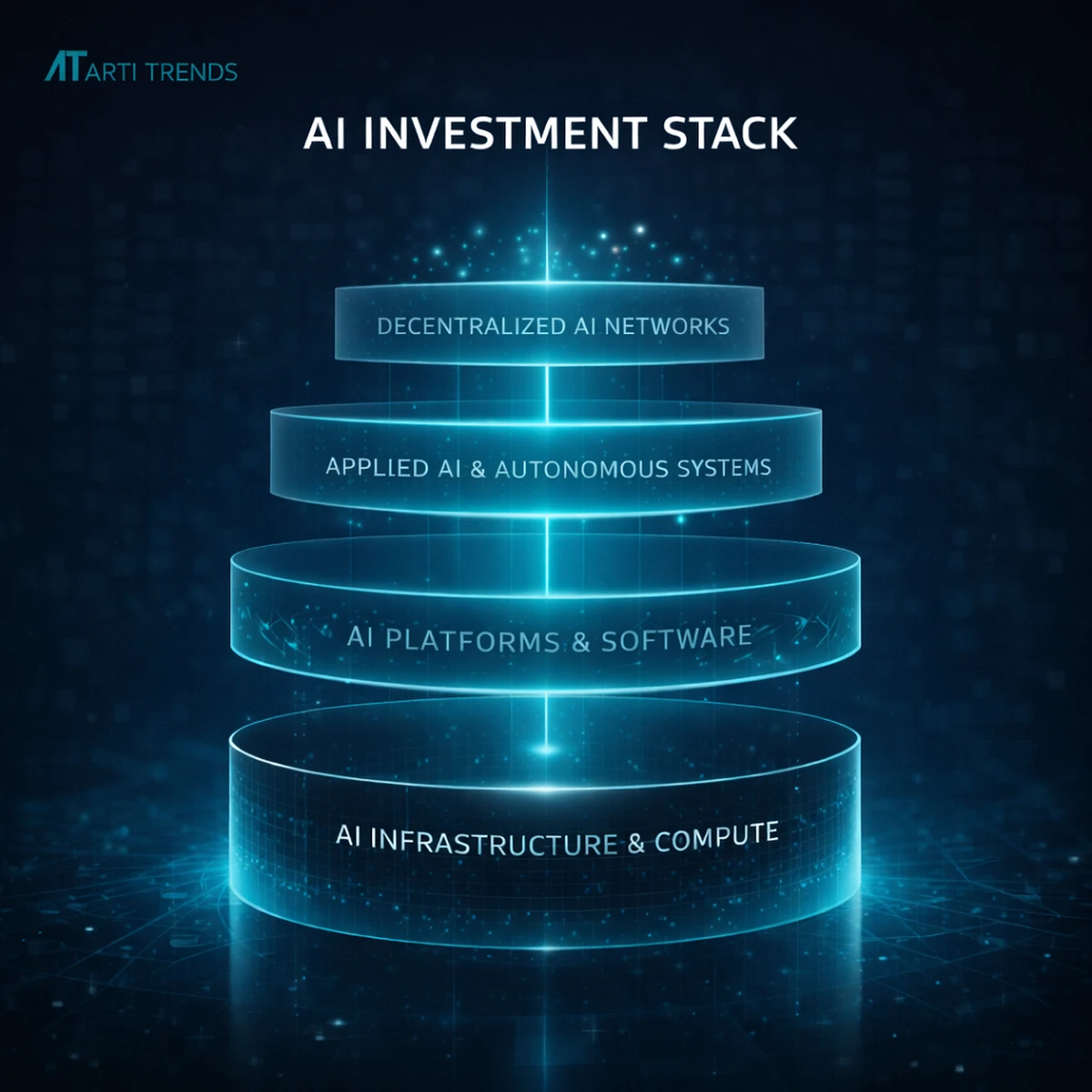
The AI Investment Stack: How Value Is Created
AI investing becomes much clearer once you stop thinking in sectors and start thinking in layers.
Artificial intelligence is not a single market. It is a stack of interdependent components, each capturing value in a different way and carrying a different risk profile. Some layers compound slowly and defensively. Others move fast, attract speculation, and experience sharp cycles of hype and correction.
Understanding this stack is essential, because most AI investment mistakes happen when investors confuse one layer for another.
At the foundation of the AI stack sits infrastructure. This layer includes the compute, chips, cloud platforms, data centers, and networking systems required to train and run AI models at scale. These businesses benefit from long-term demand growth, but they are also capital-intensive and sensitive to investment cycles. Infrastructure tends to reward patience, scale, and balance-sheet strength. Most public-market exposure to this layer sits inside the AI Stocks Hub.
Above infrastructure sits the platform layer. These are companies that translate raw AI capability into usable products for enterprises and developers: enterprise AI software, analytics platforms, copilots, security automation, and developer tooling. Platform businesses often scale faster than infrastructure, but face intense competition and rapid product iteration. Many investors combine this layer with infrastructure exposure through diversified vehicles such as those covered in the AI ETFs Hub.
Next comes the application and autonomy layer. This is where AI directly interacts with the real world: robotics, autonomous systems, industrial automation, logistics, healthcare diagnostics, and applied decision systems. Value here depends less on raw model performance and more on integration, regulation, distribution, and real-world reliability. This layer can produce category-defining winners, but outcomes vary widely across industries.
Finally, there is the decentralized AI layer. This includes blockchain-based compute networks, AI marketplaces, agent economies, and tokenized infrastructure. These systems attempt to re-architect how AI resources are owned, priced, and accessed globally. While still early, this layer introduces entirely different risk dynamics, driven by network effects, regulation, and adoption rather than traditional cash flows.
Each layer plays a role in the AI economy. None of them should be evaluated in isolation.
Strong AI investing strategies recognize that value does not accumulate evenly across the stack, and that different layers dominate at different stages of the adoption cycle. Infrastructure may lead early. Platforms scale next. Applications mature later. Decentralized systems remain experimental but asymmetric.
Before choosing specific investment vehicles, the first decision is always structural:
Which layers do you want exposure to—and why?
The Four AI Investment Vehicles
AI investing can be accessed through several distinct investment vehicles. Each offers exposure to artificial intelligence in a different way, with its own risk profile, time horizon, and suitability depending on investor experience.
Understanding these vehicles is essential. Many investors underperform not because AI fails to grow, but because they choose the wrong vehicle for their goals.
AI Stocks
AI stocks represent ownership in publicly traded companies whose revenues and competitive advantage are directly tied to artificial intelligence. This includes firms building AI infrastructure, developing enterprise AI platforms, or deploying AI at scale across products and services.
Stocks offer transparency, liquidity, and the ability to compound over time. At the same time, they are sensitive to valuation cycles, earnings expectations, and shifts in technological leadership. Some AI companies will dominate for decades; others will struggle as competition and innovation accelerate.
For investors seeking direct ownership and long-term exposure to the public AI economy, AI stocks form the core building block of most portfolios. To explore this category in depth, continue to AI Stocks Hub or learn how professionals assess quality and risk in How to Analyze AI Stocks.
AI ETFs
AI ETFs bundle multiple AI-related companies into a single investment product. They are designed to provide broad exposure across the AI landscape without requiring investors to select individual winners.
ETFs reduce single-company risk and are often used as a foundation for diversified portfolios. However, diversification comes at a cost: exceptional performers are averaged together with slower-growing firms, and not all ETFs labeled “AI” provide meaningful exposure.
For investors who value simplicity, risk control, and long-term allocation, AI ETFs can be an effective entry point. A deeper overview is available in the AI ETFs Hub, with practical portfolio construction guidance in AI ETF Portfolio Guide.
AI Crypto & Decentralized AI Networks
AI crypto assets provide exposure to decentralized AI infrastructure, compute marketplaces, data networks, and autonomous agent ecosystems. Instead of owning companies, investors gain exposure to networks that aim to re-architect how AI resources are owned, priced, and accessed globally.
This category operates under fundamentally different dynamics than stocks or ETFs. Value is driven by network adoption, token economics, regulation, and technological relevance rather than traditional cash flows. As a result, volatility is high and outcomes are asymmetric.
For investors willing to accept higher risk in exchange for potential upside, decentralized AI represents a frontier segment of the AI ecosystem. To understand how this category works in practice, explore Top AI Cryptocurrencies and the foundational concepts explained in What Are AI Tokens?.
AI Startups & Private Markets
AI startups offer exposure to early-stage innovation where some of the most disruptive breakthroughs occur. These investments target private companies working on robotics, domain-specific AI models, autonomous systems, synthetic data, and next-generation platforms.
The potential rewards can be substantial, but so are the risks. Most startups fail, access is limited, and exit timelines are uncertain. Evaluating teams, technology, capital structure, and market fit becomes critical.
For experienced investors seeking asymmetric upside beyond public markets, startups can play a role within a carefully sized allocation. For a structured overview, see Investing in AI Startups and the evaluation framework outlined in How to Evaluate AI Startups.
Why Choosing the Right Vehicle Matters
AI investing is not about choosing the “best” category. It is about alignment.
The right vehicle depends on:
- risk tolerance
- time horizon
- experience level
- need for liquidity
- tolerance for volatility
Many resilient AI portfolios combine multiple vehicles, allowing investors to capture growth across different layers of the AI economy while managing downside risk.
How AI Investing Fits Different Investor Profiles
AI investing is not one-size-fits-all. The same technology can support very different strategies depending on experience level, risk tolerance, time horizon, and portfolio goals. The mistake many investors make is not choosing the “wrong” AI assets—but choosing the wrong vehicle for their profile.
Understanding where you fit helps you avoid unnecessary risk and align AI exposure with long-term objectives.
Beginner investors
For beginners, the priority is simplicity, diversification, and downside control. At this stage, the goal is not to outperform the market but to gain structured exposure to AI without relying on deep technical analysis or frequent decision-making.
Broad, diversified vehicles are often the most appropriate starting point. Many beginners begin by learning the fundamentals through How to Start Investing in AI, while pairing that knowledge with diversified exposure to reduce early mistakes.
Intermediate investors
Intermediate investors are typically comfortable analyzing public companies, understanding earnings reports, and following competitive dynamics. At this stage, investors often move beyond broad exposure and begin selecting specific areas of the AI ecosystem they believe will outperform.
This profile focuses on balancing growth potential with valuation discipline and diversification. Risk management becomes more important, as concentrated positions can amplify both gains and losses. Understanding downside scenarios is critical, which is why many intermediate investors study AI Investing Risks before scaling exposure.
Advanced investors
Advanced investors are willing to accept higher volatility and complexity in exchange for asymmetric upside. This profile often includes exposure to emerging AI segments, early-stage innovation, and markets where outcomes are less predictable.
At this level, position sizing, portfolio construction, and loss tolerance matter more than individual narratives. Advanced investors typically combine multiple AI vehicles while keeping speculative exposure intentionally limited relative to overall capital.
Long-term allocators
Long-term allocators think in multi-year cycles rather than quarters. Their focus is on structural adoption, capital intensity, and durability of competitive advantage. AI exposure is treated as a strategic allocation—not a trade.
This profile often blends multiple AI investment vehicles to capture growth across infrastructure, platforms, and emerging systems while maintaining portfolio resilience. A clear framework helps prevent emotional decision-making during hype cycles and market corrections.
The Key Insight
There is no “best” way to invest in AI—only a way that fits your profile.
Strong AI investing strategies start by understanding who you are as an investor, then selecting vehicles that match your goals, constraints, and tolerance for uncertainty. Allocation comes before optimization.
Risks That Actually Matter in AI Investing
AI investing offers exceptional long-term potential, but it also carries risks that differ from traditional equity or technology investing. The investors who succeed are rarely those who avoid risk altogether, but those who understand where it concentrates—and how it evolves as AI markets mature.
Below are the risks that matter most in AI investing, not as abstract warnings, but as structural forces that shape outcomes.
Market hype and valuation cycles
AI markets move in narratives. Breakthroughs, model releases, and adoption headlines often push valuations far ahead of underlying fundamentals. In some cycles, this creates generational entry points. In others, it leads to sharp corrections when expectations reset.
The challenge for investors is distinguishing durable demand from temporary enthusiasm. Valuation alone does not determine success, but ignoring valuation entirely increases downside risk—especially in capital-intensive AI segments.
Understanding how hype cycles form, peak, and unwind is essential for managing exposure responsibly. A deeper framework is covered in AI Investing Risks.
Capital intensity and infrastructure cycles
Unlike many digital businesses, large parts of the AI ecosystem require massive upfront investment. Compute clusters, data centers, energy infrastructure, and advanced chips all demand sustained capital expenditure.
This creates long-term opportunity—but also cyclicality. Periods of aggressive build-out are often followed by consolidation, margin pressure, or slower growth. Investors who understand capital cycles are better positioned to avoid over-concentration at the wrong stage.
Technological disruption and fast innovation
AI evolves faster than almost any prior technology. New architectures, training techniques, and deployment models can quickly reduce the relevance of existing solutions.
Market leaders today are not guaranteed to remain leaders indefinitely. This makes diversification across AI layers more important than betting on a single technology or company. Long-term success depends on adaptability, not just early dominance.
Regulation, policy, and governance risk
As AI systems influence economies, labor markets, and information flows, regulation is inevitable. New rules around data usage, model accountability, safety standards, and market concentration can materially affect business models.
Regulation does not eliminate opportunity—but it redistributes it. Companies and networks that adapt early often gain long-term advantage, while others face friction or structural constraints. Staying informed about policy direction is critical, which is why ongoing coverage of AI Regulation matters for investors.
Competition and market concentration
AI markets tend to concentrate quickly. Scale advantages in data, compute, and distribution can create winner-take-most dynamics, especially in infrastructure and platform layers.
At the same time, open-source models, new entrants, and decentralized alternatives continue to challenge incumbents. This tension creates opportunity—but also increases uncertainty. Investors must understand not just who leads today, but why that lead exists.
Volatility in emerging AI markets
Segments such as decentralized AI networks and early-stage startups introduce additional layers of risk. Prices can move rapidly, liquidity can disappear, and adoption timelines can shift unexpectedly.
These markets can produce outsized returns, but only when position sizing and expectations are realistic. Treating speculative AI exposure as a small, intentional part of a broader strategy reduces the risk of permanent capital loss.
The core takeaway on risk
Risk in AI investing is not a reason to stay out of the market—it is a reason to be deliberate.
The most resilient strategies:
- recognize where risk concentrates
- diversify across AI layers
- size positions intentionally
- adapt as technology and regulation evolve
If you understand the risks, you can decide how much exposure makes sense for you—rather than reacting to headlines.
How This Guide Fits the Arti-Trends AI Investing Framework
This guide is designed as the starting point of a structured AI investing framework—not a standalone article.
AI investing spans multiple asset types, risk profiles, and decision layers. No single page can responsibly cover all of that in depth. Instead, this cornerstone defines the landscape and routes you to specialized guides depending on where you want to go next.
If your focus is ownership and long-term exposure, the framework branches into four core allocation hubs.
Investors exploring public-market opportunities can continue through the AI Stocks Hub, which breaks down how AI-driven companies create value, how to analyze fundamentals, and how to think about valuation cycles.
For diversified exposure with lower single-company risk, the AI ETFs Hub explains how AI-focused ETFs work, how they differ from individual stocks, and how they can be combined into long-term portfolios.
If you’re interested in decentralized AI networks, compute markets, and token-based ecosystems, the AI Crypto Investing Hub covers how these assets function, what risks matter most, and how they fit into a broader AI strategy.
For high-risk, high-reward exposure beyond public markets, the AI Startups Hub focuses on private AI companies, early-stage innovation, and evaluation frameworks used by professional investors.
Alongside allocation, some investors also care about how capital is deployed—particularly in volatile crypto markets. That execution layer is covered separately in the AI Trading Bots Hub, which focuses on automation, portfolio management, and risk-controlled execution rather than ownership.
Finally, if you’re still defining your approach, start with How to Start Investing in AI, and review AI Investing Risks to understand the trade-offs before increasing exposure.
Together, these pages form a coherent research-driven system designed to help you move from understanding to strategy—without relying on hype or speculation.
Conclusion: Building a Durable AI Investing Strategy
Artificial intelligence is no longer an emerging theme—it is becoming a foundational layer of the global economy. For investors, that creates opportunity, but also responsibility. AI investing is not about predicting the next headline or timing the next cycle. It is about positioning capital in front of long-term adoption while managing uncertainty.
Throughout this guide, you’ve seen that AI investing is multi-layered. Value is created across infrastructure, platforms, applications, and emerging decentralized systems. Each layer behaves differently. Each requires a different mindset. And each fits different investor profiles.
The most resilient AI investing strategies share a few common traits:
- they focus on allocation before optimization
- they diversify across vehicles and layers
- they respect risk, capital cycles, and regulation
- they adapt as technology and markets evolve
AI will produce extraordinary winners—and painful disappointments. The difference will not be intelligence alone, but structure. Investors who understand where value is created, how exposure is built, and why certain risks matter are better equipped to navigate volatility without losing conviction.
AI investing is a long-term journey. This guide is your starting point—not your final answer.
Internal Linking Block
If you want a practical allocation framework, continue with How to Start Investing in AI.
To understand downside scenarios and structural risks, review AI Investing Risks.
For public-market exposure, explore the AI Stocks Hub and the AI ETFs Hub.
For decentralized networks and token-based AI systems, see the AI Crypto Investing Hub.
For private-market innovation and early-stage opportunities, visit the AI Startups Hub.
If your focus is execution and automation—particularly in crypto markets—continue with the AI Trading Bots Hub.
Frequently Asked Questions
What is AI investing?
AI investing refers to allocating capital to companies, funds, or digital assets whose growth is directly driven by artificial intelligence. This includes public companies building AI infrastructure or platforms, diversified AI ETFs, decentralized AI networks, and early-stage startups. The goal is long-term exposure to AI adoption rather than short-term speculation.
Is AI investing the same as investing in tech stocks?
No. While AI investing overlaps with technology investing, it is more specific. AI investing focuses on businesses where artificial intelligence is central to value creation—not just a supporting feature. This distinction becomes clearer when comparing general tech exposure with the frameworks outlined in AI Stocks Hub.
Are AI ETFs a good way to start investing in AI?
For many beginners, yes. AI ETFs provide diversified exposure across multiple AI-related companies and reduce the risk of relying on a single winner. They are often used as a foundation before moving into more selective strategies explained in the AI ETFs Hub.
How risky is AI investing?
AI investing carries meaningful risk, including hype-driven valuations, rapid technological disruption, regulatory pressure, and capital-intensive business models. These risks do not make AI uninvestable—but they do require structure, diversification, and realistic expectations. A deeper breakdown is covered in AI Investing Risks.
What is the difference between AI investing and AI trading?
AI investing focuses on long-term ownership and compounding through stocks, ETFs, startups, or networks. AI trading focuses on execution—how positions are entered, managed, and adjusted over shorter time frames. Execution-focused systems are covered separately in the AI Trading Bots Hub.
How can beginners get started with AI investing?
Most beginners start by defining goals, risk tolerance, and time horizon before choosing a simple investment vehicle such as ETFs or established AI stocks. A step-by-step framework is outlined in How to Start Investing in AI.
Is AI investing a long-term strategy?
Yes. AI adoption unfolds over years, not weeks. While short-term cycles can be volatile, the strongest investment outcomes tend to favor investors who think in long-term adoption curves rather than short-term narratives.
Sources
#Investopedia – Artificial Intelligence (AI) in Investing: investopedia