
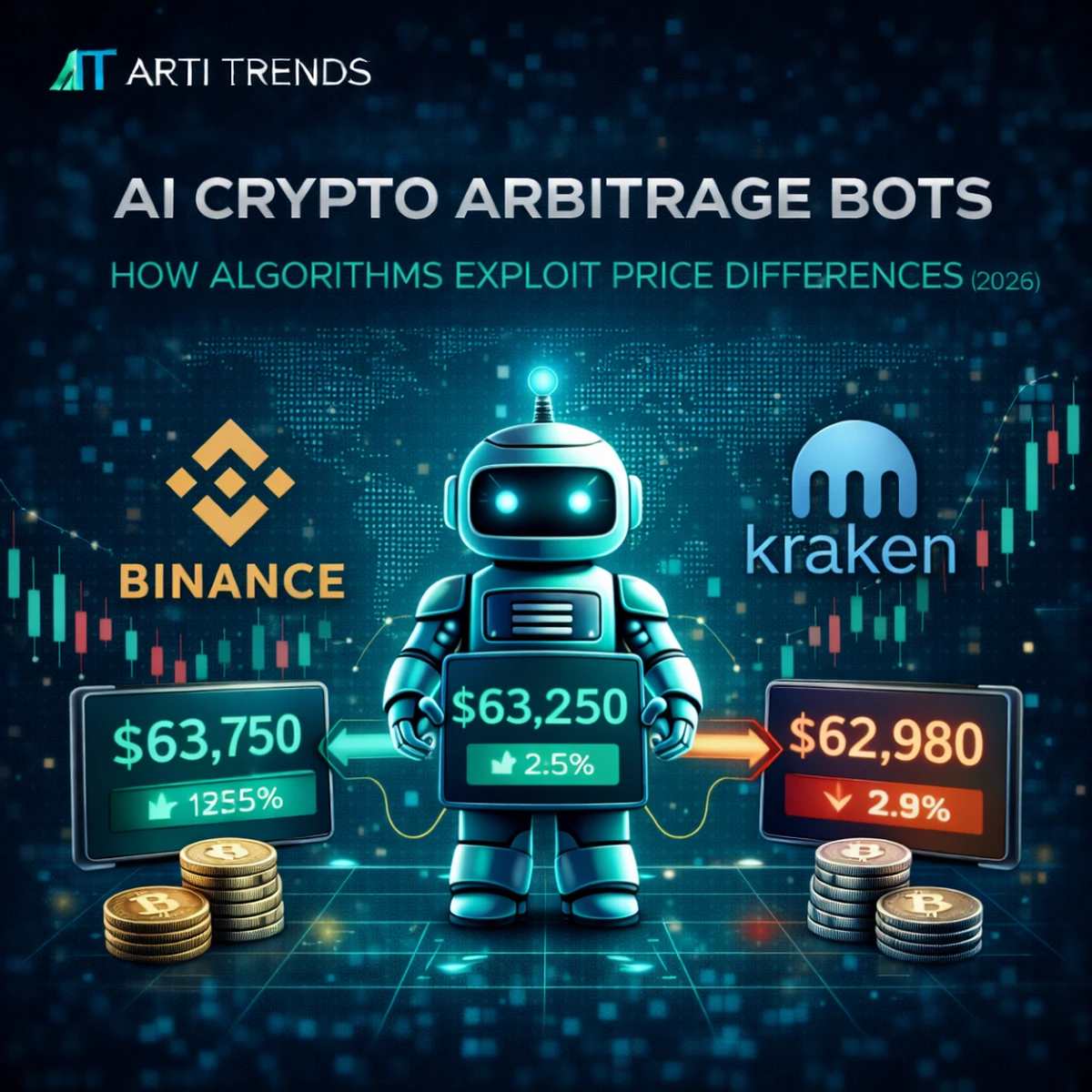
Introduction — Why Crypto Arbitrage Is an Execution Problem, Not a Prediction Game
Crypto arbitrage is often misunderstood.
It is not about forecasting price direction, finding the “next move,” or beating the market by being smarter. Arbitrage exists because crypto markets are structurally fragmented.
In 2026, the same asset trades simultaneously across dozens of exchanges, trading pairs, and derivative markets. Liquidity flows continuously between these venues, but prices never synchronize perfectly. Those structural mismatches are where arbitrage lives.
For human traders, these gaps are almost always invisible. By the time a price difference appears on a chart, it has already collapsed. For automated systems connected directly to exchange order books, however, these discrepancies are a normal part of market behavior.
This is why crypto arbitrage has become one of the most execution-intensive applications of AI-driven trading. Modern arbitrage systems do not predict price direction. They evaluate whether price differences survive real-world costs — including fees, slippage, and latency — and execute only when precision allows the edge to exist.
Success does not depend on being right about the market.
It depends on speed, cost control, liquidity access, and execution reliability.
This article is part of the broader AI Crypto Trading framework on Arti-Trends. For a complete breakdown of how AI trading systems are structured across strategy, execution, and exchange layers, see AI Crypto Trading Bots: Complete Guide (2026). To understand how arbitrage compares to other AI-driven approaches such as market-making and trend systems, explore AI Crypto Trading Strategies (2026).
In this guide, we examine how AI crypto arbitrage bots operate in real markets in 2026 — what types of arbitrage still exist, why most attempts fail, and how professional systems are designed to survive the structural constraints of modern crypto trading.
What Crypto Arbitrage Really Means in 2026
At its simplest, crypto arbitrage means buying an asset where it is cheaper and selling it where it is more expensive.
In practice, that definition is incomplete.
In 2026, crypto markets are no longer a single price discovery mechanism. They are a network of partially connected venues — each with its own liquidity profile, fee structure, participant mix, and latency characteristics. Prices converge, but never perfectly or instantaneously.
Arbitrage exists in those imperfections.
Rather than a single opportunity, arbitrage now appears across multiple dimensions at the same time:
- Cross-venue price differences between centralized exchanges
- Spot–futures basis gaps driven by leverage and funding dynamics
- Funding-rate imbalances across derivatives platforms
- Liquidity distortions between trading pairs or quote currencies
- Temporary dislocations during volatility spikes or liquidation cascades
These inefficiencies are not anomalies. They are a natural consequence of how modern crypto markets function.
Liquidity moves faster than capital.
Capital moves faster than humans.
Automation moves faster than both.
As a result, arbitrage is no longer a “trade idea.” It is a continuous process of observing market structure, measuring execution cost, and deciding whether a spread can realistically be captured before it disappears.
This is why arbitrage has shifted almost entirely toward automated systems.
The question is no longer “Is there a price difference?”
The real question is “Can this difference survive fees, slippage, latency, and fill risk?”
Only when the answer is yes does an arbitrage opportunity actually exist.
The Main Types of Crypto Arbitrage That Still Work in 2026
Not all arbitrage strategies that worked in earlier crypto cycles are still viable today.
As markets became faster, more liquid, and more competitive, many simple arbitrage models were compressed to the point where execution costs outweigh theoretical profit. What remains in 2026 are forms of arbitrage that survive because they are structurally aligned with how modern crypto markets behave.
These are the primary arbitrage models that still function in live markets.
Cross-Exchange Arbitrage
This is the most familiar form of arbitrage: the same asset trading at slightly different prices on different exchanges.
In 2026, these gaps exist mainly because exchanges differ in:
- local liquidity concentration
- regional user flow
- fee structures
- latency and matching-engine behavior
However, pure cross-exchange arbitrage is no longer trivial. Price differences are often small and short-lived, and profitability depends entirely on execution speed, pre-funded balances, and fee optimization.
For most participants, this model only works when embedded in a broader execution system rather than used in isolation.
Spot–Futures Arbitrage (Basis Trading)
One of the most durable arbitrage models in crypto is the price relationship between spot markets and perpetual futures.
When futures trade at a premium or discount relative to spot, traders can:
- buy spot and sell futures, or
- sell spot and buy futures
This captures the basis rather than price direction.
Because funding rates fluctuate continuously, this form of arbitrage remains viable across market conditions and does not depend on predicting price movement. Its limiting factors are capital efficiency, margin requirements, and execution coordination between legs.
Funding-Rate Arbitrage
Funding payments create predictable cash flows when positioning becomes imbalanced.
When long or short pressure dominates a derivatives market, funding rates adjust to rebalance positioning. Arbitrage systems monitor these rates across venues and allocate capital to capture favorable funding while remaining market-neutral.
This model works best when:
- execution is automated
- positions are carefully hedged
- exposure limits are strictly enforced
It is less sensitive to price volatility but highly sensitive to execution errors and sudden funding regime shifts.
Latency-Driven Micro-Arbitrage
At the extreme end of the spectrum are ultra-short-lived price discrepancies driven by:
- order-book updates arriving at different times
- temporary liquidity gaps during volatility
- delayed reactions across venues
These opportunities exist for milliseconds, not seconds.
They are inaccessible to manual traders and most retail systems. Only infrastructure optimized for low latency, queue positioning, and rapid order cancellation can operate here. For most participants, this category defines the upper boundary of what is realistically achievable.
What No Longer Works Reliably
Several arbitrage ideas that appear attractive in theory are largely ineffective in practice:
- slow manual cross-exchange trading
- arbitrage without pre-funded balances
- models that ignore fees and slippage
- strategies dependent on visible chart-based spreads
In modern crypto markets, if an opportunity looks obvious, it is usually already gone.
The surviving arbitrage models share one trait: they are execution problems first, and strategy problems second.
Why Crypto Arbitrage Is an Execution Game, Not a Prediction Game
Arbitrage is often misunderstood as a form of “smart trading.”
In reality, arbitrage has very little to do with intelligence or insight. It does not reward better forecasts, deeper market opinions, or superior indicators.
It rewards execution.
Every arbitrage opportunity exists inside a narrow window defined by four variables:
- time
- fees
- liquidity
- coordination
If any one of these fails, the opportunity disappears — or worse, turns into a loss.
Arbitrage Does Not Care About Direction
Unlike most trading strategies, arbitrage does not benefit from being right about where price will go.
A price difference already exists.
The only question is whether it can be captured before it collapses.
This makes arbitrage fundamentally different from:
trend-following
momentum trading
discretionary setups
Those strategies tolerate delay. Arbitrage does not.
If you want the broader landscape of how professional bots approach market-making, trend systems, and portfolio automation in 2026, see AI Crypto Trading Strategies (2026).
The Real Bottleneck: Execution Friction
In live markets, every arbitrage trade is reduced by friction:
- exchange trading fees
- bid–ask spreads
- slippage during fills
- latency between legs
On paper, a 0.15% spread looks attractive.
In practice, a few milliseconds of delay or a partial fill can erase it entirely.
This is why many theoretical arbitrage models fail the moment real money is involved.
Multi-Leg Risk Is the Hidden Enemy
Most arbitrage trades involve at least two coordinated actions.
If one side fills and the other does not, the trader is briefly exposed to market movement. This is known as leg risk, and it is the primary source of arbitrage losses.
Managing this risk requires:
- pre-funded balances
- precise order sequencing
- strict size limits
- fast cancellation logic
None of these are solved by better market prediction.
Why Faster Always Beats Smarter
Two traders can identify the same arbitrage opportunity.
The one with:
- lower latency
- better fee structure
- more reliable order execution
will capture it consistently.
The other will miss it, partially fill it, or pay too much to make it worthwhile.
Over hundreds or thousands of attempts, these differences compound.
This is why arbitrage is dominated by systems that treat execution as infrastructure, not as an afterthought.
The Core Insight
In arbitrage, the strategy does not create the edge.
The edge exists because markets are fragmented and asynchronous.
The only question is whether a system can observe, decide, and execute faster and cheaper than the spread collapses.
That is why arbitrage belongs at the execution end of AI trading — not the prediction end.
In the next section, we will introduce the framework that explains this clearly: the three-layer structure that determines whether arbitrage survives contact with real markets.
The Three-Layer Model Behind Successful Arbitrage
Crypto arbitrage looks simple on the surface.
Buy cheaper here.
Sell higher there.
In reality, it only works when three layers function together. If one layer fails, the entire arbitrage breaks — regardless of how “smart” the strategy looks.
This layered structure is not unique to arbitrage. It reflects how modern AI trading systems are designed more broadly, where strategy selection, execution quality, and exchange infrastructure must align for any edge to survive. A full breakdown of this framework across all AI trading styles is explained in AI Crypto Trading Bots: Complete Guide (2026).
Layer 1 — Strategy: Where does the price gap come from?
The strategy layer defines what kind of arbitrage you are running.
For example:
- price differences between exchanges
- spot vs futures pricing gaps
- funding rate imbalances
This layer answers one question only:
Does a real, repeatable price mismatch exist?
If the answer is no, nothing else matters.
Layer 2 — Execution: Can you actually capture it?
This is where most arbitrage fails.
Execution determines:
- how fast orders are placed
- whether both sides fill
- how much slippage occurs
A good strategy with poor execution loses.
An average strategy with excellent execution can survive.
Arbitrage lives or dies here.
Layer 3 — Exchange: Does the environment allow arbitrage to work?
Not every exchange is suitable for arbitrage.
The exchange layer defines:
- fees
- liquidity
- API reliability
Small price gaps only matter if costs stay low and orders fill cleanly.
Why This Model Matters
Many traders focus only on the strategy.
Professionals understand that arbitrage is a system, not a setup.
- Strategy finds the opportunity
- Execution determines survival
- Exchanges decide profitability
Miss one layer, and arbitrage turns from “low risk” into guaranteed leakage.
This is why arbitrage is considered one of the most execution-sensitive forms of AI trading.
How Crypto Arbitrage Bots Work in Practice
A crypto arbitrage bot does not “trade the market.”
It reacts to price differences that already exist.
In practice, an arbitrage bot runs through the same simple loop — thousands of times per day.
Step 1 — Monitor multiple markets simultaneously
The bot continuously watches:
- prices across exchanges
- spot and futures markets
- funding rates and spreads
These updates happen in real time, directly from exchange APIs — not from charts.
Step 2 — Check if the gap is actually profitable
Not every price difference is worth trading.
Before acting, the bot calculates:
- trading fees
- potential slippage
- execution risk
Only if the spread survives after costs does the bot proceed.
Most “opportunities” fail at this step.
Step 3 — Execute both sides as one action
Arbitrage is never a single trade.
The bot must:
- buy on one market
- sell on another
- do so fast enough that the gap doesn’t close
If one side fails to fill, the arbitrage collapses into risk.
This is why execution quality matters more than clever logic.
This execution layer is where most retail bots fail.
Tools like Open-source execution frameworks are designed specifically for this environment, allowing traders to control order timing, fee logic, and exchange connectivity at a much deeper level than typical SaaS platforms.
Step 4 — Reset and repeat
Once both sides are complete, the system:
- updates balances
- recalculates exposure
- scans again
Profits come from repetition, not from big wins.
The Key Takeaway
Arbitrage bots do not win because they predict better.
They win because they:
- observe faster
- calculate costs precisely
- execute consistently
That is why arbitrage is one of the purest forms of AI-driven trading — and one of the hardest to get right.
Why Crypto Arbitrage Is Not Risk-Free
Crypto arbitrage is often described as “low risk.”
That does not mean no risk.
Arbitrage removes market direction risk — not execution risk.
The three real risks every arbitrage bot faces
1. Execution risk
Price gaps can disappear in seconds.
If one side of the trade fills and the other does not, the bot is temporarily exposed to the market.
This happens more often during:
- high volatility
- sudden news events
- exchange slowdowns
2. Fee and slippage risk
Many apparent arbitrage opportunities vanish once costs are included.
Small differences in:
- maker vs taker fees
- order-book depth
- fill quality
can turn a “profitable” trade into a loss.
3. Exchange and infrastructure risk
Arbitrage bots rely entirely on:
- exchange uptime
- API stability
- accurate market data
Outages, throttling, or delayed data can break otherwise sound strategies.
These risks are not unique to arbitrage, but they are amplified by its reliance on speed, automation, and multi-exchange execution. A broader overview of the legal, technical, and market risks involved in running AI-driven trading systems is covered in AI Crypto Trading Risks & Regulation.
What arbitrage does not protect you from
Arbitrage bots cannot:
- prevent exchange failures
- eliminate liquidity shocks
- compensate for poor execution infrastructure
This is why professional traders treat arbitrage as an engineering problem, not a shortcut.
The Key Takeaway
Arbitrage reduces uncertainty — it does not remove it.
Successful arbitrage is about:
- controlling risk
- managing execution
- accepting that mistakes still happen
When done well, losses are small and controlled.
When done poorly, small errors compound quickly.
Who Crypto Arbitrage Bots Are Actually For
Crypto arbitrage bots are not for everyone.
They are built for a specific type of trader — and outside that profile, they usually disappoint.
Arbitrage bots are a good fit if you:
✔ Prefer market-neutral strategies
You want returns that do not depend on guessing whether Bitcoin goes up or down.
✔ Accept small, repeatable gains
Arbitrage focuses on many small edges, not big wins.
If you expect fast, dramatic profits, this is the wrong strategy.
✔ Understand execution matters more than ideas
You are comfortable thinking in terms of:
- fees
- liquidity
- order execution
- infrastructure
Not indicators and predictions.
✔ Have sufficient capital
Because margins are thin, arbitrage works best when:
- order sizes are meaningful
- fees are relatively small compared to position size
Very small accounts struggle to scale arbitrage efficiently.
Arbitrage bots are usually a bad fit if you:
✖ Want “set and forget” automation
Arbitrage requires monitoring, adjustment, and discipline.
✖ Chase high-risk, high-reward strategies
Trend-following or momentum trading fits that mindset better.
✖ Rely on emotion or intuition
Arbitrage rewards consistency, not conviction.
How professionals actually use arbitrage
Most experienced traders do not rely on arbitrage alone.
They use it as:
- a stabilizing component
- a low-volatility return stream
- a complement to directional strategies
In other words:
arbitrage supports a trading system — it rarely is the entire system.
How Arbitrage Fits Into the 3-Layer AI Trading Model
Crypto arbitrage makes one thing very clear:
strategy alone is never enough.
Arbitrage only works when strategy, execution, and exchange infrastructure are aligned. That is why it fits so cleanly into the Arti-Trends 3-Layer AI Trading Model.
Let’s keep this practical.
Layer 1 — Strategy: Where the edge comes from
At the strategy level, arbitrage is simple in theory:
- identify a price or funding difference
- buy on one side
- sell on the other
The edge does not come from prediction.
It comes from market structure.
That makes arbitrage:
- market-neutral
- rules-based
- repeatable
But on its own, this layer is fragile.
A theoretical arbitrage edge means nothing if it cannot survive execution.
Layer 2 — Execution: Where most arbitrage fails
This is where arbitrage is usually won or lost.
Execution decides:
- whether both legs fill
- how much slippage occurs
- whether fees destroy the spread
In arbitrage, execution is the strategy.
A small delay, partial fill, or wrong order type can turn a profitable setup into a loss. That is why arbitrage bots focus far more on:
- order timing
- maker vs taker logic
- inventory balance
than on “smarter signals”.
Layer 3 — Exchange: Where edges survive or disappear
Even perfect execution fails on the wrong exchange.
Arbitrage depends on:
- deep liquidity
- predictable fees
- stable APIs
Exchanges with:
- thin order books
- unstable infrastructure
- aggressive taker fees
simply do not support arbitrage at scale.
This is why professional arbitrage traders are extremely selective about where they deploy bots — and why exchange choice is part of the strategy, not an afterthought.
Why arbitrage exposes weak systems immediately
Arbitrage has no room for illusion.
There is:
- no trend to hide losses
- no long-term “belief” to fall back on
- no narrative to justify bad execution
If the system is inefficient, arbitrage reveals it immediately.
That is exactly why professionals respect it — and why beginners often struggle with it.
Bottom line:
Arbitrage is the cleanest example of the 3-layer model in action.
- Strategy finds the inefficiency
- Execution determines whether it can be captured
- Exchange infrastructure decides whether it is worth attempting at all
Arbitrage is just one expression of this three-layer structure. The same framework applies to other AI-driven trading approaches, from market-making to portfolio automation and execution-focused strategies. To explore how these layers come together across the full AI trading ecosystem, see the AI Trading Bots Hub.
Common Arbitrage Mistakes (and Why Bots Lose Money)
On paper, arbitrage looks almost risk-free.
In reality, most arbitrage bots fail — not because the idea is wrong, but because the system around it is.
These are the most common mistakes that quietly destroy arbitrage performance.
1. Ignoring fees and spreads
Many beginners spot a price difference and assume it is profit.
But arbitrage only works after:
- trading fees
- funding costs
- spread width
- and slippage
A 0.2% price gap can easily turn negative once real costs are applied. Bots that do not calculate net profitability will slowly bleed capital.
2. Using the wrong order types
Market orders feel safe because they fill instantly.
In arbitrage, they are often deadly.
Market orders:
- increase slippage
- trigger taker fees
- reduce control over execution
Professional arbitrage systems rely heavily on limit orders, maker logic, and controlled execution — even if that means missing some trades.
3. Underestimating liquidity
A price gap means nothing if there is no depth behind it.
Common mistakes include:
- sizing trades too large for the order book
- assuming top-of-book liquidity represents real depth
- ignoring how fast liquidity disappears during volatility
Arbitrage fails when fills move the market against you.
4. Poor balance and inventory management
Arbitrage requires capital on both sides of the trade.
Bots fail when:
- one exchange runs out of balance
- one leg fills while the other doesn’t
- inventory becomes skewed during fast markets
Without strict inventory rules, a “market-neutral” strategy can suddenly become directional.
5. Running arbitrage on unstable exchanges
No strategy survives bad infrastructure.
API delays, rate limits, and exchange downtime introduce risks that no algorithm can fix. Even brief outages can trap positions and force exits at unfavorable prices.
This is why professionals treat exchange selection as part of system design — not a convenience choice.
6. Assuming arbitrage is passive
Arbitrage is not “set and forget”.
Successful systems require:
- constant monitoring
- performance reviews
- parameter tuning
- exchange condition checks
Bots that run unchanged for months almost always decay.
Why most arbitrage bots lose
Arbitrage punishes inefficiency.
It does not forgive:
- sloppy execution
- poor cost control
- weak infrastructure
If something is wrong in the system, arbitrage exposes it immediately.
That is why it is difficult — and why it remains attractive to professionals.
Who Should (and Shouldn’t) Use AI Crypto Arbitrage Bots
AI arbitrage is powerful — but it is not for everyone.
Understanding whether it fits your situation is more important than understanding how it works.
Who AI arbitrage is suited for
Experienced traders
- You already understand exchanges, fees, order books, and execution.
- You think in probabilities, not predictions.
Well-capitalized users
- Arbitrage profits are small per trade.
- Capital efficiency matters more than win rate.
Execution-focused traders
- You care about fees, slippage, latency, and liquidity.
- You treat trading as a system, not a signal.
Market-neutral profiles
- You want exposure to market structure, not price direction.
- You prefer consistency over outsized upside.
Who should not use arbitrage bots
Beginners
- Arbitrage assumes you already understand how crypto markets function.
- Mistakes are expensive and often invisible until capital is gone.
Small accounts
- Fees and minimum order sizes dominate results.
- Many setups are not viable below a certain balance.
Hands-off traders
- Arbitrage requires monitoring and adjustment.
- It is not passive income.
Signal-driven traders
- If you rely on indicators or predictions, arbitrage will feel unintuitive.
- Execution matters more than “being right”.
Arbitrage vs other AI trading styles
Arbitrage is not better than:
- trend-following
- grid trading
- AI-driven DCA
It is simply different.
Where other strategies seek alpha, arbitrage seeks efficiency.
Where others bet on direction, arbitrage exploits structure.
That distinction matters.
The honest bottom line
AI arbitrage works best when:
- execution is strong
- costs are controlled
- expectations are realistic
It is one of the cleanest examples of infrastructure-driven trading — and one of the fastest ways to lose money if used without discipline.
For the right trader, it is a powerful tool.
For the wrong one, it is unforgiving.
Conclusion — Why AI Crypto Arbitrage Is About Structure, Not Prediction
AI crypto arbitrage is often misunderstood.
It is not about forecasting price.
It is not about finding the “smartest” model.
And it is not about chasing outsized returns.
Arbitrage works because crypto markets are structurally fragmented — across exchanges, instruments, and liquidity pools. Those structural gaps create brief inefficiencies. AI systems exist to capture them through execution, not insight.
This is why arbitrage succeeds or fails before a trade is ever placed.
When the strategy layer selects realistic opportunities,
the execution layer converts them with speed and control,
and the exchange layer preserves the edge through fees and liquidity,
arbitrage becomes repeatable.
When even one of those layers is weak, it collapses.
That three-layer reality is what separates professional arbitrage systems from retail bot experiments. It is also why arbitrage is one of the clearest examples of AI trading done right — and one of the least forgiving when done wrong.
If you approach arbitrage as a prediction game, it will disappoint you.
If you approach it as an infrastructure problem, it can become one of the most stable components in an AI-driven trading stack.
To see how arbitrage fits alongside other execution-focused and strategy-driven approaches within a complete system, explore the AI Trading Bots Hub. For readers comparing platforms across strategy, execution, and exchange layers, a structured overview is available in Best AI Crypto Trading Bots of 2026.
In execution-driven markets, edge is not guessed.
It is engineered.
Frequently Asked Questions about AI Crypto Arbitrage Bots
1. Are AI crypto arbitrage bots legal?
In most countries, using automated trading software is legal as long as you trade on licensed exchanges and comply with local financial and tax regulations. Some regions restrict access to leveraged products or futures markets, which can affect which exchanges and strategies you can use. Always check whether the exchange you connect your bot to is permitted in your jurisdiction.
2. Can AI arbitrage bots really make money?
AI arbitrage bots can generate profits by exploiting price differences, funding rate gaps, and liquidity imbalances between exchanges. However, results depend on execution quality, fees, market conditions, and risk management. They do not guarantee profits, and poorly configured bots can still lose money.
3. How much capital do you need to run an arbitrage bot?
Arbitrage works best with larger balances, because profits per trade are usually small. Many professional users start with several thousand dollars to make fees and spreads worthwhile. Smaller accounts can still be used for learning, but returns may be limited by minimum order sizes and exchange fees.
4. Is Hummingbot safe to use?
Hummingbot is open-source software that runs on your own computer or server, which means you keep control over your API keys and trading logic. Security depends on how you configure your exchange permissions, server access, and withdrawal limits. Using trade-only API keys and disabling withdrawals is strongly recommended.
5. What is the biggest risk in AI crypto arbitrage?
The biggest risks are exchange failures, API outages, sudden liquidity drops, and unexpected market events. Even a perfectly designed arbitrage strategy can be disrupted if an exchange goes offline or if funding rates and fees change suddenly. This is why exchange selection and risk controls are just as important as the trading model itself.
Related Reading — Build Your AI Trading Stack
If you’re exploring arbitrage and execution-driven AI trading, these guides show how the full system fits together — from strategies to exchanges to real-world performance.
Foundations
- AI Crypto Trading Bots: Complete Guide — How modern AI trading actually works across strategy, execution, and exchanges
- AI Crypto Trading Strategies — Where arbitrage, market-making, and trend systems really make money
- AI Crypto Trading Risks & Regulation — The legal, technical, and market risks every automated trader must understand
Execution & Infrastructure
- Hummingbot Review (2026) — Why professional traders use open-source execution engines instead of SaaS bots
- Best Crypto Exchanges for AI Trading — Where arbitrage and high-frequency bots actually perform
- AI Trading Bots on HTX — How low fees and deep liquidity improve bot profitability
Platform Selection
- Best AI Crypto Trading Bots of 2026 — Which tools belong in each layer of the AI trading stack
- AI Trading Bots Hub — The complete map of strategies, execution engines, and exchanges inside Arti-Trends