
What Is Artificial Intelligence?
Definition: What AI Really Means
Artificial Intelligence (AI) refers to computer systems capable of performing tasks that normally require human intelligence — such as recognizing patterns, learning from experience, making decisions, or understanding language.
The key difference between AI and traditional software is simple:
Traditional software follows fixed rules.
AI learns from data and continually improves its predictions.
If you want a deeper breakdown of how this learning process actually works, see our guide How Artificial Intelligence Works, which explains AI systems step-by-step using beginner-friendly visuals and examples.
A simple example is image recognition.
To identify whether a photo contains a cat or a dog, an AI model learns from thousands or millions of labeled images. It gradually builds an internal understanding of shapes, textures, ear positions, and body outlines — and becomes increasingly accurate even when it encounters images it has never seen before.
For a structured comparison of how AI differs from related concepts like machine learning, neural networks and deep learning, explore Machine Learning vs Artificial Intelligence.
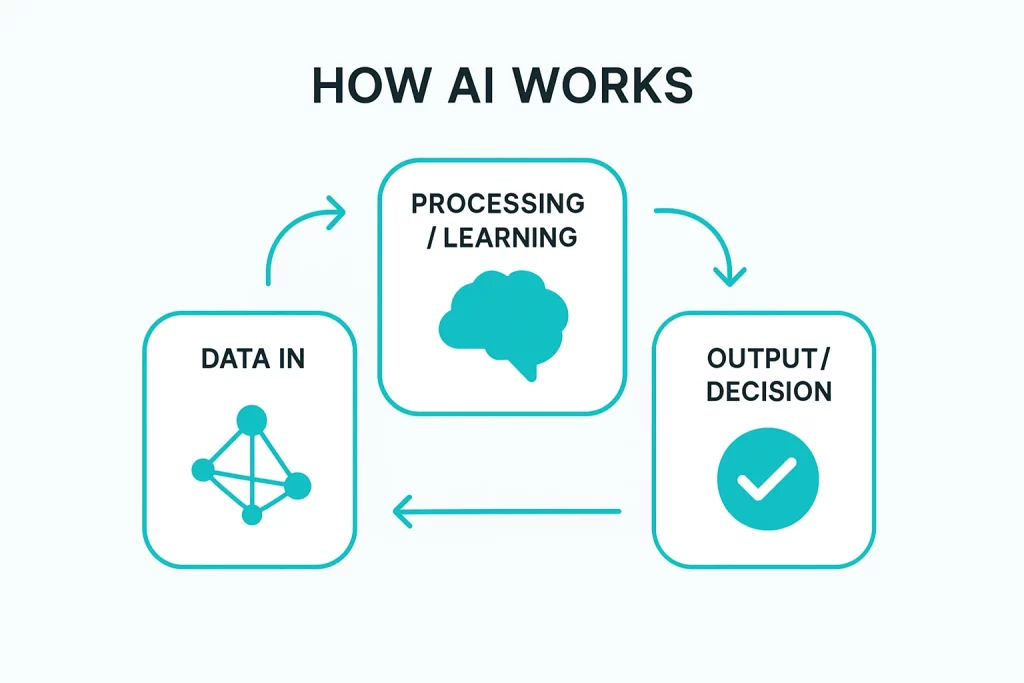
How AI Really Works — the Core Mechanism
Although AI often feels magical, it is powered by mathematics and probability.
Models calculate likelihoods:
-
- “How likely is this word to come next in a sentence?”
-
- “How likely does this X-ray indicate an abnormality?”
-
- “Which product is the user most likely to click next?”
AI doesn’t “understand” the way humans do.
It predicts based on patterns learned from massive datasets.
Three things matter most:
-
- AI doesn’t have human intuition — it simulates understanding.
-
- AI is only as good as the data it learns from.
-
- The best results happen when humans and AI collaborate.
If you want a deeper explanation of the actual internal mechanisms — neural networks, layers, activations, weights — visit Neural Networks Explained for a visual, simplified breakdown.
And if you’re curious how today’s AI systems (like ChatGPT and Gemini) generate text, images and reasoning steps, see Transformers Explained, which covers the architecture behind all modern large language models.
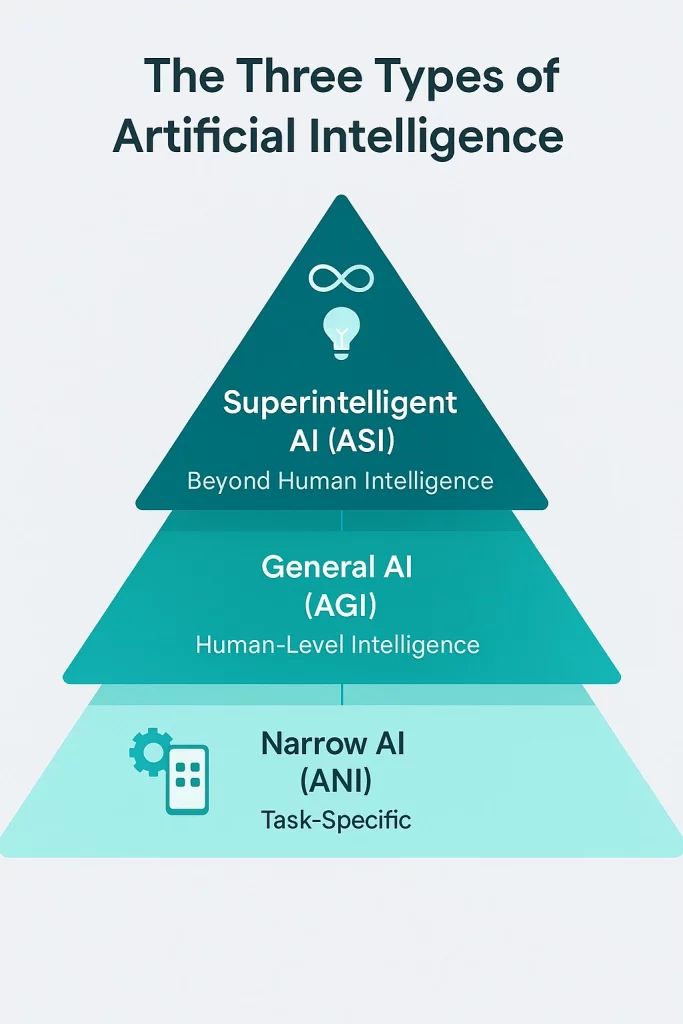
The Three Types of AI: ANI, AGI and ASI
AI exists in different forms depending on its capabilities and scope.
For beginners, the three-level model is the clearest way to understand it:
Artificial Narrow Intelligence (ANI)
The AI we use today.
Specialized in one task: translation, facial recognition, route planning, recommendation engines, fraud detection.
Smart in one domain — useless in others.
This includes systems like ChatGPT, Midjourney, self-driving car modules, and medical imaging AI.
Artificial General Intelligence (AGI)
A hypothetical system that can learn, adapt and reason across any domain — like a human.
Can transfer knowledge between tasks, reason contextually, and solve problems in flexible ways.
If you want to explore how close we are to AGI, and what future systems may look like, see our deep dive The Future of AI Systems.
Artificial Superintelligence (ASI)
A theoretical form of intelligence surpassing human capabilities across all dimensions: speed, creativity, reasoning, scientific discovery.
Still speculative — but part of long-term AI safety discussions.
Our guide AI Risks: Safety, Hallucinations & Misuse covers the ethical and societal implications of advanced systems in more detail.
The Building Blocks of AI
To truly understand AI, remember its core components:
-
- Data — the fuel (text, images, audio, numbers).
-
- Algorithms — the learning rules.
-
- Models — the structures that store learned patterns.
-
- Feedback — the process that improves predictions over time.
This cycle — data → training → prediction → feedback — is the foundation of all modern AI.
For a practical breakdown of how data shapes these models, including datasets, quality, and bias challenges, see How AI Uses Data, which explains this loop in detail.
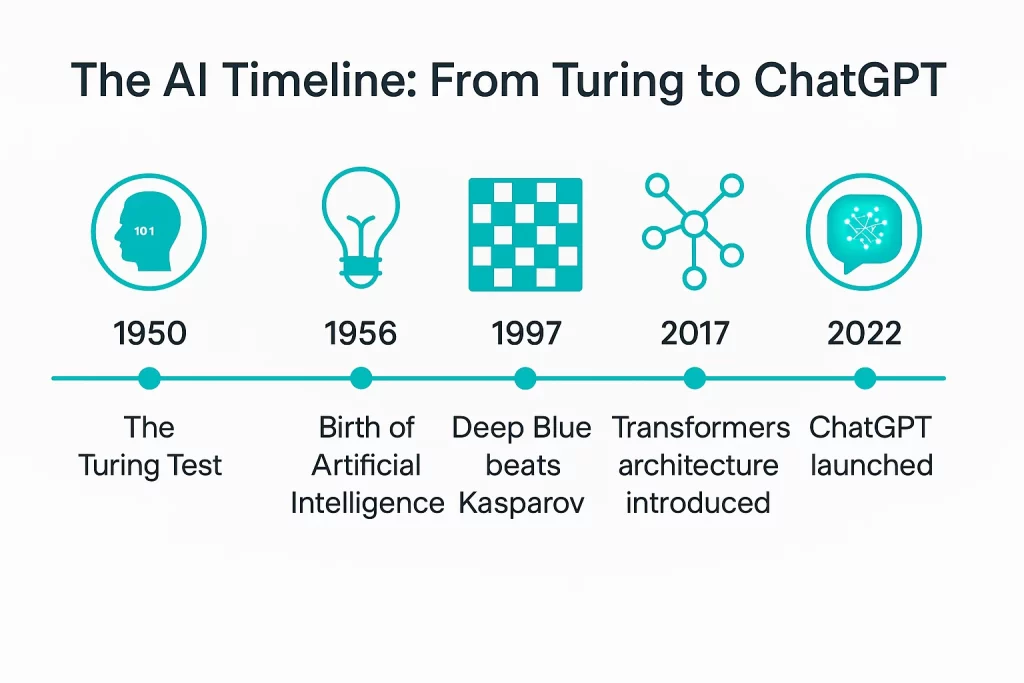
Brief History of AI: From Turing to Transformers
Artificial Intelligence isn’t a trend from the past few years.
As early as the 1950s, mathematician Alan Turing asked one of the most important questions in computer science:
“Can machines think?”
Key milestones:
-
- 1950s–1970s: Symbolic AI
Hand-crafted rules and logic-based systems.
- 1950s–1970s: Symbolic AI
-
- 1980s–1990s: Neural Networks
Inspired by the brain; early pattern recognition.
- 1980s–1990s: Neural Networks
-
- 2012: Deep Learning Revolution
Massive accuracy jump in image recognition (ImageNet breakthrough).
- 2012: Deep Learning Revolution
-
- 2017: Transformers
The architecture that enabled natural language understanding and generation at scale.
Dive deeper in Transformers Explained.
- 2017: Transformers
-
- 2020–2025: Multimodal AI
AI models began combining text, images, audio, video — leading to powerful assistants like GPT-4.1, Gemini, and Claude.
- 2020–2025: Multimodal AI
If you want more details about why deep learning became the engine of modern AI, read our guide Deep Learning Explained.
What AI Can — and Cannot — Do
AI is incredibly powerful in pattern-rich environments, but it also has limits:
Where AI excels
-
- Recognizing images, speech and patterns at massive scale
-
- Summarizing and structuring complex information
-
- Generating text, code, visuals and ideas
-
- Making predictions based on large datasets
Where AI struggles
-
- Understanding context or nuance
-
- Reasoning beyond its training data
-
- Handling ambiguous instructions
-
- Ethical or moral judgments
-
- Real-world unpredictability
If you’re interested in the evidence-based breakdown of these limitations, see Limitations & Risks of Deep Learning.
For the human impact — hallucinations, misinformation risk, misuse scenarios — go to AI Risks: Safety, Hallucinations & Misuse.
How Artificial Intelligence Works (From Data to Decisions)
The Core Idea: Learning From Data
Every modern AI system follows the same principle:
machines learn by detecting patterns in data.
Where humans rely on intuition and experience, AI relies on:
-
- examples
-
- repetition
-
- statistical probability
Show a child a few hundred photos of dogs and cats, and they’ll eventually understand the difference.
Show an AI model millions of examples, and it learns to distinguish them mathematically — not visually like we do, but through patterns in pixels, shapes, and textures.
If you want a beginner-friendly breakdown of this entire process, including diagrams and analogies, start with How Artificial Intelligence Works, our foundational walkthrough designed for new learners.
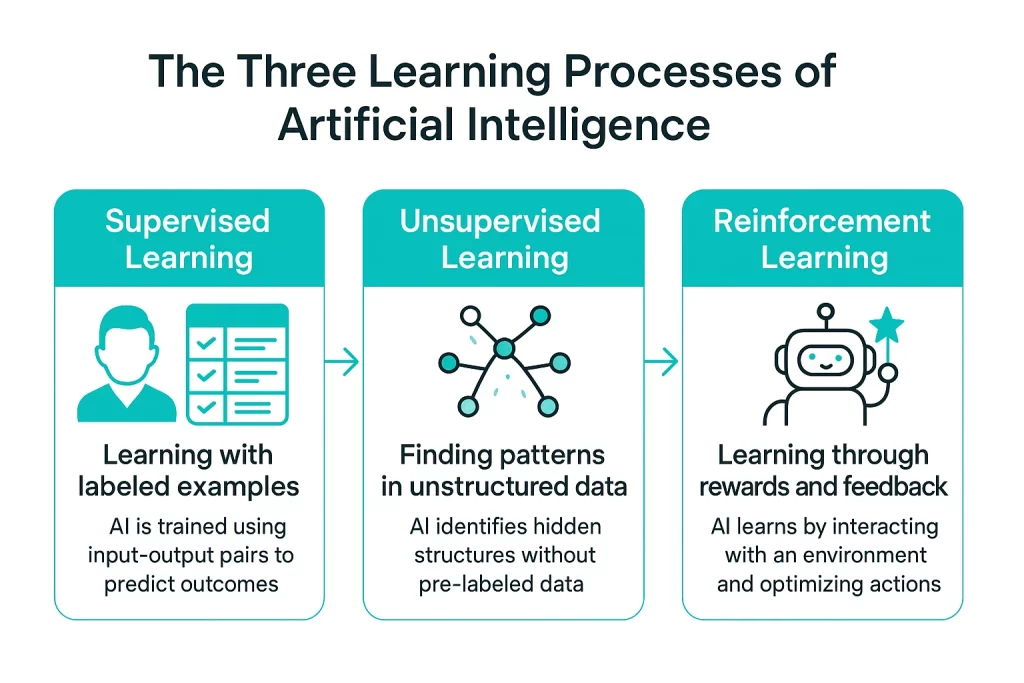
AI learns in three main ways, each powering different parts of today’s ecosystem.
Supervised Learning
The model learns from labeled data where both input and correct output are known.
(Example: “This image contains a cat.”)
Unsupervised Learning
The model discovers structure in the data without predefined labels.
(Example: grouping customers into clusters based on behavior.)
Reinforcement Learning
The system learns through trial and error, improving based on rewards and penalties.
(Example: game-playing AI teaching itself optimal strategies.)
Machine Learning — The Engine Behind AI
Machine learning (ML) is the core technology behind nearly every AI system you use daily.
From recommendations on Netflix to fraud detection in banking, ML works by identifying patterns in massive datasets — patterns no human could process manually.
Here’s how it works in practice:
-
- The model is fed large amounts of data.
-
- It looks for statistical relationships between features.
-
- It uses those relationships to make predictions on new, unseen data.
Imagine an ML system classifying emails as spam or genuine. It learns from:
-
- common phrases
-
- sender behavior
-
- past user actions
-
- metadata patterns
ML doesn’t memorize — it generalizes.
If you want a structured comparison between these models and the broader field of AI, see Machine Learning vs Artificial Intelligence, which breaks it down clearly for beginners.
Deep Learning — The Layered Brain of Modern AI
Deep learning is the powerhouse behind today’s most advanced AI capabilities.
It’s built on neural networks — digital structures inspired by how neurons in the human brain fire and connect.
Here’s the magic behind deep learning:
-
- Early layers detect simple features (lines, curves, textures).
-
- Middle layers recognize components (eyes, wheels, objects).
-
- Late layers understand concepts (a face, a car, a sentence, a context).
This layered hierarchy makes deep learning incredibly effective for:
-
- language understanding
-
- speech recognition
-
- image generation
-
- autonomous driving
-
- real-time translation
-
- prediction and forecasting
For a beginner-friendly breakdown of how these networks actually function — including neurons, weights, activations, and backpropagation — explore Neural Networks Explained.
To understand why deep learning became dominant after 2012 and how it powers ChatGPT, Gemini, Midjourney and modern assistants, see Deep Learning Explained for a deeper technical dive.
Transformers — The Architecture Behind Modern AI
Transformers changed AI forever.
Introduced in 2017, the transformer architecture made it possible for models to:
-
- understand long sequences
-
- maintain context
-
- generate coherent language
-
- combine text and images
-
- reason step-by-step
Transformers use a mechanism called attention, allowing the model to weigh which parts of input matter most — the foundation of every large language model today.
If you want a non-technical but accurate breakdown of how attention works, why transformers scale, and how they compare to older neural network designs, read How Transformers Work, our dedicated deep-dive into this architecture.
This is essential knowledge for anyone wanting to understand ChatGPT, Claude, Gemini, and upcoming AGI-scale models.
Natural Language Processing (NLP) — Teaching AI to Understand Language
NLP is the field that enables machines to understand, interpret, and generate human language.
It powers:
-
- chatbots
-
- translation tools
-
- digital assistants
-
- sentiment analysis
-
- content generation
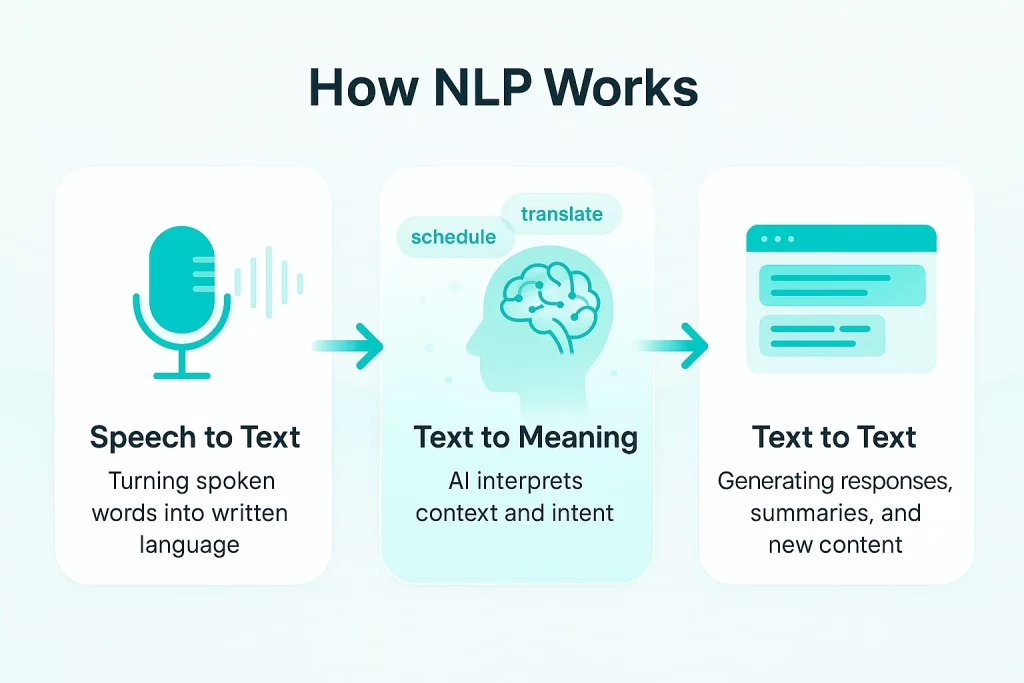
NLP works in multiple stages:
-
- Speech → Text
-
- Text → Meaning (context, intent, entities)
-
- Text → Text (generation, summarization)
Modern models combine NLP with vision, audio, and reasoning — creating multimodal assistants that understand what you type, show, or say.
For a deeper breakdown of how language models are trained — including tokens, embeddings, and the scaling laws behind modern LLMs — see Large Language Models Explained.
AI in Practice — Everyday Systems Powered by ML & DL
AI’s principles become clearer when you see them applied in real products:
-
- Smartphones adjusting battery life and camera settings
-
- Healthcare models assisting in early diagnosis
-
- Recommendation engines shaping your entertainment feed
-
- Autonomous vehicles processing real-time sensor data
-
- Marketing tools predicting customer behavior
If you want a curated list of the most important real-world applications, including examples across industries, explore Real-Life Applications of AI, one of the most popular entries in this cluster.
The Limits of AI — Where It Still Struggles
Even the most advanced models have real constraints:
-
- they don’t understand like humans
-
- they rely heavily on training data
-
- they struggle with ambiguity
-
- they can hallucinate
-
- they have no real-world grounding
-
- they can misinterpret edge cases
-
- they can reinforce bias
For a structured, evidence-based breakdown of these limitations, read:
These deep dives explain why reliability remains one of AI’s biggest open challenges — and what researchers are doing to improve it.
Real-World Applications of Artificial Intelligence
Artificial intelligence has quietly shifted from a futuristic concept to an invisible operating layer of modern life.
Ten years ago, AI mostly lived inside research labs. Today, it runs inside your smartphone, your entertainment apps, your navigation tools — and increasingly, inside the systems that guide healthcare, business decisions, and public infrastructure.
To understand how deeply AI is already embedded in society, it helps to first grasp the foundations behind it. If you’re new to these concepts, you can revisit the fundamentals in How Artificial Intelligence Works, unpack the core differences in Machine Learning vs Artificial Intelligence, or explore the role of data in How AI Uses Data.
Everything you see in this chapter builds on those basics.
AI Is Everywhere
AI is no longer visible only when you use a chatbot or open an AI-powered image tool. It operates behind the scenes in ways most people never notice.
AI now:
-
- chooses the fastest route in your navigation app
-
- shapes your social-media feed
-
- filters your email
-
- recommends the next show you’re likely to binge
-
- adjusts your smartphone camera settings in real time
Artificial intelligence has become the silent infrastructure supporting daily decision-making.
It boosts efficiency, improves personalisation, and anticipates what you may want or need — often before you think about it consciously.
If you want to understand the technical mechanics behind this, see Neural Networks Explained or Deep Learning Explained, which break down the systems enabling these capabilities.
AI in Everyday Life
Entertainment & Streaming
Platforms like Netflix, Spotify and YouTube rely on machine-learning models to analyse what you watch or listen to, how long you stay engaged, what you skip, and what time of day you typically tune in.
These models predict what content will keep you watching — and they adapt continuously.
Social Media
Algorithms rank posts based on your behaviour: the accounts you interact with, the topics you linger on, and even how long your eyes rest on a specific video.
These models, explained in detail in Deep Learning Explained, determine the content that becomes visible (and the content that disappears).
Shopping & E-Commerce
AI analyses browsing behaviour, purchase history, product descriptions, and seasonal patterns to recommend products.
Modern systems even adjust prices dynamically based on supply, demand, or user segment.
Personal Assistants
Tools like Siri, Google Assistant and Alexa use Natural Language Processing (covered earlier in How Artificial Intelligence Works) to interpret commands, schedule tasks and adapt to your tone and phrasing.
AI doesn’t just automate.
It personalises — learning from you, about you, and for you.
AI in Smartphones
Your smartphone is arguably the most advanced AI device you own.
Examples in daily use:
-
- computational photography that adjusts lighting, sharpness and shadows
-
- AI-powered noise reduction during calls
-
- real-time translation of conversations
-
- predictive keyboards that learn your writing style
-
- intelligent battery optimisation based on your behaviour
Every year, smartphone AI becomes more multimodal — combining text, camera input, audio and sensors.
To understand how these models interpret different types of data, see Transformers Explained and Large Language Models (LLMs) Explained, which detail the architectures behind modern assistants.
Smartphones are no longer just smart — they’re adaptive, constantly learning from how you use them.
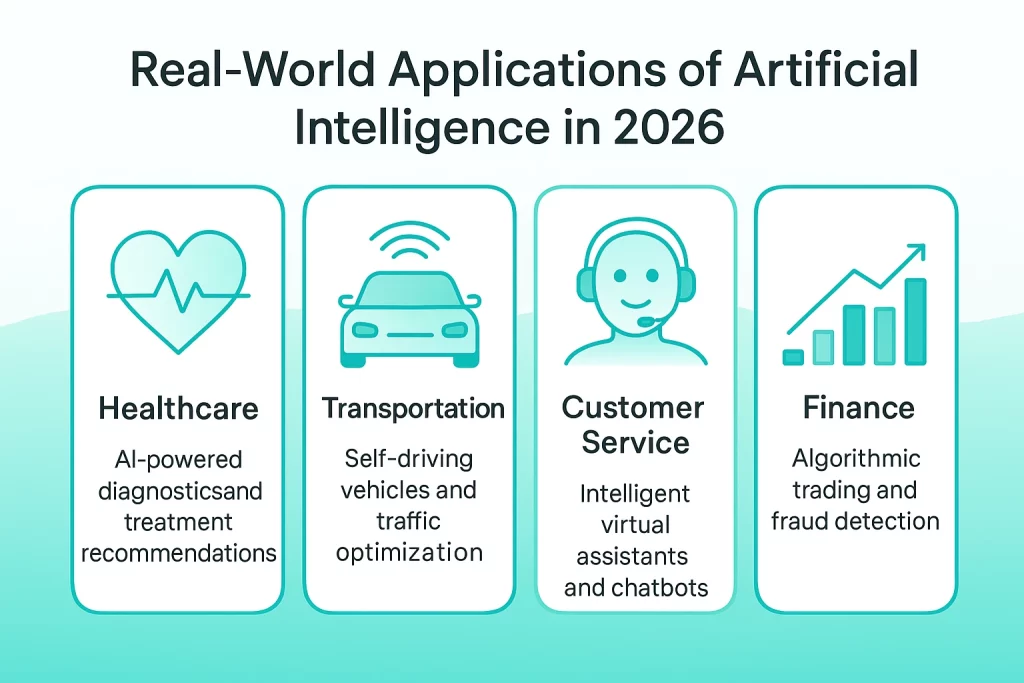
AI in Healthcare
Healthcare has become one of the sectors most transformed by AI.
Key use cases:
-
- Diagnostics: AI can analyse X-rays, CT scans and MRI images, identifying early signs of disease.
-
- Prediction: models forecast patient risk by combining lifestyle, genetic and historical data.
-
- Personalised treatment: smart systems recommend medication dosages or therapy paths tailored to individual profiles.
-
- Workflow optimisation: scheduling, triage and documentation become faster and more consistent.
Importantly, AI does not replace doctors.
It enhances accuracy, frees clinicians from repetitive tasks and supports better decision-making.
The limitations of these systems — and why human oversight remains essential — are explained in AI Limitations & Reliability and AI Risks: Safety, Hallucinations & Misuse.
AI in Business and Marketing
Companies use AI to work faster, forecast more accurately and understand customers at a deeper level.
Examples:
-
- automated customer support
-
- targeted marketing campaigns
-
- behaviour prediction based on massive datasets
-
- sentiment analysis from social platforms
-
- AI-generated content for blogs, ads and email sequences
In marketing especially, AI acts as an accelerator.
Models can draft ideas, analyse performance and propose optimisations.
If you want to understand how business models are reshaped by these technologies, see The Future of AI Systems, which explains the shift toward autonomous workflows.
AI in Education
The classroom of 2026 looks very different from that of 2016.
Use cases:
-
- adaptive learning platforms that personalise difficulty
-
- automated grading and feedback
-
- AI-based tutoring companions
-
- tailored curricula based on a student’s pace and strengths
Educators remain essential — but AI augments their capacity, enabling more individualised support.
AI and Creativity
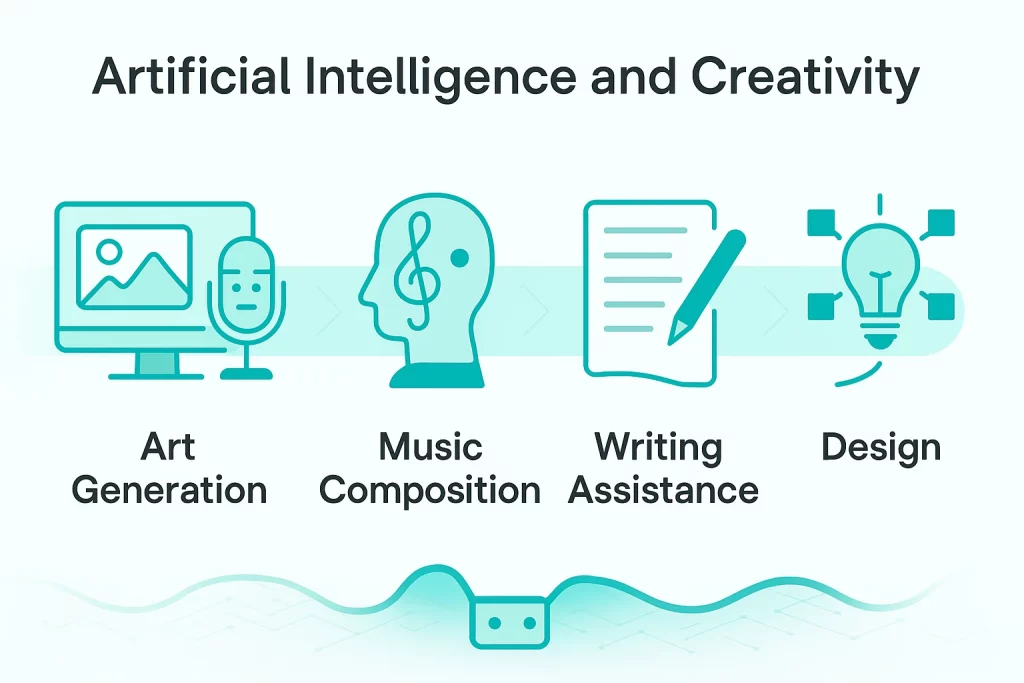
AI has become a co-creator in fields once considered purely human-driven:
-
- visual art generation with Midjourney or DALL·E
-
- music composition algorithms
-
- story outlining and scriptwriting
-
- editing tools that transform raw clips into polished video
Creativity doesn’t disappear — it expands.
As explored in The Future of AI Systems, AI is shifting from “generating” to “collaborating,” offering variation and speed while humans provide originality and intent.
AI in Transport and Mobility
AI is redefining mobility:
-
- smart traffic systems that adapt in real time
-
- route optimisation for logistics companies
-
- driver-assist models that learn from billions of kilometres
-
- smart-city infrastructure connecting sensors, cameras and signals
Modern transport is built on continuous prediction — a core capability of machine learning and deep learning systems.
“AI is no longer futuristic. It’s the invisible engine behind our daily decisions — quietly shaping the world around us.”
Artificial Intelligence and Creativity
Creativity has long been seen as the last frontier of human intelligence — the one place where logic, emotion and experience merge in ways machines could never replicate. Yet over the past few years, artificial intelligence has proven that creativity is not a single spark, but a pattern. And patterns, when they are present in large quantities of data, can be learned.
AI hasn’t made humans less creative. It has expanded what creativity can be.
If you want the deeper technical foundations behind the systems driving this shift, explore Large Language Models (LLMs) Explained, Generative AI Explained, and Transformers Explained. These pages uncover the architectures behind today’s most creative AI systems.
From Science Fiction to the Studio
Not long ago, the idea of computers composing symphonies or generating original art was reserved for sci-fi. Today, creators use AI as naturally as they use cameras, keyboards or design software. Instead of replacing artistic intuition, AI accelerates it — multiplying variations, removing friction and expanding the creative canvas.
Where traditional tools required specialised skills or long production time, AI allows creators to iterate rapidly, explore new styles and bypass technical bottlenecks. As a result, people who never identified as “creative” now produce stunning visuals, music and written work.
This shift is not about automating creativity. It’s about making creativity more accessible, more experimental, and more collaborative.
Visual Arts
In the visual world, AI tools like Midjourney, Runway, DALL·E and Stable Diffusion have transformed artistic workflows. They can:
-
- generate concept art in seconds
-
- reimagine scenes in different styles
-
- produce illustrations for books and marketing
-
- create visual variations from a single prompt
-
- combine text, images and patterns into brand-new compositions
But behind these magical outputs sits a very real technical foundation. Vision transformers, diffusion models and multimodal neural networks — all explained in Generative AI Explained and Transformers Explained — learn visual structure by analysing billions of images and their relationships.
Artists now use AI to explore direction, not to outsource identity. It’s a co-creation process: the artist guides the intention, while the model provides speed, variation and possibility.
Music and Audio
AI is reshaping sound in ways we’ve never seen before:
-
- composers generate melodies or film-score drafts
-
- podcasters use AI for noise cleaning, voice leveling and transcription
-
- producers remix tracks using AI-assisted beat composition
-
- creators clone voices for narration, dubbing or rapid prototyping
These systems rely heavily on sequence models and multimodal training. If you want to understand how machines interpret rhythm, timbre and waveform structures, the best starting point is Deep Learning Explained.
What used to require expensive studios and years of training is suddenly accessible to anyone with an idea and a laptop. AI doesn’t remove musicianship — it lowers the wall between imagination and output.
Writing and Storytelling
Text is where AI has become most visible.
Large Language Models (LLMs) — covered in depth in Large Language Models Explained — can:
-
- generate first drafts
-
- outline articles
-
- offer structural suggestions
-
- write dialogue
-
- summarise long material
-
- help brainstorm creative options
For writers, AI is a thinking partner. It helps overcome blank pages, explore multiple angles and refine tone or style. But it does not replace human lived experience — the emotional depth, cultural nuance and personal perspective behind meaningful storytelling.
Professional workflows in journalism, marketing and even scriptwriting increasingly combine human insight with AI acceleration. The result: faster iteration, deeper exploration and more room for creative decision-making.
The Limits of Creative AI
Despite its power, creative AI has clear boundaries:
It does not “feel.”
AI lacks intuition, emotion and lived experience. It works through statistical patterns, not personal meaning.
It recombines rather than truly invents.
AI can remix patterns in original ways — but the initial ingredients still come from human-created data.
It struggles with context, symbolism and deep narrative intention.
Especially in long-form storytelling or metaphor-heavy art.
It raises new ethical questions.
Who owns AI-generated content?
How do we verify authenticity?
How do we prevent deepfake misuse?
These topics are explored further in AI Risks: Safety, Hallucinations & Misuse and AI Regulation (2025–2026).
Creative AI’s greatest lesson is not what machines can do — but what makes human creativity irreplaceable.
Human + Machine: Stronger Together
The most exciting creative frontier isn’t machine-made art — it’s collaboration.
AI can generate hundreds of variations in seconds, brainstorm alternate directions, or visualise early-stage ideas before humans refine them.
Humans bring:
-
- taste
-
- personal history
-
- cultural understanding
-
- emotional intuition
-
- narrative intention
In creative industries, speed and variation amplify quality — and AI offers exactly that.
Creativity is no longer a linear process. It’s a conversation between human intention and machine possibility.
As explored in The Future of AI Systems, the role of AI is shifting from “generate this” to “collaborate with me.”
Humans bring the emotion, intention, and meaning that turn ideas into art.
“AI can create patterns, but only humans give them meaning. True creativity happens in the dialogue between human and machine.”
Artificial Intelligence and the Future of Work
Artificial intelligence is reshaping the global workforce faster than any technology of the last century.
Automation, prediction, reasoning and real-time decision-making are no longer confined to blue-collar or repetitive tasks — they now touch knowledge work, creative work and strategic decision-making.
This chapter explains what’s changing, why it matters and how workers, teams and organisations can adapt.
For a deeper technical foundation behind these systems, revisit Machine Learning vs Artificial Intelligence, Deep Learning Explained, and How Artificial Intelligence Works.
For risks and safeguards, see AI Limitations & Reliability and AI Risks: Safety, Hallucinations & Misuse.
The Impact of Automation
AI doesn’t automate jobs — it automates tasks.
That distinction matters, because most roles contain both high-value responsibilities and repetitive work.
AI systems excel at:
-
- pattern recognition
-
- summarising information
-
- generating first drafts
-
- analysing large datasets
-
- automating routine decisions
This means that administrative workloads shrink, content production accelerates and data-heavy tasks become faster and more consistent.
But the outcome isn’t job elimination — it’s job transformation.
Every major technological wave (electricity, computing, the internet) removed certain tasks and created entirely new professions.
AI is following the same pattern, but at a far higher speed.
Jobs Under Pressure
Roles most affected share two characteristics:
1. High repetition
Tasks that follow predictable steps or clear rules.
2. Low requirement for human judgment
Tasks where accuracy matters more than nuance.
Examples:
-
- data entry
-
- customer support triage
-
- appointment scheduling
-
- inventory management
-
- basic financial reporting
-
- transportation and logistics roles with repetitive routes
AI tools — often powered by the architectures explained in Transformers Explained and LLMs Explained — can handle these tasks consistently and at scale.
However, even in these fields, AI doesn’t replace entire jobs.
It reshapes the role: employees manage exceptions, supervise automation, ensure quality and handle complex scenarios.
New Opportunities and Emerging Roles
While some tasks decline, new professions grow rapidly:
AI Trainers & Prompt Engineers
People who teach models to follow instructions accurately.
This connects directly to the competencies explored in the Prompt cluster.
AI Workflow Designers
Professionals who combine AI tools into automated pipelines, especially in marketing, finance, healthcare and operations.
AI Ethicists & Legal Specialists
Roles focused on accountability, fairness and compliance — explained in depth in AI Regulation (2025–2026).
Data Scientists & ML Engineers
Builders of the models powering AI systems.
Their work relies heavily on the foundations covered in Neural Networks Explained and Deep Learning Explained.
Creators With AI Superpowers
Marketers, writers and designers who combine human creativity with multimodal models — a shift described in The Future of AI Systems.
AI is not closing the labour market.
It’s changing what good work looks like.
How to Stay Relevant in an AI-Driven World
This is the part most people misunderstand.
The best way to stay relevant isn’t to compete with AI — it’s to complement it.
You can future-proof your career by focusing on five skills:
1. Learn the fundamentals of AI
Understanding the basics — covered in How AI Works and Machine Learning vs AI — dramatically improves your ability to work with AI tools.
2. Develop strong prompt-writing skills
How well you communicate with AI determines how much value you can extract from it.
3. Strengthen uniquely human skills
Empathy, negotiation, leadership, storytelling and creative strategy remain difficult to automate.
4. Embrace tooling
Workers who adopt AI tools gain a structural speed advantage.
5. Stay adaptive
The biggest winners in an AI-driven economy are those who evolve continuously.
AI rewards those who combine human judgment with machine-driven efficiency.
The Broader Societal Impact
AI doesn’t just reshape individual careers — it reshapes economies.
Key questions shaping global policy include:
Who benefits from AI-driven efficiency?
Companies that adopt AI faster often gain disproportionate advantage.
How do we prevent inequality from accelerating?
If only a portion of the workforce gains AI literacy, gaps widen.
Do we need new safety nets?
Universal basic income, reskilling programs and labour-market transformation are active discussions across governments.
How do we ensure responsible deployment?
Unregulated, opaque or biased systems can create significant harm.
The frameworks in AI Risks and AI Regulation (2025–2026) explore these issues in depth.
The future of work is not predetermined — it’s shaped by how societies choose to deploy, govern and democratise AI capabilities.
“AI won’t replace people. But people who understand AI — and learn to work with it — will replace those who don’t.”
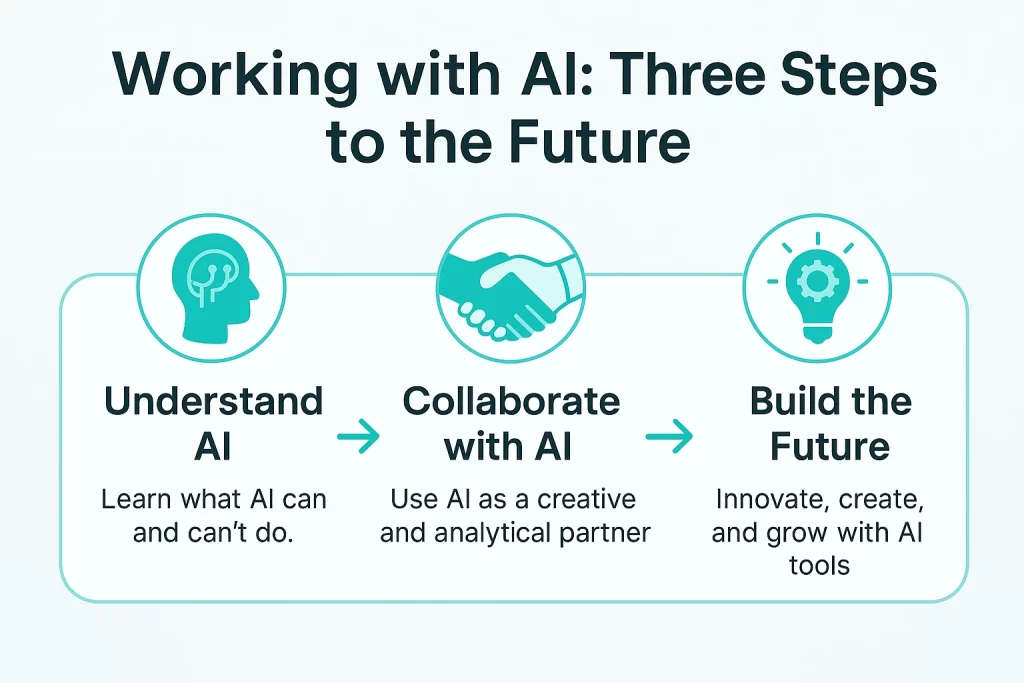
The Benefits and Risks of Artificial Intelligence (Ethics & Regulation)
Artificial intelligence delivers extraordinary value — but that value comes with serious responsibilities.
The same technology that helps diagnose disease, accelerate research and automate work can also amplify bias, spread misinformation or create systems that are difficult to govern and understand.
Understanding AI’s benefits means recognising its risks.
And understanding its risks is what enables safe, responsible use.
This chapter gives you a balanced, clear-eyed perspective on what AI can empower — and what must be protected.
For deeper technical explanations of model behaviour, see Deep Learning Explained, Neural Networks Explained and LLMs Explained.
For system-level implications, see AI Risks: Safety, Hallucinations & Misuse and AI Regulation (2025–2026).
The Flip Side of Progress
Artificial intelligence is powerful because it recognises patterns at scale and learns from enormous amounts of data.
But that power can become a liability when the patterns reflect bias, when the data is incomplete, or when systems operate without transparency.
The same capabilities that make AI transformative — automation, prediction, generative creativity — are the same capabilities that can cause harm if deployed without oversight.
AI is not inherently good or bad.
Its impact depends on the intentions of its designers, the quality of its data and the safeguards surrounding its use.
Bias and Discrimination
AI mirrors the world it is trained on — and the world contains bias.
Examples of real-world risks include:
-
- hiring algorithms that prioritise male candidates
-
- facial recognition systems that perform worse on darker skin tones
-
- credit-scoring models that disadvantage certain communities
-
- healthcare models that underdiagnose underrepresented groups
These problems don’t come from “bad AI” — they come from biased data, poorly designed processes or insufficient human oversight.
To understand how bias arises within model architectures, revisit How AI Uses Data and Neural Networks Explained, which break down the relationship between training data and model behaviour.
Privacy and Surveillance
AI can analyse enormous volumes of personal information — from smartphones and social media to medical records and behavioural data.
This creates opportunity, but also vulnerability.
Primary risks include:
Mass surveillance
Governments and corporations may track or profile citizens at scale.
Data misuse
Sensitive information can be leaked, sold or repurposed without consent.
Behavioural manipulation
Recommendation systems can influence choices so precisely that autonomy becomes blurred.
Privacy is not only a technical issue.
It is a societal obligation that requires transparent policy, secure infrastructures and clear boundaries on data collection and usage.
Work and Inequality
AI-driven productivity can accelerate economic growth — but not everyone benefits equally.
Potential consequences include:
-
- widening skill gaps between workers who adopt AI and those who don’t
-
- concentration of power in a small number of tech companies
-
- uneven access to high-quality AI tools and education
-
- growing inequality between AI-leading nations and developing economies
These concerns connect directly to The Future of Work in Chapter 5.
Addressing them requires investment in reskilling, accessibility and global cooperation.
Deepfakes and Misinformation
Generative AI has made it easy to create realistic images, videos and text — a breakthrough for creativity, but a threat when misused.
Risks include:
Deepfakes
Highly realistic but fabricated videos that can impersonate individuals.
Synthetic news at scale
Bots can generate millions of misleading posts in minutes.
Erosion of trust
When anything can be faked, verifying truth becomes harder.
This topic is explored more deeply in AI Risks: Safety, Hallucinations & Misuse, which breaks down hallucinations, manipulation dangers and real-world case studies.
Legislation and the New Global AI Rules
AI governance is evolving quickly.
The European Union’s AI Act remains the most comprehensive framework to date — classifying systems into risk levels:
-
- Unacceptable risk (e.g. social scoring) → banned
-
- High risk (medical diagnostics, credit scoring) → heavy oversight
-
- Limited risk (chatbots, creative tools) → transparency requirements
-
- Low risk (most consumer AI) → minimal obligations
Other regions, including the US, UK and Asia, are developing their own guidelines, focusing on accountability, transparency, safety and fairness.
For a complete breakdown of how these systems are evaluated — and what changes businesses must prepare for — see AI Regulation (2025–2026).
The Ethical Balance
The central question is simple:
How do we capture the benefits of AI without sacrificing our values?
Ethical AI requires collaboration between:
-
- developers
-
- businesses
-
- policymakers
-
- researchers
-
- end users
Key responsibilities include:
-
- building transparent systems
-
- auditing datasets
-
- ensuring human oversight
-
- defining accountability
-
- preventing misuse
-
- protecting individuals and communities
AI is not self-regulating.
It requires intentional design choices, clear governance frameworks and a commitment to fairness.
Ethical AI is a shared responsibility — not an optional feature.
“The greatest challenge of AI isn’t what the technology can do — it’s what we choose to do with it.”
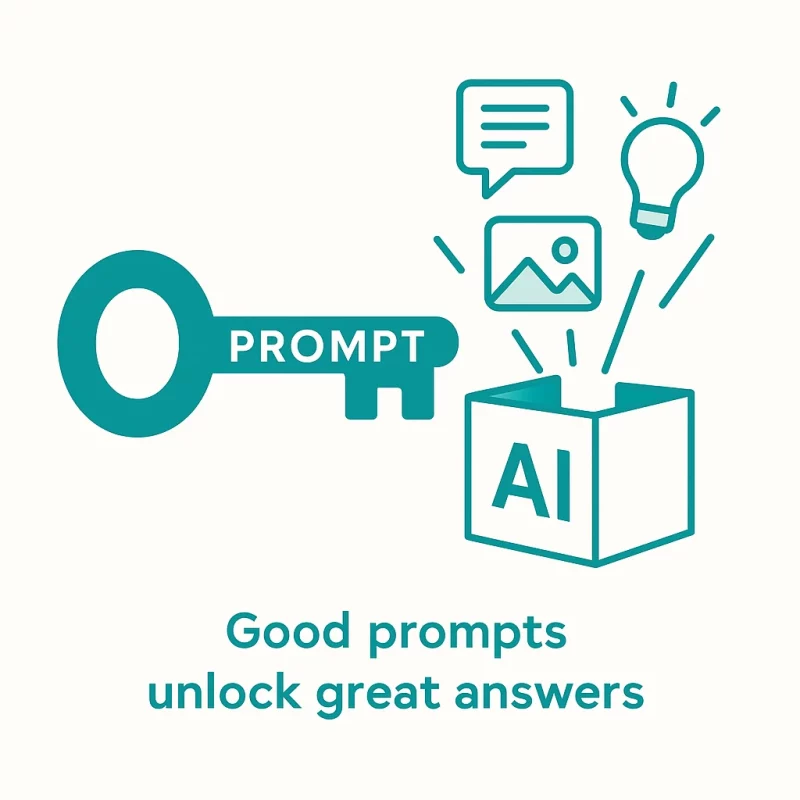
The Power of AI Prompts (Why Input Shapes Output)
Artificial intelligence has become more capable every year — but it still relies on one crucial ingredient:
your instructions.
Prompts are the bridge between human intention and machine intelligence. They shape what AI understands, how it reasons and what it produces. Whether you’re generating images, writing content, analysing data or building workflows, a well-designed prompt can turn a general system into an expert assistant.
This chapter shows how prompts work, why they matter and how to use them effectively.
For deeper strategies, explore AI Prompt Writing: The Ultimate Guide, the cornerstone of your full Prompt Mastery cluster.
What Are Prompts?
A prompt is any instruction you give an AI model: a question, request, description or even a combination of text, images and examples.
What makes prompts powerful is not the format — but the clarity, structure and intent behind them.
Compare:
“Explain AI.” → broad, generic output.
“Explain artificial intelligence to a beginner using simple language and one real-world example.” → targeted, useful insight.
Prompts don’t just ask the model to produce something — they set expectations, context and constraints.
If you want a deeper dive into structure and logic, see AI Prompt Frameworks Explained: The 4C Model and Beyond, which breaks down context, constraints, clarity and creativity.
Why Prompts Matter More Than People Think
Large Language Models like GPT, Claude and Gemini respond to intent, not just words.
When your intent is vague, models guess — and guessing leads to weak output.
Prompts matter because they:
-
- define the model’s role
-
- set the boundaries of the task
-
- shape the logic behind the reasoning
-
- influence tone, depth and structure
-
- prevent hallucinations & drift
A great prompt reduces uncertainty.
A poor prompt increases randomness.
For practical examples of how small changes make a big difference, explore How to Write Better ChatGPT Prompts (with Examples) — a hands-on subblog full of transformations.
Prompt Engineering in Practice
Prompt engineering isn’t technical — it’s communicative. You’re not programming the model; you’re instructing it with precision.
Core techniques include:
1. Provide context
Explain the situation, the goal and the audience.
2. Assign a role
“Act as a senior UX researcher…”
This dramatically improves accuracy and style.
See Act as a… Prompts for deep role-assignment strategies.
3. Use step-by-step reasoning
This prevents shortcuts and increases factual reliability.
For structured explanations, see Chain-of-Thought Prompting.
4. Give examples (few-shot prompting)
Show the model what a good answer looks like.
Compare Few-Shot vs Zero-Shot Prompting for when to use each.
5. Iterate and refine
Great outputs rarely come from one-shot instructions.
Prompting is collaborative — a dialogue, not a command.
Examples of Effective Prompts
Different goals require different prompt structures:
For learning & explanation
“Teach me how neural networks work.
Write it for beginners, in three clear sections, using simple analogies.”
For creativity
“Write a short story about a future city where AI collaborates with humans.
Focus on atmosphere and human emotion.”
For marketing
“Act as a senior copywriter.
Create 5 ad variations for a productivity app using transformation-based messaging.”
For reasoning
“Analyse this dataset and explain the top three patterns.
Use chain-of-thought reasoning and show your steps clearly.”
Want ready-to-use structures?
See Prompt Templates for Marketers and Creators, a practical library of plug-and-play prompts.
Common Mistakes (and Why They Break AI Output)
Most weak outputs come from predictable errors:
-
- Too vague
“Write a blog post” → about what? for whom?
- Too vague
-
- No role definition
Without a persona, the tone becomes generic.
- No role definition
-
- No constraints
When the task is open-ended, models ramble.
- No constraints
-
- No examples
Examples anchor the output and reduce hallucinations.
- No examples
-
- Overprompting
Bloated, contradictory instructions confuse the model.
- Overprompting
Want a deep diagnostic breakdown?
See Common Prompt Writing Mistakes (and How to Fix Them) — one of the most actionable subblogs in your cluster.
Prompting as a Future Skill
Prompting is rapidly becoming a mainstream skill — a blend of communication, creativity, strategy and digital literacy.
People who master prompting will:
-
- work faster
-
- generate higher-quality work
-
- automate workflows with ease
-
- collaborate better with AI agents
-
- build advanced systems without code
This is why prompt literacy is considered the “new writing.”
It’s not a technical skill — it’s a thinking skill.
For career-focused strategies, see AI Prompts for Business & Strategy, which shows how professionals can use prompts to accelerate decision-making and productivity.
Beyond Prompts: The Future of AI Workflows
Prompting is the foundation — but not the end point.
The next evolution is agentic AI:
-
- systems that plan steps
-
- take autonomous actions
-
- evaluate their own output
-
- connect with tools
-
- and operate long workflows without constant input
This shift is explored in The Future of AI Workflows: From Prompts to Autonomous Systems, where you dive into the transition from prompting to full orchestration.
Want to explore the tools behind these next-generation workflows?
Visit Top AI Prompt Tools to Boost Productivity in 2026 and Multimodal AI Tools 2026.
Prompting is the starting line — not the finish.
“AI isn’t replacing you. But someone who knows how to prompt it effectively might.”
The Future of Artificial Intelligence (Inside a Rapidly Changing World)
Artificial intelligence is accelerating faster than any technology before it.
Not because it’s replacing humans, but because it is amplifying what humans can do — reasoning, creating, automating, analysing, and imagining.
This chapter explores where AI is heading, which breakthroughs matter most, how they shape society and what individuals and companies should prepare for next. For deeper context, readers can explore several subblogs in the AI Explained cluster, including The Future of AI Systems and How Deep Learning Powers Modern AI.
From Trend to Infrastructure: AI’s Next Phase
AI is moving from “exciting new technology” to foundational digital infrastructure — the layer beneath apps, workplaces, communication, content creation, and global industries.
Just like electricity and the internet once reshaped daily life, AI is becoming:
-
- the default logic layer of software
-
- the intelligence behind productivity tools
-
- the engine of personalization
-
- the driver of automation
-
- the strategic differentiator for businesses
But unlike previous technologies, AI doesn’t just enhance tools — it enhances human capability.
Those who understand its foundations and limitations (explained in How Artificial Intelligence Works) gain long-term advantage in a world where AI becomes as normal a
8.2 The Rise of Multimodal Intelligence
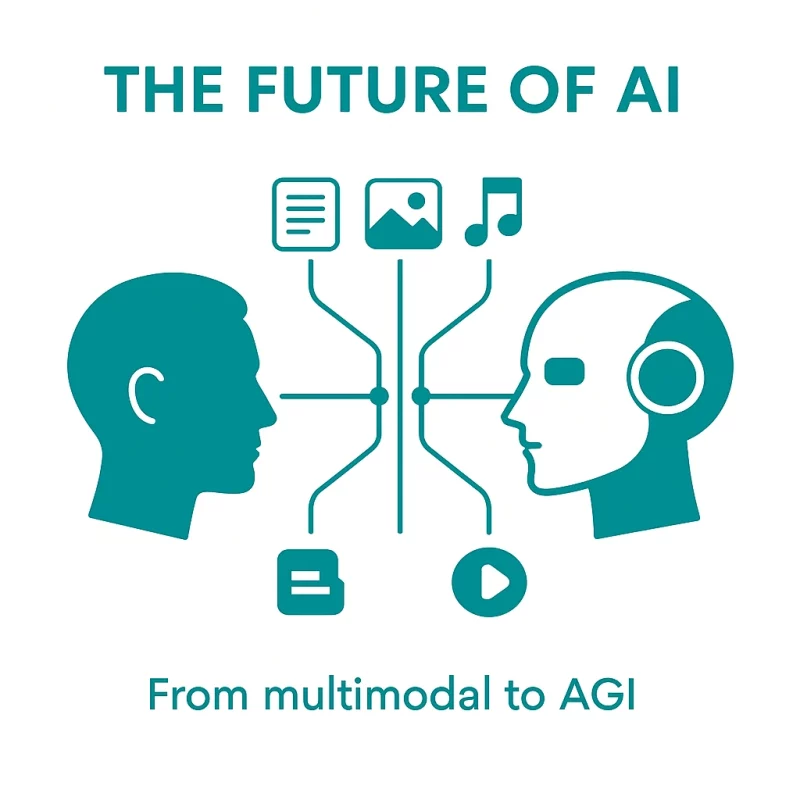
The next generation of AI models is multimodal — systems that understand and combine:
-
- text
-
- images
-
- audio
-
- video
-
- sensor data
-
- real-time context
Instead of interacting through one channel (like typing), users engage naturally across formats.
Imagine an AI assistant that:
-
- reads your documents
-
- sees your screen
-
- listens to your instructions
-
- analyses your data
-
- generates reports
-
- designs a visual mockup
-
- and turns everything into an actionable workflow
These systems aren’t speculative — they’re already emerging.
For a practical deep dive, see Multimodal AI Tools 2026: The Next Evolution of Human-Machine Collaboration.
Toward Autonomous AI Systems (Agents)
Today’s AI reacts to instructions.
Tomorrow’s AI will plan, act, evaluate, and improve without constant human supervision.
This leads to AI agents — systems that:
-
- break down goals into steps
-
- choose tools
-
- take actions
-
- analyse feedback
-
- refine results over time
Agentic AI will power:
-
- self-optimizing workflows
-
- business operations automation
-
- autonomous research assistants
-
- logistics planning
-
- personal productivity systems
This evolution is explained in The Future of AI Workflows: From Prompts to Autonomous Systems, where prompting becomes orchestration.
We are moving from “prompt → answer” to “goal → system handles it.”
8.4 The Path Toward AGI (and Why the Debate Matters)
Artificial General Intelligence (AGI) — AI capable of learning and reasoning across domains — has shifted from speculative theory to active debate.
Breakthroughs in neural architectures (explained in How Transformers Work) and scaling laws push models toward broader reasoning capabilities.
Predictions vary:
-
- decades away
-
- closer than expected
-
- early forms emerging through multimodal integration
Regardless of timelines, AGI discussions shape:
-
- global governance
-
- AI safety research
-
- long-term ethical frameworks
-
- strategic regulation
For risks, alignment issues, and safety concerns, see AI Risks: Safety, Hallucinations & Misuse and AI Limitations & Reliability.
How AI Will Transform Society
AI will influence every aspect of human life.
Work & Professions
Automation reduces repetitive tasks while amplifying strategic and creative roles.
For real-world scenarios, see How AI Works in Real Life.
Education
AI tutors deliver personalised learning, adapting content to student pace and gaps.
Healthcare
Models analyse scans, genetics, and patient records to support earlier and more accurate diagnostics.
Creativity & Media
Generative models — explored in Generative AI Explained — expand human imagination across writing, design, film, and music.
Economy & Global Competition
Nations leading in AI gain structural advantages in productivity, innovation, and influence.
“The future of AI won’t be written by machines —it will be defined by the humans who decide what those machines stand for.”
The Human Role in an AI-Driven Future
AI expands possibilities — humans define purpose.
Humans remain unmatched in:
-
- emotional intelligence
-
- ethics and values
-
- contextual reasoning
-
- creativity grounded in experience
-
- long-term strategic vision
AI extends these strengths but cannot replace them.
What Individuals and Companies Should Do Now
For Individuals
-
- Learn prompting through AI Prompt Writing: The Ultimate Guide.
-
- Understand the building blocks via Neural Networks Explained and Deep Learning Explained.
-
- Use AI daily in planning, research, automation, and creativity.
-
- Evaluate model strengths and weaknesses using How AI Uses Data.
For Companies
-
- Identify processes suitable for automation.
-
- Introduce prompt literacy across teams.
-
- Deploy multimodal tools (see Multimodal AI Tools 2026).
-
- Develop governance aligned with AI Regulation (2025–2026).
Small steps create exponential advantage.
A Future Defined by Human Choice
AI doesn’t define the future — we do.
The systems we build, regulate, trust, and use will shape culture, work, creativity, and opportunity.
Artificial intelligence expands potential. Human intention provides direction.
Conclusion: Understanding AI Today to Lead Tomorrow
Artificial intelligence is no longer a passing technology trend. It has become a foundational layer of modern society — powering how we work, learn, create, communicate, and make decisions. From recommendation systems to real-time assistants, from medical diagnostics to creative tools, AI already shapes daily life across every industry.
Understanding AI is no longer optional.
It is a core skill for professionals, creators, entrepreneurs, and anyone preparing for a digital-first future.
This guide has taken you through the full picture: what artificial intelligence is, how it works, where it excels, where it struggles, and how its influence is reshaping the world. The real value now lies in applying this understanding strategically — in your work, your creativity, and your long-term decisions.
Applying AI Strategically
The real transformation begins when AI moves from theory to practice.
Start small by automating one repetitive task.
Build prompt literacy to communicate effectively with AI systems.
Use AI as decision support — not decision replacement.
Adopt multimodal tools early as they become standard.
Follow regulation closely and treat compliance as a competitive advantage.
AI rewards those who combine human judgment with machine-driven efficiency.
The Human Advantage in an AI-Driven World
Technology alone does not create impact — people do.
The qualities that matter most in the age of AI are the ones machines cannot replicate:
judgment, empathy, ethics, creativity, leadership, and long-term vision.
AI extends human capability, but it cannot define meaning or values.
That responsibility remains human.
Those who understand AI, question it, guide it, and use it intentionally will continue to lead — regardless of how the technology evolves.
Continue Learning With the AI Explained Hub
This guide is part of the AI Explained Hub, a structured learning center designed to build deep, practical AI understanding from first principles to real-world impact.
To continue your journey, explore:
And if you want to build hands-on skills, start with AI Prompt Writing: The Ultimate Guide and unlock the full Prompt cluster.
Final Thought
Artificial intelligence does not determine our future — we do.
The choices we make today about how we understand, use, and govern AI will shape careers, businesses, and societies for decades. By learning how these systems work and how to guide them responsibly, we gain the ability to create opportunity, reduce risk, and build technology that genuinely serves people.
The next chapter of AI will not be written by machines.
It will be shaped by the humans who decide what those machines stand for.