
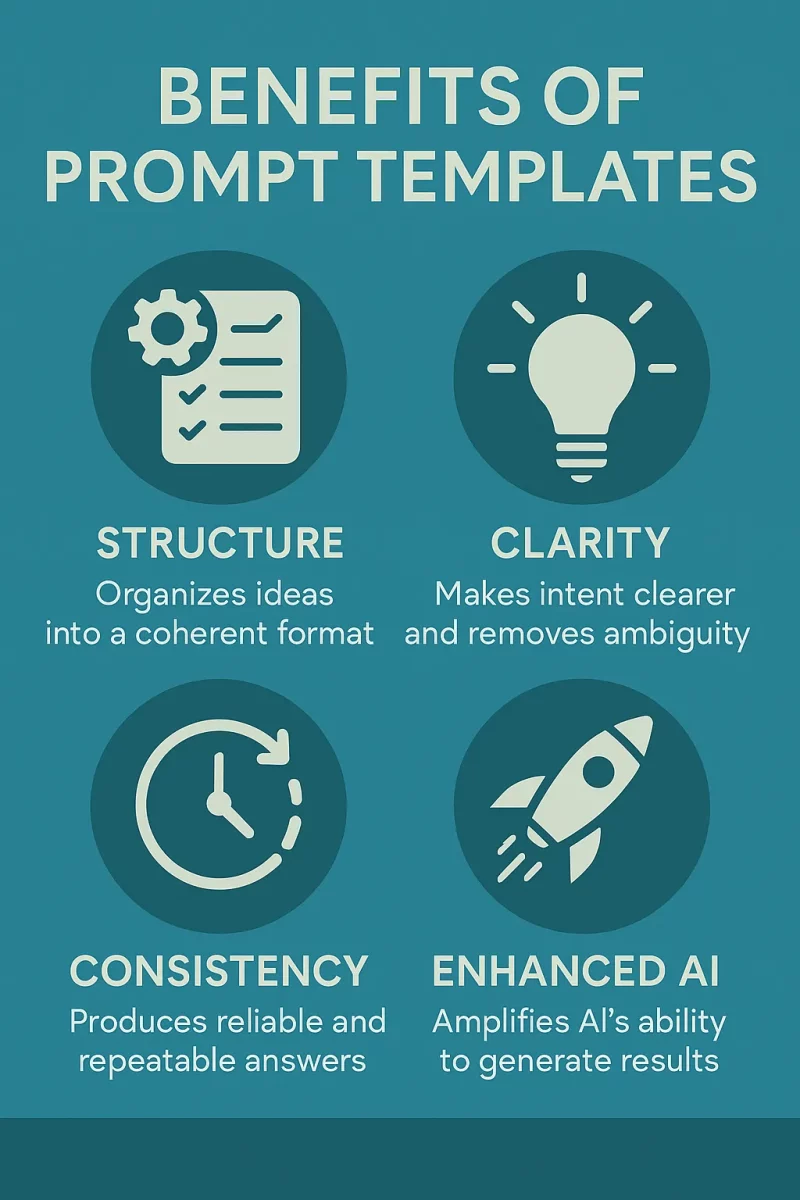
Prompt templates aren’t shortcuts — they are creative amplifiers. While most people tell AI what to do, experienced marketers and creators use templates to shape how AI thinks, reacts, and reasons. Templates turn scattered ideas into structured output, and inconsistent results into repeatable, high-impact content.
Earlier in the Prompt Mastery series, we explored how small refinements can dramatically upgrade prompt quality in How to Write Better ChatGPT Prompts (with Examples).
We then showed how assigning AI a clear persona transforms tone, focus, and reasoning in Act as a… Prompts: How Roles Transform AI Output.
In this guide, we move from technique to system. You’ll see how professional prompt templates help marketers and creators scale content, sharpen messaging, ideate faster, and maintain consistency across channels — without sacrificing creativity.
For the complete end-to-end prompting system behind all techniques in this series, revisit the cornerstone guide AI Prompt Writing: The Ultimate Guide to Working Smarter (2026).
What Makes a High-Quality Prompt Template?
Great templates aren’t about clever phrasing — they’re about strategic architecture.
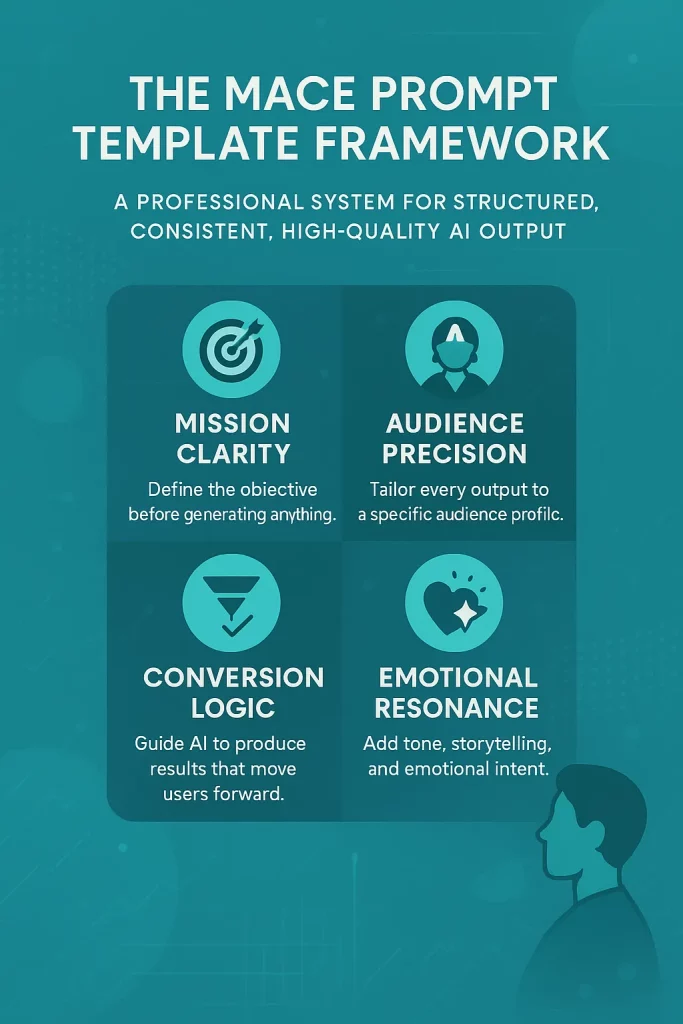
To evaluate whether a template will consistently deliver results across campaigns and formats, we use the MACE Criteria:
M — Mission Clarity
Define the desired outcome.
Are you trying to generate awareness? Build trust? Drive conversions? Increase engagement?
Templates without mission clarity dilute output. Templates with clear intent direct AI toward value.
A — Audience Precision
Sharp templates understand who the message is for — their desires, objections, beliefs, fears, motivations, and informational needs.
Audience framing determines tone, emotional weight, and persuasion strategy.
C — Conversion Logic
High-performing templates rely on proven psychological structures such as:
- Hook → Value → Proof → CTA
- Problem → Insight → Solution → Outcome
- Story → Tension → Breakthrough → Result
These frameworks help AI generate messaging that isn’t just interesting — but effective.
For a deeper look at how structure and examples influence AI reasoning, see Few-Shot vs Zero-Shot Prompting: When to Use Which.
E — Emotional Resonance
Emotion is the ignition switch of human behavior.
Templates must identify which emotion activates your audience:
- curiosity
- hope
- relief
- urgency
- ambition
- recognition
- FOMO
When you combine emotional resonance with structural logic, templates become persuasive engines.
For deeper clarity on contextual structure, revisit Act as a… Prompts: How Roles Transform AI Output to combine roles with templates for significantly sharper messaging.
Why Marketers and Creators Need Prompt Templates in 2026
AI isn’t replacing marketers. It’s replacing marketers without systems.
Prompt templates give you:
Speed
Instant structure eliminates blank-page paralysis.
Consistency
Your voice, tone, and persuasive logic stay consistent across all platforms.
Scalability
Generate dozens of variations in seconds — for ads, emails, scripts, hooks, or landing pages.
Creative Freedom
Templates remove friction, so creativity flows more freely.
Where Prompt Templates Deliver the Biggest Impact
1. Audience Research & Insights
Extract motivations, pain points, behaviors, and objections with structured queries.
2. Brand Voice & Positioning
Maintain a consistent brand tone across all content types.
3. Content Ideation & Differentiation
Generate angles, narratives, and formats that stand out.
4. SEO Strategy & Search Intent Mapping
Build keyword clusters, SERP gaps, and topical authority.
5. Ad Creative & Hook Development
Produce emotional, curiosity-driven or contrast-driven hooks instantly.
6. Funnel & Conversion Optimization
Write sequences, landing pages, and CTAs with persuasive flow.
30 Prompt Templates for Marketers & Creators
Below is a curated collection of unique, high-value templates designed for real-world workflows.
A. Audience Insight Templates
1. Pain-Point Deep Dive
“Analyze [audience]. Identify the top 10 frustrations, hidden objections, and emotional triggers. Present in a table with: Pain → Why it matters → Impact → Opportunity.”
2. Behavior Pattern Decoder
“Explain how [audience] researches, compares, and decides. Break down the cognitive steps from awareness to purchase.”
3. Objection Mapping
“List the 10 biggest objections [audience] has toward [product]. Include root cause + emotional driver + best counter-message.”
4. Motivation Segmentation
“Segment [audience] into four motivation profiles. Describe their goals, fears, triggers, tone, and decision style.”
5. Desire Amplifier
“List 20 desires your audience has related to [topic]. Rank by emotional intensity.”
B. Brand Voice & Positioning Templates
1. Brand Tone Transfer
“Rewrite this text in the brand voice of [brand]. Keep rhythm, tone, phrasing style.”
2. Founder Story Builder
“Turn these facts into a compelling founder story with tension, transformation, and mission clarity.”
3. Reverse Positioning
“Describe what this brand refuses to do — highlight what makes it different.”
4. Archetype Alignment
“Rewrite this message in the style of a [Hero/Sage/Rebel/Magician] archetype.”
5. Emotional Narrative Builder
“Turn this message into a six-sentence emotional progression: Pain → Recognition → Insight → Shift → Solution → Resolution.”
For even sharper messaging, combine templates with role-based prompting as explained in Act as a… Prompts: How Roles Transform AI Output.
C. Content Ideation Templates
1. Category Reframing
“Reframe [topic] using a new analogy or viewpoint that challenges traditional thinking.”
2. Format Remix Generator
“Turn this idea into 10 different content formats: video, carousel, thread, tutorial, newsletter, case study, etc.”
3. Angle Triangulation
“Generate 15 angles combining [topic] + [audience] + [emotion]. Rank by creative potential.”
4. Contrast Method
“Create content concepts based on contrasts: before/after, fast/slow, old/new, with/without.”
5. Content Series Builder
“Generate a 10-part content series where each entry solves one micro-problem.”
D. SEO & Discoverability Templates
1. Search Intent Filter
“Analyze the search intent behind [keyword]. Suggest 10 topic variations aligned with that intent.”
2. Semantic Cluster Builder
“Generate a semantic cluster for [topic]. Group keywords by theme and difficulty.”
3. Content Gap Analysis
“Identify competitor blind spots: topics they fail to cover but the audience wants.”
4. SERP Opportunity Finder
“Extract 10 unique angles not represented on page one for [keyword].”
5. Outline Optimizer
“Improve this outline using EEAT principles and user-focused flow.”
For end-to-end SEO and prompting workflows, revisit AI Prompt Writing: The Ultimate Guide to Working Smarter (2026).
E. Ad Creative Templates
1. High-Velocity Hook Generator
“Generate 20 hooks for (product/topic) using curiosity, contrast, tension, or emotion.”
2. Emotion Split Test
“Write four ad variations: Rational, Emotional, Urgent, Social Proof.”
3. Pain → Insight → Solution Template
“Write an ad following: Pain → Shift → Solution → CTA.”
4. 5-Second Scroll Test
“Create 10 opening lines designed to stop scrolling within five seconds.”
5. Micro-Story Ads
“Write a three-sentence micro-story showing the transformation your product delivers.”
F. Conversion & Funnel Templates
1. Friction Removal Audit
“Analyze this landing page and list every friction point blocking conversion.”
2. Desire Amplification Script
“Rewrite this section to intensify emotional desire using sensory detail.”
3. Objection-to-CTA Transformer
“Turn each objection into a CTA-ready statement using empathy + benefits.”
4. Conversion Storyboard
“Create a six-frame narrative guiding the user emotionally toward conversion.”
5. Email Sequence Builder
“Write a five-email nurture sequence using: Hook → Value → Story → Proof → Offer.”
Advanced Prompt Templates (For Power Users & Agencies)
1. Insight Layering Templates
“Generate first-layer insights → second-layer patterns → third-layer strategic opportunities.”
2. Multi-Modal Prompt Templates
“Analyze this image and rewrite the script for a rhythm optimized for six-second retention.”
3. Counter-Persona Templates
“Create an anti-audience profile to reveal blind spots in messaging.”
4. Scenario Simulation Templates
“Simulate what happens if competitor X launches feature Y.”
5. Transformation Templates
“Turn this article into a keynote speech with narrative flow and emotional beats.”
For more on how AI reasoning shifts based on structure, revisit Few-Shot vs Zero-Shot Prompting.
Conclusion — Templates Multiply Creativity
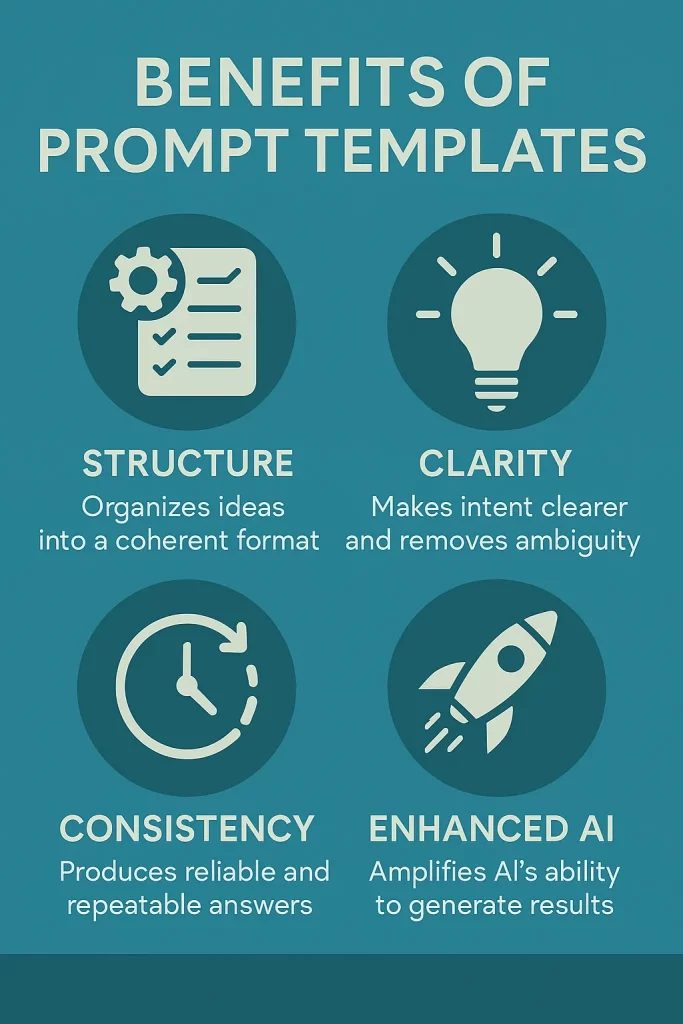
Prompt templates are not constraints — they are creative accelerators.
They make your work:
- more structured
- more consistent
- more strategic
- more scalable
The next advantage in marketing won’t come from writing more prompts.
It will come from designing systems that ensure quality — and templates are the backbone of that system.
For a complete overview of all prompt guides, frameworks, templates, and use cases, visit the AI Prompts Hub.
For teams applying prompt templates to strategy, funnels, and decision-making, explore AI Prompts for Business & Strategy.
To master the complete prompting ecosystem, revisit AI Prompt Writing: The Ultimate Guide to Working Smarter (2026) and explore applied workflows in the AI Tools Hub and AI Trends & News Hub.
To understand how templates evolve into agentic workflows, see The Future of AI Workflows: From Prompts to Autonomous Systems.
Related Reading from the Prompt Cluster
If you want to go deeper into specific techniques and use cases, these guides expand on the core ideas in this article:
- AI Prompt Writing Guide 2026 — The complete foundation for modern prompting and structured AI collaboration.
- How to Write Better ChatGPT Prompts (with Examples) — Practical, copy-and-paste prompts that show how small wording changes transform output quality.
- AI Prompt Frameworks Explained: The 4C Model and Beyond — Structured models that make your prompts more consistent, scalable, and teachable.
- Act as a… Prompts: How Roles Transform AI Output — How role assignment upgrades AI from generic assistant to specialist expert.
- AI Prompt Mistakes: What Most Users Get Wrong (and How to Fix It) — A field guide to diagnosing vague, inconsistent prompts and turning them into high-signal instructions.
- Top AI Prompt Tools to Boost Productivity in 2026 — The tools, optimizers, and testing platforms that help you refine and scale your prompts.
- Best Prompt Libraries & Communities for AI Creators — Curated places to learn from other creators, share your best prompts, and stay ahead of new patterns.
- Multimodal AI Tools 2026: The Next Evolution of Human-Machine Collaboration — How prompting expands beyond text into images, audio, video, and real-time interaction.
- The Future of AI Workflows: From Prompts to Autonomous Systems — A strategic look at how prompts evolve into agents, workflows, and fully autonomous systems.