
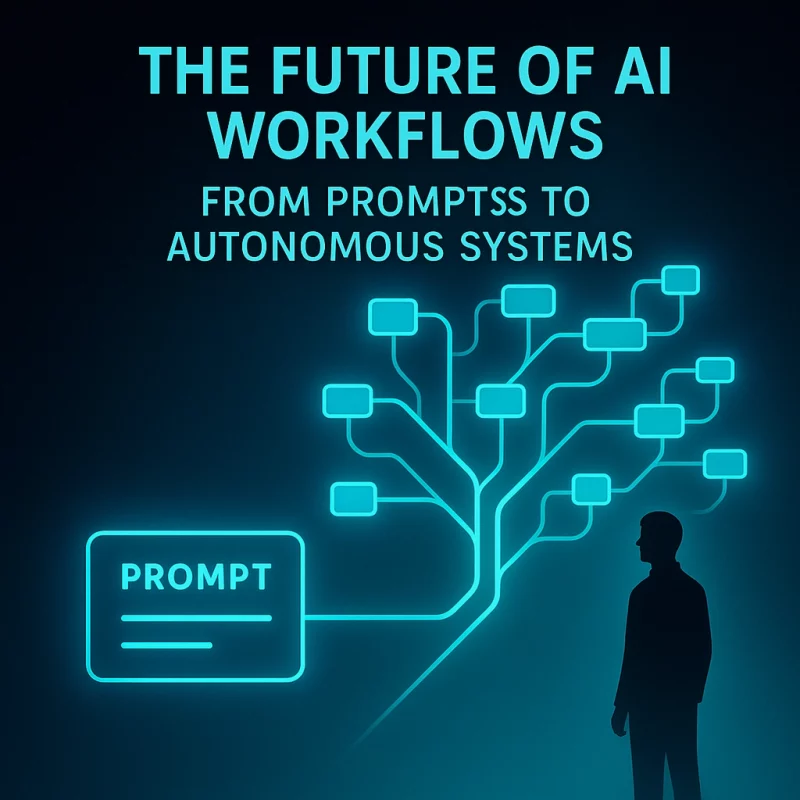
The future of AI workflows is accelerating faster than most organizations realize. For years, working with AI followed a familiar pattern: you wrote a prompt, received an output, refined the instructions, and repeated the process. Powerful — but manual, repetitive, and limited by human attention.
By 2026, that model is breaking.
AI workflows are evolving beyond prompt–response interactions into autonomous systems that can interpret objectives, plan multi-step strategies, take action across tools, evaluate their own output, and continuously improve with minimal human input. Instead of asking AI to generate, we are increasingly asking it to operate.
This shift represents more than a productivity upgrade — it marks a fundamental change in how digital work is designed and executed.
For creators, it means moving from task-by-task execution to outcome-driven automation.
For teams, it means workflows that run in the background — researching, analysing, producing, refining, and preparing deliverables before the workday even begins.
For businesses, it means operational intelligence becoming embedded infrastructure: always-on, invisible, and compounding.
This guide explains how AI workflows are evolving from manual prompting to fully autonomous systems — what defines each stage, which technologies enable the transition, and how individuals and organizations can prepare for this shift today.
It is a core article within the Arti-Trends Prompt Writing Cluster, connecting directly to foundational concepts such as structured prompting, reasoning frameworks, prompt templates, and agent-based systems.
Manual prompting was the interface.
Autonomous workflows are becoming the operating system.
Let’s explore how we got here — and what comes next.
The First Era: How Early AI Tools Shaped the Future of AI Workflows
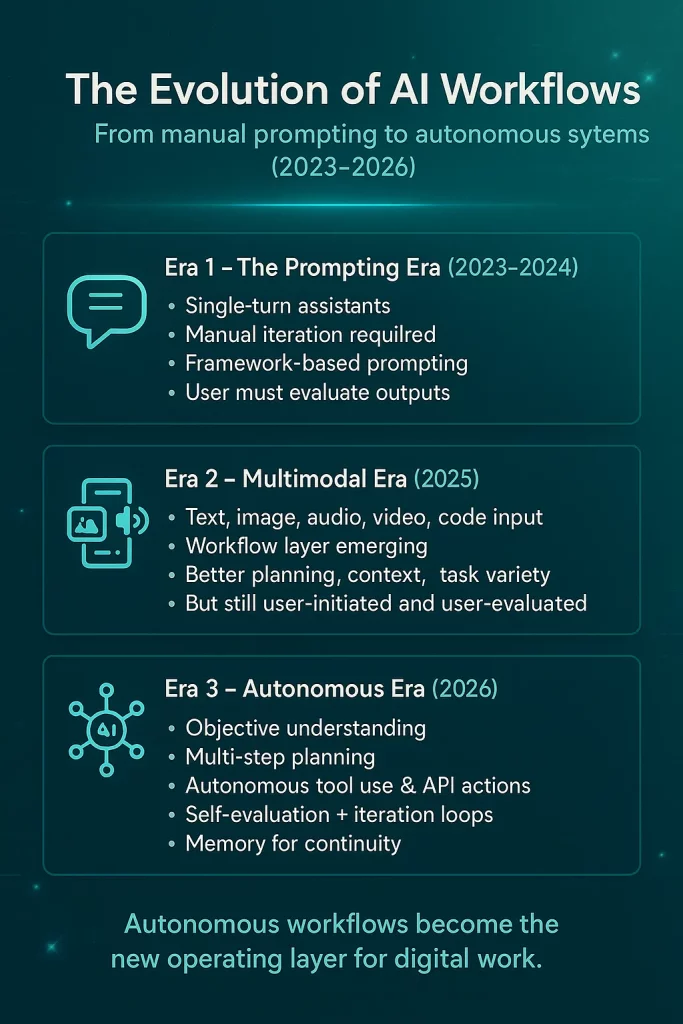
In the early phase of generative AI (2023–2024), language models functioned primarily as single-turn assistants. Each interaction stood on its own, and output quality depended almost entirely on the user’s ability to guide the model effectively.
Success in this era required users to:
- craft structured, explicit prompts
- apply frameworks such as AI Prompt Frameworks Explained: The 4C Model and Beyond
- iterate manually across multiple turns
- evaluate and refine every output themselves
While this phase unlocked enormous creative and analytical potential, AI systems remained fundamentally reactive. They could respond intelligently, but they could not plan, evaluate, or improve without continuous human direction.
This era laid the essential groundwork for the future of AI workflows — but true automation was still limited by human bandwidth and prompt craftsmanship.
For anyone building modern, scalable workflows, the foundational skills introduced in AI Prompt Writing: The Ultimate Guide to Working Smarter (2026) remain essential.
The Second Era: Multimodal Models and the Foundations of Future AI Workflows
With the rise of multimodal models in 2025 (explored in Multimodal AI Tools 2026), AI evolved beyond text generation and began to function as a true workflow layer.
Models gained the ability to interpret and operate across multiple input types, including:
- text
- images
- audio
- video
- code
- spreadsheets
- APIs
- device-level actions
This dramatically expanded what users could build with AI, enabling:
- content pipelines
- research and synthesis systems
- video editing workflows
- data analysis automations
- document processing systems
- multi-step planning assistants
For the first time, AI could connect information across modalities and operate within broader task flows. However, these systems were still human-initiated and human-evaluated. Users had to define when workflows started, assess outputs at each step, and manually trigger refinements.
The multimodal era provided the architectural foundation for the future of AI workflows — but not yet true autonomy.
As prompting complexity increased, clear instruction design became even more important. Resources like How to Write Better ChatGPT Prompts (with Examples) emerged as essential references for guiding multimodal systems with precision and consistency.
The Third Era: Autonomous Systems and the Future of AI Workflows
2026 marks the beginning of the Agentic Era — a fundamental shift where AI moves from responding to instructions to operating toward outcomes.
Autonomous systems no longer wait for step-by-step prompts. Instead, they function as goal-driven operators that can:
- Interpret objectives
They understand intent and desired outcomes — not just literal wording. - Plan tasks and strategies
They generate execution trees, break goals into subtasks, and sequence actions logically. - Take action across tools
They interact with browsers, APIs, spreadsheets, documents, and devices without continuous human supervision. - Evaluate their own output
They apply internal rubrics, benchmarks, or success criteria to assess quality. - Iterate automatically
They refine results, correct errors, and rerun steps until standards are met. - Maintain memory and continuity
They preserve context across sessions, workflows, and long-term projects.
This is the true future of AI workflows: systems that autonomously achieve outcomes, rather than merely generating isolated pieces of content.
What makes this possible is that advanced prompting techniques are no longer manual inputs — they are embedded capabilities. Methods such as Chain-of-Thought Prompting and Few-Shot vs Zero-Shot Prompting now operate under the hood, shaping reasoning, consistency, and decision quality by default.
At this stage, prompting stops being an interaction layer — and becomes infrastructure.
What the Future of AI Workflows Means for Real-World Teams
As AI workflows become autonomous, the impact on teams is not incremental — it’s structural. The way work is planned, executed, reviewed, and scaled is fundamentally changing.
A. Prompts Become System Instructions
In autonomous workflows, prompts no longer function as isolated requests. They become system-level instructions that define objectives, constraints, and success criteria.
Instead of writing long prompt chains, teams define outcomes such as:
“Create a complete Q2 content strategy and prepare it for scheduling.”
From there, an autonomous system can independently:
- research markets and audiences
- analyze competitors and positioning
- generate ideas and strategic angles
- create and refine assets
- align tone with brand guidelines
- validate quality against predefined criteria
- prepare files, calendars, and handoff-ready outputs
Reusable prompt components — like those found in Prompt Templates for Marketers and Creators — become the building blocks of these systems. What used to be “good prompts” turn into modular workflow logic that can be reused, combined, and scaled across teams.
The result: less manual orchestration, more outcome-driven execution.
B. A New Generation of AI Tools Is Emerging
This shift is driving a new class of tools — not designed for chatting with AI, but for orchestrating autonomous work.
These platforms focus on:
- agent builders
- workflow automation layers
- AI-native CRMs and planning systems
- multimodal assistants
- operational dashboards
- orchestration and monitoring systems
- autonomous research and analysis agents
Instead of optimizing individual prompts, these tools manage entire execution loops: planning, action, evaluation, and iteration.
Guides like Top AI Prompt Tools to Boost Productivity in 2026 and AI Prompts for Business & Strategy illustrate how quickly this tooling landscape is reshaping productivity, decision-making, and operational scale.
C. On-Device AI Will Transform Workflow Speed and Privacy
On-device AI accelerates this transformation even further by removing latency, dependency, and privacy constraints.
Key advantages include:
- ultra-low latency
- offline reasoning and execution
- privacy-by-default processing
- real-time decision support
- native integration with operating systems and apps
This unlocks new workflow categories, such as:
- instant transcription and summarisation
- AR-guided operational tasks
- private document and data reasoning
- real-time code generation and debugging
These developments align closely with the insights outlined in the On-Device AI Guide, where speed, privacy, and autonomy converge into a new execution layer.
Why this matters for teams
Together, these shifts mean teams move from managing tasks to designing systems.
Workflows no longer depend on constant human input — they run, evaluate themselves, and improve in the background.
This is not about replacing people.
It’s about removing friction between intent and execution.
The Architecture Defining the Future of AI Workflows
Autonomous AI workflows are not random or “intelligent by magic.”
They follow a repeatable architectural pattern — one that mirrors how high-performing teams think, plan, execute, and review work.
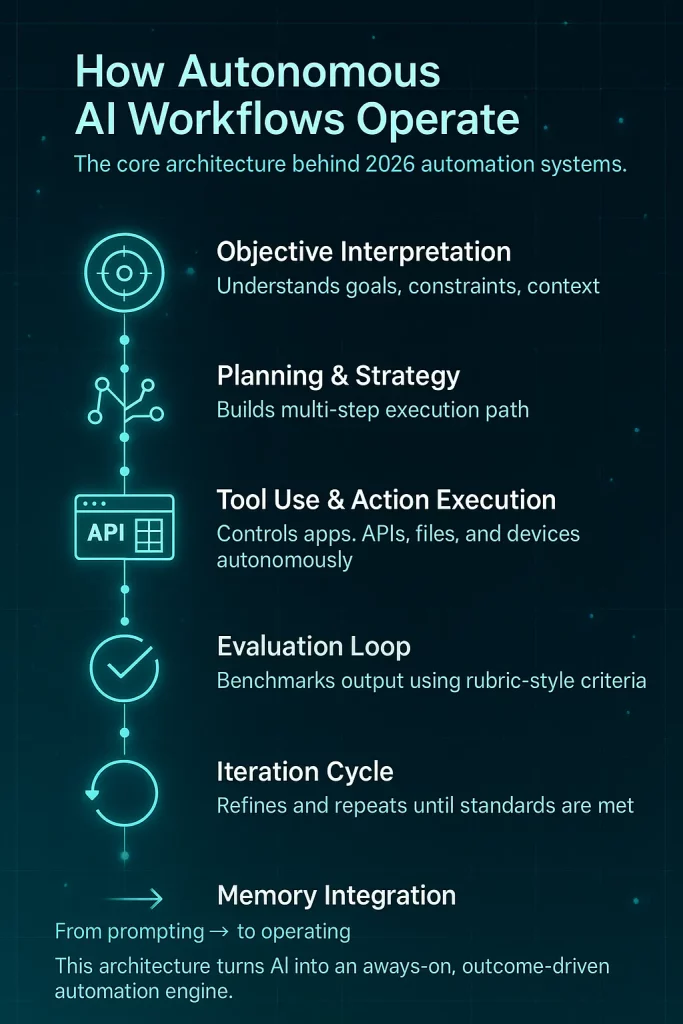
At their core, autonomous systems operate through six tightly connected layers:
1. Objective Interpretation
Every workflow starts with intent.
The system interprets:
- the objective
- the context
- constraints and boundaries
- success criteria
This is where vague instructions become operational clarity. Without this layer, autonomy collapses into guesswork.
2. Planning & Strategy
Once intent is understood, the system builds a decision structure.
This includes:
- task decomposition
- dependency mapping
- prioritisation logic
- execution sequencing
In practice, this looks like a dynamic decision tree that adapts as new information becomes available.
3. Tool Use & Action Execution
With a plan in place, the system takes action.
This can include:
- browser automation
- API calls
- spreadsheet manipulation
- document creation and editing
- data extraction and transformation
- tool-to-tool handoffs
At this stage, AI stops “suggesting” and starts operating.
4. Evaluation
Execution alone is not enough — autonomous systems must judge their own output.
Evaluation layers typically use:
- rubric-based scoring
- rule-based validation
- consistency checks
- quality thresholds
This replaces manual review loops with built-in quality control.
5. Iteration
If the output does not meet expectations, the system doesn’t stop.
It:
- identifies weak points
- adjusts parameters
- reruns specific steps
- refines results
Iteration turns one-shot execution into continuous improvement.
6. Memory Integration
The final layer enables long-term intelligence.
Memory allows systems to:
- retain preferences and context
- maintain continuity across workflows
- personalise outputs
- improve over time
This is what transforms automation from repetitive execution into learning systems.
One Engine, Not Separate Techniques
Modern autonomous workflows merge multiple prompt-engineering disciplines into a single execution engine:
- Few-Shot vs Zero-Shot Prompting for pattern alignment
- Chain-of-Thought Prompting for explicit reasoning
- Prompt Frameworks for structure and constraint
- Act as… Prompts for role-based expertise
Individually, these techniques improve prompts.
Combined, they form the operating logic of autonomous AI systems.
This architecture is what allows AI to move from answering questions to achieving outcomes.
Preparing for the Future of AI Workflows Today
The shift toward autonomous AI workflows is not something you prepare for later — it’s something you design for now. Organizations and creators who start early build a compounding advantage as systems, templates, and automation mature over time.
Here’s how to prepare effectively.
1. Document Your Existing Workflows
Autonomous systems require clarity before they require intelligence.
Document:
- recurring tasks
- decision points
- inputs and outputs
- quality criteria
If a process only exists “in your head,” AI cannot automate it. Structure is the prerequisite for autonomy.
2. Build Reusable Prompt Templates
Prompt templates are the bridge between manual prompting and autonomous execution.
Well-designed templates:
- standardize reasoning
- encode best practices
- reduce ambiguity
- scale across teams
These templates later become system instructions inside agents and workflows (see Prompt Templates for Marketers and Creators).
3. Experiment With AI Agents (Early and Often)
You don’t need full autonomy on day one — but you do need experience.
Start experimenting with:
- task decomposition
- planning logic
- iteration loops
- evaluation criteria
This builds intuition for how agents think, fail, correct themselves, and improve.
4. Automate 20–40% of Your Work First
Full autonomy is not the starting point.
The highest-impact early candidates include:
- research
- reporting
- planning
- writing
- outreach
- organising
- analysis
Automating even a fraction of these tasks creates immediate leverage — without operational risk.
5. Choose Tools Built for Autonomous Execution
Not all AI tools are designed for the future.
Prioritize platforms that support:
- multi-step workflows
- tool usage (APIs, files, browsers)
- evaluation loops
- memory and persistence
Avoid tools that only optimize single-turn text generation. The future belongs to full-cycle automation systems.
Preparing for autonomous AI workflows is not about replacing human judgment —
it’s about amplifying it through systems that think, act, and improve alongside you.
Those who prepare today won’t just use autonomous AI tomorrow.
They’ll define how it’s built, governed, and trusted.
Conclusion: AI Isn’t Just Answering — It’s Acting
The future of AI workflows isn’t about writing the perfect prompt.
It’s about engineering systems that understand objectives, plan intelligently, act independently, and improve with every cycle.
The real leverage no longer comes from isolated prompt techniques.
It comes from designing the infrastructure that allows AI to operate with clarity, consistency, and autonomy.
Prompts were the interface.
Workflows became the engine.
Autonomous systems are now the operating layer of digital work.
And like every major technological shift — from search engines to cloud computing to mobile platforms — the early builders will define the standards everyone else follows.
Those who start today will:
- move faster than competitors who still rely on manual execution
- build compounding automation assets that increase in value over time
- drastically reduce the gap between idea and execution
- operate with a level of consistency and scale that humans alone can’t sustain
Businesses that adopt autonomous workflows will outperform.
Creators who design their own systems will become exponentially more productive.
Teams that learn to collaborate with AI instead of merely using it will set the pace for their entire industry.
For a complete overview of the techniques, frameworks, templates, tools, and workflows that make this transition possible, the AI Prompts Hub serves as the central entry point — connecting foundational prompt design with advanced systems, agents, and autonomous execution.
This is not just a technological upgrade.
It’s a strategic transformation.
Autonomy isn’t coming.
It’s already here.
And the individuals, teams, and organizations that learn to build with it today
will define what tomorrow looks like.
Related Reading from the Prompt Cluster
If you want to understand how autonomous AI workflows are built in practice, these guides cover the core building blocks behind agentic systems:
- AI Prompt Writing Guide 2026 — The foundational system for designing clear, structured, and reusable prompts.
- AI Prompt Frameworks Explained: The 4C Model and Beyond — How structured frameworks turn intent into predictable execution.
- Chain-of-Thought Prompting: Make AI Think Step-by-Step — Why explicit reasoning is critical for autonomous decision-making.
- Few-Shot vs Zero-Shot Prompting: When to Use Which — How examples teach agents consistency, structure, and alignment.
- Prompt Templates for Marketers and Creators — Turning prompt logic into reusable, automation-ready components.