This article is part of our AI Future Trends series, where we break down the most important developments shaping artificial intelligence each month.
The April 2026 edition highlights a critical moment in the evolution of AI. Three major forces are converging simultaneously: the rise of AI super apps, the rapid acceleration of model competition, and breakthrough advances in efficiency that are redefining the cost of AI.
Rather than isolated updates, these developments signal a broader structural shift in how AI is built, deployed, and used in real-world workflows. Understanding these trends is essential for anyone looking to move beyond experimentation and start applying AI with intent.
A Structural Shift in Artificial Intelligence
Artificial intelligence is no longer progressing in incremental steps; it is accelerating through overlapping waves of innovation. In April 2026, three developments are unfolding simultaneously: AI platforms are evolving into full-scale ecosystems, the number of competing models is expanding at an unprecedented rate, and efficiency breakthroughs are fundamentally changing the economics of AI. Each of these trends is significant on its own, but their convergence signals a deeper transition. This is not simply another update cycle — it marks a structural shift in how AI is built, distributed, and applied in real-world workflows. For a broader contextual overview, this development fits within the larger trajectory outlined in our complete AI trends overview.
The Rise of AI Super Apps
AI platforms are rapidly transitioning from standalone tools into integrated ecosystems. Environments such as ChatGPT increasingly combine search, content generation, coding, automation, and agent-based execution within a single interface. This consolidation mirrors earlier shifts in the software landscape, where fragmented applications evolved into unified platforms and eventually into dominant ecosystems. The implication is clear: users are no longer navigating between tools, but operating within a centralized AI layer that coordinates tasks across domains.
This transition has direct consequences for the broader AI landscape. Independent tools risk becoming commoditized features within larger platforms, while distribution power shifts toward ecosystem owners. User behavior follows the same pattern, consolidating around a limited number of dominant interfaces that reduce friction and increase efficiency. From a structural perspective, AI is becoming the new operating layer of the internet — a mediating system between user intent and digital execution.
For users and businesses, this reinforces the importance of thinking beyond individual tools. The real value is no longer derived from standalone capabilities, but from how systems are orchestrated. This is precisely where structured workflows become critical, as illustrated in the AI Stack Builder, where tools are positioned within functional layers rather than evaluated in isolation.

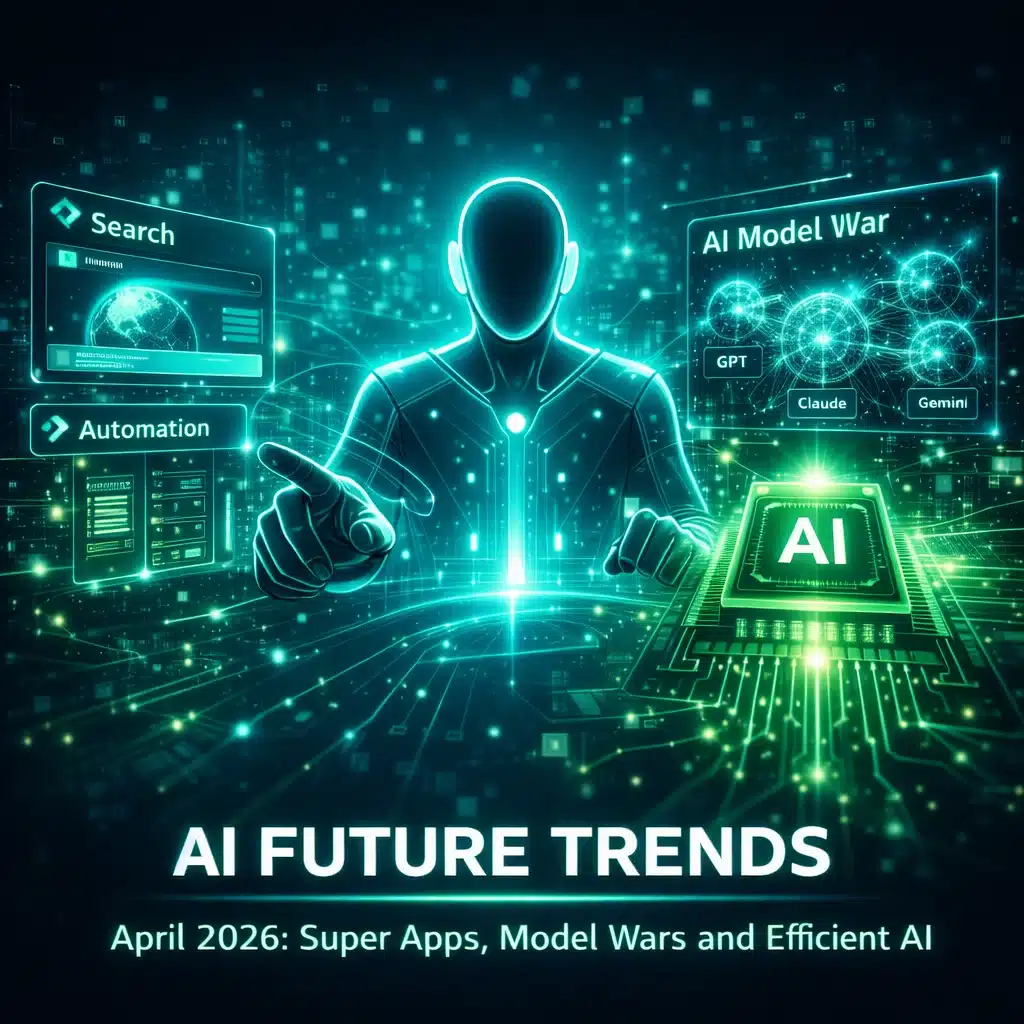
This visualization illustrates how AI super apps are transforming isolated tools into fully integrated ecosystems in 2026.
The AI Model War Is Accelerating
At the same time, the pace of AI model development has intensified dramatically. Leading organizations including OpenAI, Google, Anthropic, and NVIDIA continue to release new models at a frequency that challenges traditional evaluation cycles. As a result, the concept of a single “best model” is rapidly losing relevance. Performance is increasingly context-dependent, varying based on task type, input structure, and integration environment.
This shift introduces a new layer of complexity. Models are improving, but they are also becoming interchangeable in many scenarios. What differentiates outcomes is not the model itself, but how it is deployed within a workflow. The question is no longer which model performs best in isolation, but which configuration delivers the most reliable and efficient results in a given context.
From a strategic standpoint, AI is entering a phase of commoditization at the model level. Competitive advantage is moving away from raw capability and toward orchestration — how models are combined, how tasks are distributed, and how outputs are refined. This is why comparative analysis must evolve as well. Within the AI Tools Hub, tools are evaluated based on their role within workflows rather than standalone benchmarks, reflecting how AI is actually used in practice.

This visualization represents how competing AI models are rapidly evolving and reshaping the AI landscape in 2026.
The End of Expensive AI
Parallel to the expansion of models, a less visible but equally important development is taking place: AI is becoming significantly more efficient. Emerging approaches that combine neural architectures with structured reasoning are achieving substantial reductions in computational requirements while maintaining or even improving performance. Early indications suggest that, in specific applications, efficiency gains can reach up to an order of magnitude that fundamentally alters cost structures.
Historically, improvements in AI capability were tightly coupled to increases in scale. Larger models required more data, more compute, and higher infrastructure costs. This relationship is now being challenged. Advances in architecture and optimization are demonstrating that intelligence does not necessarily require exponential increases in resource consumption. Instead, efficiency is becoming a primary driver of progress.
This has far-reaching implications. Lower costs reduce barriers to entry, enabling smaller teams and independent developers to build competitive AI-driven solutions. It also accelerates adoption across industries where cost sensitivity previously limited experimentation. In practical terms, AI is becoming more accessible, more scalable, and more economically viable — a combination that typically precedes rapid expansion and innovation.
This visualization highlights how efficient AI models are reducing costs and accelerating adoption across industries in 2026.
The Bigger Picture: Platformization, Commoditization, and Democratization
When viewed in isolation, each of these trends represents a meaningful development. When combined, they form a coherent pattern that defines the next phase of AI. Platforms are consolidating user interaction, models are becoming interchangeable components, and efficiency is expanding access. Together, these forces are transforming AI from a fragmented set of tools into an integrated, widely accessible system.
This transition can be understood across three dimensions. First, AI is becoming platformized, with a small number of ecosystems controlling distribution and user interaction. Second, AI is becoming commoditized at the model level, reducing differentiation based purely on capability. Third, AI is becoming democratized through efficiency gains that lower the cost of participation. The intersection of these dynamics marks a structural shift from scarcity to abundance — not in access to AI, but in the ability to apply it effectively.
Practical Implications for Users and Businesses
For users and organizations, this shift requires a change in approach. The search for a single “best tool” is no longer productive, as performance depends heavily on context and integration. Instead, value is created through workflow design — how tools are combined, how tasks are structured, and how outputs are refined across stages.
This means prioritizing systems over features. Automation, integration, and execution speed become the primary drivers of productivity, rather than individual tool capabilities. It also emphasizes the importance of input quality. As explored in our AI prompts guide, the effectiveness of AI systems is directly linked to how they are instructed and guided. Better inputs lead to better outputs, regardless of the underlying model.
Ultimately, the shift toward systems thinking reflects the broader evolution of AI itself. As tools become more powerful and more accessible, the limiting factor is no longer technology, but how effectively it is applied.
Where This Is Heading
The current trajectory suggests a clear direction for AI development. Platforms will continue to consolidate control over user interaction, models will become increasingly interchangeable, and efficiency will drive widespread adoption across industries. The competitive landscape will not be defined by access to AI, but by the ability to structure and apply it effectively within specific contexts.
This creates a divergence between passive users and active operators. Those who rely on AI as a standalone tool will see incremental gains, while those who integrate it into structured workflows will unlock exponential leverage. The difference lies not in the technology itself, but in how it is used.
Final Thought
Artificial intelligence is entering a phase where understanding matters more than access. While most users are still adapting to individual tools, a smaller group is beginning to think in systems, workflows, and leverage. Within that shift lies the opportunity. As AI continues to evolve, the advantage will increasingly belong to those who can translate capability into structured execution.
Related reading
Explore the AI Tools Hub to compare tools in real workflows.
Build your system with the AI Stack Builder.
Improve outputs with the AI Prompts Guide.
Understand the fundamentals in What is Artificial Intelligence?