Artificial intelligence is reshaping financial markets, but investors can engage with that transformation in fundamentally different ways. Some allocate capital to AI-driven companies and thematic vehicles with a long-term perspective. Others seek to capture shorter-term price dynamics through active execution strategies.
Both approaches provide exposure to the same technological shift. They do not, however, represent the same strategy.
AI investing vs AI trading is not a debate about optimism versus skepticism. It is a structural distinction involving time horizon, capital allocation, risk architecture and behavioral demands. Confusing these approaches often leads to misaligned expectations — long-term investors reacting to short-term volatility, or short-term traders relying on long-term conviction without adequate risk control.
For a broader structural overview of AI as an asset class, the AI Investment Hub maps stocks, ETFs and crypto exposure across the ecosystem. For readers focused on execution mechanics in crypto markets, the AI Crypto Trading Hub explains how algorithmic systems operate within volatile environments. This article bridges both perspectives. It clarifies when long-term capital allocation is appropriate — and when active execution is the better fit.
At its core, the difference is structural: allocation versus execution.
Allocation vs Execution
AI investing is a capital allocation exercise. It involves acquiring ownership exposure to companies or thematic instruments expected to benefit from multi-year AI adoption trends. The return driver is enterprise value expansion over time, supported by revenue growth, margin development and competitive durability. Performance evaluation is periodic and anchored in financial metrics rather than short-term price action. Volatility is contextualized within structural adoption cycles.
Institutional capital allocation frameworks — as discussed in IMF Global Financial Stability Reports — emphasize macro sensitivity, sector concentration and valuation compression as core drivers of thematic drawdowns. AI investing therefore absorbs market risk as its primary exposure: macroeconomic tightening, rate shifts, capital rotation and multiple contraction can materially affect returns independent of operational execution at the firm level.
AI trading, by contrast, is an execution discipline. It seeks to exploit shorter-term inefficiencies within price formation. The return driver is not enterprise value but price movement. Performance depends on timing precision, liquidity depth, spread stability and disciplined risk management. Monitoring frequency is continuous. Time amplifies exposure differently: in allocation strategies, time enables compounding; in trading strategies, time increases exposure to volatility.
Research from the Bank for International Settlements on market microstructure highlights how liquidity cycles, order book depth and volatility clustering can materially affect execution outcomes. These dynamics form the structural risk layer for trading-oriented capital.
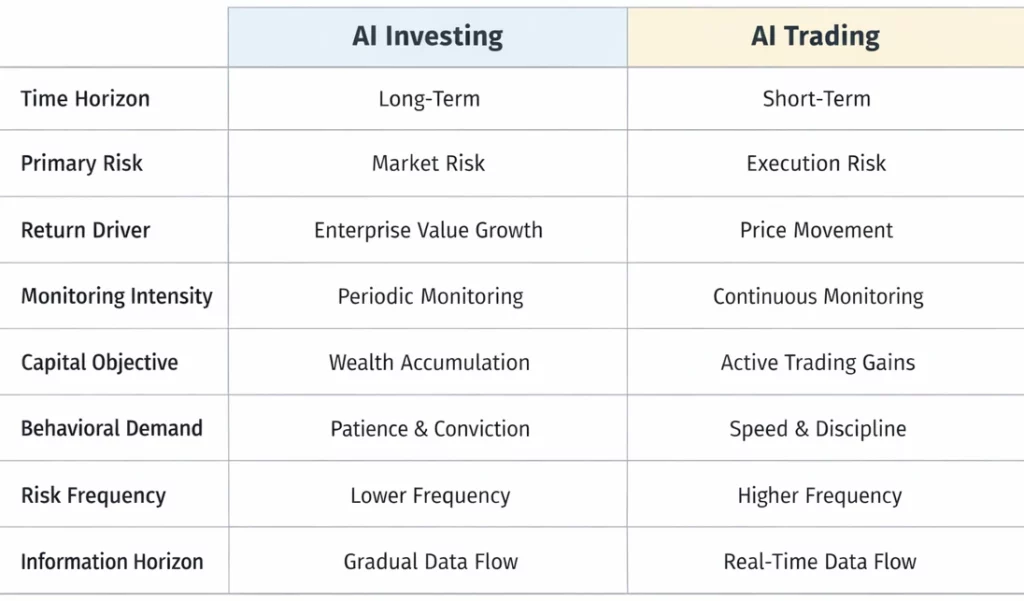
The structural differences between AI investing and AI trading can be summarized as follows:
Risk Profile Comparison
Although both AI investing and AI trading provide exposure to the same technological transformation, the nature of risk differs fundamentally. The difference lies not merely in magnitude, but in structure.
Market Risk vs Execution Risk
In AI investing, the dominant exposure is market risk. This includes macroeconomic shifts, interest rate movements, sector rotation and valuation compression. Even fundamentally strong companies may experience price declines due to broader market repricing. The core risk lies in valuation entry, timing and the durability of the business model. Investors accept interim volatility as part of the long-term compounding process. In AI trading, exposure shifts toward execution risk. Here the focus is not enterprise value but price behavior. Slippage, spread widening, liquidity gaps, volatility spikes or misinterpreted signals can immediately affect outcomes. Where investing is influenced by fundamental change, trading is influenced by market microstructure.
Drawdown Risk vs Liquidation Risk
In investing, drawdowns are cyclical and expected. AI-related assets may correct 20–40% without altering their long-term growth trajectory. The challenge is psychological and strategic: maintaining discipline through temporary repricing. In trading, drawdowns can escalate rapidly — particularly when leverage is involved. Liquidation risk or forced exits triggered by predefined risk thresholds can impair capital quickly. Losses must be controlled before compounding turns negative. Investors manage volatility over time. Traders manage volatility in real time.
Thesis Risk vs Signal Risk
AI investing relies on a structural thesis:
- Will AI adoption continue to accelerate?
- Can competitive advantage be sustained?
- Is valuation supported by durable cash flow?
When these assumptions fail, the investor faces thesis risk — a fundamental breakdown of the original allocation logic. AI trading involves signal risk. Models may fail. Market regimes may shift. Patterns may disappear. The strategy becomes temporarily or structurally ineffective.
The risk in investing is that the long-term story proves flawed. The risk in trading is that the short-term method stops working.
Information Horizon Risk
Investing is based on information that unfolds gradually: earnings cycles, strategic initiatives, product development and market share progression. Trading responds to information that translates immediately into price action: order flow, volatility, sentiment and liquidity shifts. Slow information can delay thesis adjustments in investing. Rapid information can trigger overreaction in trading.
Risk Intensity vs Risk Frequency
In investing, risk events are less frequent but often larger in magnitude. Major market corrections are episodic but meaningful. In trading, risk events are more frequent but typically smaller per transaction — assuming disciplined position sizing. However, the cumulative effect of repeated minor errors can compound negatively. Risk management frameworks must therefore differ structurally. Investing emphasizes diversification and valuation discipline. Trading emphasizes strict position sizing, loss limits and execution control.
Time Horizon & Behavioral Demands
Time is not merely a parameter — it is a constraint that shapes psychological exposure.
AI investing operates within a multi-year horizon. Capital is positioned for structural participation in AI-driven economic transformation. Volatility is interpreted through a long-term lens. AI trading operates within compressed horizons. Capital is deployed tactically in response to price conditions. Monitoring intensity is significantly higher.
Investing requires patience. Trading requires constant discipline.
The cognitive load differs accordingly. Long-term allocation can be managed with periodic review. Trading demands continuous oversight, rapid decision-making and emotional control. Strategy must align with lifestyle. Capital that cannot tolerate monitoring intensity should not be allocated to active trading. Capital required for liquidity should not be locked into long-duration exposure.
Misalignment between strategy and personal capacity creates structural friction.
Capital Allocation Framework
The distinction between AI investing and AI trading becomes practical when translated into capital structure.
When AI Investing Is Structurally Appropriate
AI investing is suited for:
- Multi-year wealth-building capital
- Lower monitoring frequency
- Tolerance for cyclical volatility
- Structural exposure to AI adoption
The objective is participation in durable value creation. Returns accumulate gradually through compounding.
When AI Trading Is Structurally Appropriate
AI trading is suited for:
- Tactical capital
- High liquidity preference
- Defined risk tolerance
- Willingness to actively monitor positions
The objective is extracting value from volatility and price movement.
Capital Segmentation
Blending objectives within a single capital pool often leads to instability. A clearer structure separates capital by mandate:
Core capital → long-term AI investing exposure
Tactical capital → short-term AI trading allocation
Segmentation reduces psychological conflict and prevents short-term volatility from distorting long-term conviction.
Decision Matrix
| Factor | AI Investing | AI Trading |
|---|---|---|
| Time Horizon | Long-term | Short-term |
| Primary Risk | Market & valuation | Execution & volatility |
| Monitoring | Periodic | Continuous |
| Capital Objective | Compounding | Tactical return |
| Psychological Demand | Patience | Discipline |
This comparison of AI investing vs AI trading clarifies how AI investing strategy differs from AI trading strategy in capital allocation and risk structure.
Conclusion
Artificial intelligence is likely to remain a defining force in capital markets. The critical decision is not whether to gain exposure, but how that exposure is structured. AI investing and AI trading represent structurally distinct mandates.
AI investing is a capital allocation strategy anchored in long-term value creation. It absorbs macro volatility in pursuit of compounding. AI trading is an execution strategy anchored in price dynamics. It manages volatility actively and continuously.
Misalignment between mandate and capital purpose is a primary driver of underperformance. Sustainable outcomes depend less on predicting AI’s trajectory and more on structuring capital with clarity.
Investors seeking a structural overview of AI-related allocation across stocks, ETFs and digital assets may consult the AI Investment Hub. Those evaluating execution-oriented approaches can review the AI Crypto Trading Hub to understand how algorithmic systems operate within volatility regimes.
AI markets will continue to evolve. Capital structure — not narrative conviction — will determine resilience.
Sources & References
This analysis draws on institutional research and market structure publications to frame the structural differences between long-term investing and active trading in AI-driven markets.
- International Monetary Fund — Global Financial Stability Report
Used for broader context on market concentration, capital flows and systemic risk dynamics. The IMF’s analysis helps frame how thematic capital allocation can influence volatility and valuation sensitivity. - Bank for International Settlements — Annual Economic Report & market microstructure research
Referenced to contextualize liquidity cycles, trading intensity and behavioral responses to volatility. BIS publications provide insight into how short-term trading environments amplify execution risk. - CFA Institute — Market Microstructure & Risk Management Publications
Used to inform the distinction between allocation risk and execution risk, including concepts such as slippage, liquidity constraints, drawdown management and risk budgeting. - McKinsey & Company — Global AI Adoption Studies
Referenced to frame the structural AI adoption thesis underlying long-term investing. Adoption data supports the differentiation between enterprise value creation and short-term price dynamics.
These sources are not cited for specific forecasts or recommendations, but to provide institutional context for understanding how capital allocation and active execution operate differently within AI markets.