
A Market Reaction That Signals Structural Change
When Google unveiled a new AI model capable of generating fully interactive digital worlds from simple text prompts, the most immediate response did not come from game developers.
It came from investors.
Video game stocks fell sharply across multiple markets — not because a single AI model will replace traditional games overnight, but because the announcement exposed something deeper:
the economic foundation of game development is starting to shift.
Financial markets rarely react to technology demos.
They react to changes in long-term cost structures and value creation.
Key Takeaway
AI is no longer just accelerating game development — it is reshaping where value is created.
Markets are responding to a structural shift: world creation is moving from labor-intensive production toward AI-driven systems, compressing costs, timelines, and competitive moats across the gaming industry.
What Makes This AI Model Fundamentally Different
Generative AI is not new to gaming.
Studios already use AI for:
- asset generation
- NPC dialogue
- environment variations
- procedural elements within fixed engines
This model operates at a higher level.
Instead of generating content inside a world, it generates the world itself, including:
- environmental logic
- interaction rules
- spatial consistency
- cause-and-effect behavior
In effect, the system behaves less like a tool and more like a world-level engine layer.
This aligns with a broader shift toward AI tools evolving from assistants to production infrastructure, where AI systems stop supporting workflows and begin defining them.
The key change is not speed alone — it is compressed iteration.
Why Markets Reacted Before Studios Did
Public markets price expectations, not intentions.
Traditional game development depends on:
- large multidisciplinary teams
- multi-year production cycles
- high fixed costs
- limited scalability per title
World-level AI challenges each of these assumptions simultaneously.
Traditional economics
- long pre-production phases
- costly iteration
- high execution risk
AI-driven alternative
- smaller teams
- rapid experimentation
- lower marginal cost per world
- faster learning loops
This creates immediate margin pressure, particularly for:
- mid-sized studios
- publishers reliant on long release cycles
- companies whose advantage lies in scale rather than tooling
From an investment perspective, this mirrors patterns already visible in AI-driven shifts across creative and software markets, where value migrates away from labor and toward systems.
From Linear Pipelines to Prompt-Driven Design
The disruption is not visual fidelity.
It is workflow architecture.
Traditional pipeline
Concept → design documentation → engine implementation → asset creation → testing
A linear, slow, and capital-intensive process.
AI-driven workflow
Prompt → interactive world → real-time iteration → refinement
A feedback loop measured in days, not months.
This shifts the core bottleneck away from production capacity and toward creative direction.
The scarce capability becomes:
- defining compelling world logic
- guiding AI systems effectively
- curating experiences rather than assembling assets
The same pattern is emerging across AI-augmented creative workflows in multiple industries.
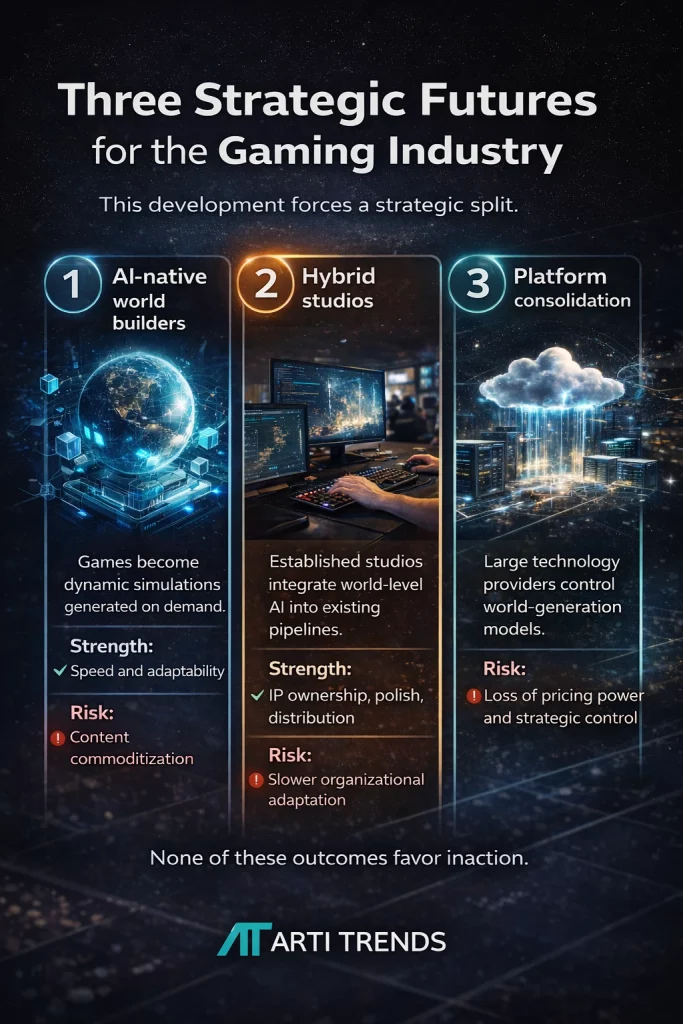
Three Strategic Futures for the Gaming Industry
This development forces a strategic split.
1. AI-native world builders
Games become dynamic simulations generated on demand.
Engines turn into interchangeable infrastructure.
Strength: speed and adaptability
Risk: content commoditization
2. Hybrid studios
Established studios integrate world-level AI into existing pipelines.
Strength: IP ownership, polish, distribution
Risk: slower organizational adaptation
3. Platform consolidation
Large technology providers control world-generation models.
Studios move downstream.
Risk: loss of pricing power and strategic control
None of these outcomes favor inaction.
Practical Implications
For studios
AI strategy is no longer a tooling choice — it is a structural decision affecting costs, timelines, and competitiveness.
For investors
Future valuation will focus less on existing IP and more on:
- iteration speed
- AI integration depth
- system-level leverage
For players
Expect more experimental worlds, faster releases, and a transitional period of uneven quality.
Why This Moment Matters
This is not about AI “making games easier.”
It is about value moving upstream:
- from labor to systems
- from production to orchestration
- from scale to adaptability
The gaming industry has survived engine transitions before.
What makes this one different is speed — and the fact that it originates outside the traditional gaming ecosystem.
Markets recognized that immediately.
Studios are still adjusting.
Sources & Context
- Public research communications and demonstrations from Google
- Market reactions across publicly traded gaming companies following the announcement
- Historical parallels with engine and tooling disruptions in gaming and software
- Arti-Trends internal analysis of AI-driven cost-structure shifts in creative industries