Introduction — Starting AI Investing the Right Way
In 2026, artificial intelligence is no longer a speculative theme. It is a structural force shaping capital flows across infrastructure, software, automation, and decentralized networks. The real question is no longer whether AI matters — it is how to start investing in AI without making avoidable mistakes.
Many investors enter AI exposure reactively. They buy after strong rallies, concentrate capital in a single narrative, or confuse brand visibility with durable value creation. The result is often unnecessary volatility and poorly structured portfolios.
Starting correctly requires something different: clarity before capital. You need to understand your risk tolerance, define your time horizon, choose the right investment vehicle, and build allocation discipline from day one. Without that structure, even strong long-term themes can produce disappointing outcomes.
This guide is designed as a practical starting point. It does not redefine what AI investing is — that foundation is covered in What Is AI Investing Instead, it focuses on execution. You will learn how to approach AI exposure step by step, how to build a starter allocation framework, and how to scale responsibly as the market evolves.
AI investing is not about being early. It is about being structured. The investors who compound successfully over the next decade will not be those who react fastest to headlines, but those who deploy capital deliberately and adjust with discipline.
Let’s begin with the first decision that matters: whether you are ready to allocate capital to AI at all.
Capital Readiness: Prepare Before You Allocate
Before deciding how to start investing in AI, you need to determine whether you are structurally prepared to add AI exposure to your portfolio. Many early mistakes happen not because AI underperforms, but because investors allocate capital without aligning it to their own constraints.
The first variable is time horizon. Artificial intelligence adoption unfolds over multi-year cycles. Infrastructure buildouts, enterprise integration, regulatory shifts, and competitive consolidation do not resolve in quarters. If your capital may be needed within the next one to two years, concentrated AI exposure can introduce unnecessary stress. AI works best as capital that can remain invested through volatility.
Risk tolerance is equally important. AI segments — particularly infrastructure and emerging decentralized networks — can experience sharp valuation swings. If short-term drawdowns materially affect your decision-making, exposure should be sized conservatively. Volatility is not a flaw of AI investing; it is a structural characteristic of fast innovation cycles.
Liquidity needs must also be considered. Public market vehicles such as AI stocks or AI-focused ETFs provide flexibility and exit options. Private startups or illiquid digital assets operate under different constraints. If capital accessibility matters, vehicle selection becomes critical.
Another overlooked factor is existing portfolio concentration. Many broad technology indices already contain significant AI exposure through large-cap infrastructure and platform companies. Before increasing allocation, assess whether you are adding new exposure or simply amplifying what you already own indirectly.
Finally, discipline around position sizing should be defined in advance. Decide what percentage of your total portfolio AI can reasonably represent before market momentum influences that number. Structure first, conviction second.
Preparing capital in this way transforms AI investing from a reaction to a decision. Once readiness is clear, the next step is selecting the right entry vehicle — the structure through which your exposure will actually be built.
Choose Your Core Entry Vehicle First
Once you have clarified your time horizon, risk tolerance, and liquidity needs, the next decision is structural: through which vehicle will you build your initial AI exposure?
Different vehicles create different risk profiles. The mistake many beginners make is jumping directly into the most volatile segment instead of selecting a foundation first.
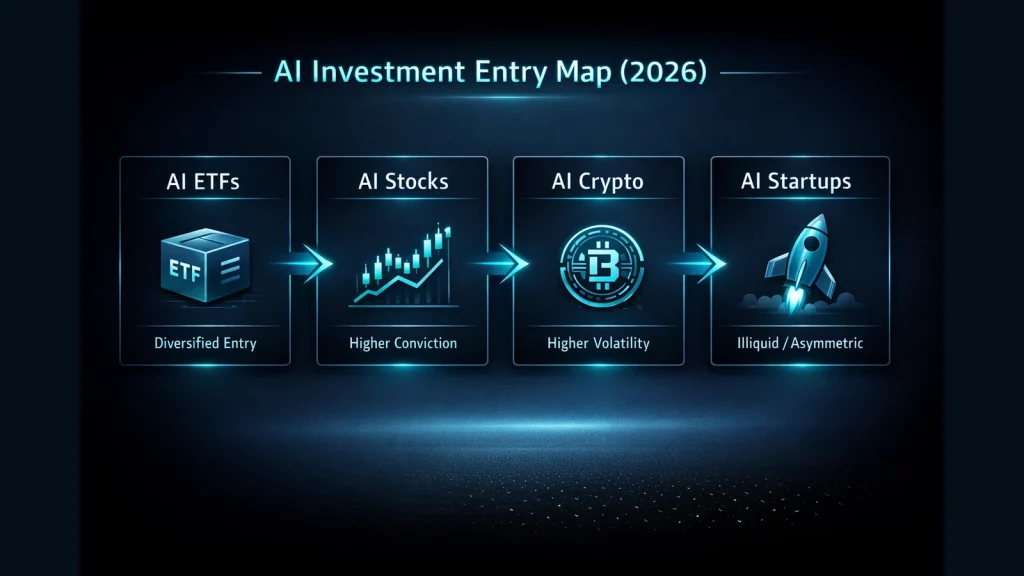
This visual summarizes how investors typically progress from diversified AI ETFs to higher-conviction vehicles such as individual stocks, decentralized AI assets, and private startups, with risk and asymmetry increasing at each stage.
Starting With AI ETFs
For investors who want immediate diversification with minimal complexity, AI-focused ETFs often provide the most stable entry point. They bundle multiple AI-related companies into a single product, reducing single-company concentration risk while maintaining exposure to broader adoption trends.
This approach is particularly useful if you are building your first AI allocation and prefer structured exposure over stock selection. A deeper breakdown of ETF construction and composition can be found in the AI ETFs Hub.
ETFs are not designed to maximize upside in a single winner — they are designed to reduce structural mistakes early in the process.
Moving Into Individual AI Stocks
Investors seeking higher conviction and greater upside sensitivity typically transition into individual companies. This requires more active monitoring, valuation awareness, and comfort with volatility.
Single-stock exposure increases both potential return and risk. Strong performance depends not only on AI adoption, but on execution, margins, competitive positioning, and capital discipline. For a structured framework on how to evaluate companies in this space, explore the AI Stocks Hub.
Stocks reward analysis. They also punish overconfidence.
Adding AI Crypto Exposure (Optional Layer)
AI-related crypto assets represent a higher-volatility segment of the ecosystem. They provide exposure to decentralized AI infrastructure, compute networks, and token-based coordination systems.
This category operates under different valuation mechanics than traditional equities. Volatility is structurally higher, liquidity can shift quickly, and regulatory developments can materially impact outcomes. For those considering this layer, understanding the mechanics first is essential, which is covered in the AI Crypto Investing Hub.
Crypto should be an intentional decision, not an impulsive addition.
Considering AI Startups (Advanced Only)
Private AI startups offer asymmetric upside but require long time horizons and tolerance for illiquidity. Access is limited, failure rates are high, and outcomes are highly dispersed.
This vehicle is typically suitable only for experienced investors who understand capital structure, dilution risk, and venture dynamics. For a structured overview of how private AI investments are evaluated, see the AI Startups Hub.
Startups can amplify returns — but they amplify risk just as quickly.
Build a Starter AI Allocation Framework
Starting to invest in AI is not about finding one standout company or trend. It is about building exposure in a way that supports long-term compounding without creating unnecessary fragility in your portfolio. Allocation shapes results long before individual picks do.
A clear framework forces discipline. It defines how large AI exposure should be, how risk is distributed across different vehicles, and how conviction scales over time. Without that structure, portfolios tend to drift toward whatever narrative is strongest in the moment.

Conservative AI Allocation
A conservative approach treats AI as a defined growth component within a broader diversified portfolio. Exposure is anchored in diversified vehicles such as AI-focused ETFs or established public companies with durable balance sheets and recurring revenue.
The goal is steady participation in long-term AI adoption while limiting single-company risk. Volatility is moderated, liquidity remains high, and exposure increases gradually rather than aggressively. This structure works well for investors integrating AI for the first time or those who prioritize stability over maximum upside.
Balanced AI Allocation
A balanced allocation introduces more selective conviction. Diversified exposure remains present, but individual AI stocks begin to play a larger role. Investors at this level are comfortable analyzing earnings, competitive positioning, and valuation sensitivity.
Limited exposure to higher-volatility segments—such as decentralized AI networks—may be included, but only within clearly defined sizing rules. The defining feature of this structure is controlled concentration: potential returns increase, yet the overall portfolio remains resilient.
High-Conviction AI Strategy
A high-conviction approach concentrates more capital in specific AI companies or sub-sectors where the investor holds strong structural beliefs. Diversification becomes less dominant, and volatility tolerance must be materially higher.
Even here, discipline is essential. Experimental allocations—whether in early-stage startups or token-based AI infrastructure—should remain intentionally limited relative to total investable capital. Strong conviction should increase return potential, not expose the portfolio to disproportionate downside.
The Structural Principle
Across all three approaches, the principle is the same: allocation precedes optimization. Before deciding which AI asset appears most attractive, determine how AI fits within your broader capital structure.
Durable compounding rarely comes from chasing the strongest narrative. It comes from aligning exposure size, risk tolerance, and long-term objectives from the outset.
The next step is practical rather than conceptual: once allocation is defined, how should capital be deployed without increasing timing risk?
How Much of Your Portfolio Should Be Allocated to AI?
Deciding how much of your portfolio to allocate to AI is not about excitement. It is about balance. AI can function as a focused growth theme within a diversified portfolio, or as a larger structural conviction if your time horizon and risk tolerance allow it. The right allocation depends on how AI fits alongside your existing holdings.
For many investors, AI starts as a defined growth sleeve rather than a dominant position. Core capital remains diversified across broader equity exposure, while AI represents a measured allocation designed to capture long-term adoption. This approach allows participation without overexposing the portfolio to a single technological theme.
As conviction increases, AI exposure can become more significant. At that stage, the goal shifts from simple participation to deliberate positioning across different AI segments. Even then, diversification across vehicles and layers remains important. Concentrating entirely in one AI narrative—such as infrastructure or a single high-growth company—can amplify volatility more than expected.
Overexposure often develops unintentionally. Strong performance can cause AI holdings to grow faster than the rest of the portfolio, increasing risk concentration. Periodic review and rebalancing help maintain alignment with your original allocation goals.
In practice, the objective is not to maximize AI exposure, but to position it proportionally. AI should strengthen your portfolio’s growth potential without compromising its resilience.
Once allocation size is defined, the next question becomes practical: how should capital be deployed without increasing timing risk?
Deploying Capital Without Amplifying Timing Risk
Once your allocation structure is defined, the next challenge is execution. Even a well-designed AI allocation can underperform if capital is deployed impulsively. Timing rarely determines long-term success, but poor entry discipline can amplify short-term volatility and distort decision-making.
The first principle is gradual deployment. Instead of allocating the full intended amount at once, many investors phase capital into the market over time. This approach reduces the risk of entering at peak valuation levels and creates psychological flexibility if markets fluctuate shortly after entry.
A staggered entry strategy is particularly relevant in AI-related segments, where sentiment can shift quickly following earnings announcements, regulatory developments, or major technological releases. Phasing exposure allows conviction to build alongside information rather than ahead of it.
The second principle is pre-defined sizing. Decide in advance how large an individual position can become relative to your total AI allocation. Without defined limits, strong short-term performance can lead to unintentional concentration. Position caps help maintain structural balance across different AI layers and vehicles.
Rebalancing discipline is equally important. If AI holdings significantly outperform the rest of the portfolio, periodic trimming may be necessary to restore alignment with original allocation targets. This is not a lack of confidence in AI’s long-term trajectory—it is a recognition that risk accumulates with concentration.
Finally, separate thesis from price movement. A long-term AI investment thesis should be grounded in structural adoption, capital cycles, and competitive durability—not short-term market momentum. If the underlying thesis remains intact, short-term volatility becomes part of the process rather than a trigger for reaction.
Execution does not require perfect timing. It requires consistency. The goal is not to enter at the lowest possible price, but to build exposure in a way that can be maintained through cycles.
The final layer of starting well, therefore, is not about entry mechanics alone—but about avoiding the most common mistakes that derail AI investors early in the process.
Common Mistakes When Starting to Invest in AI
Most underperformance in AI investing does not come from choosing the “wrong” theme. It comes from avoidable structural mistakes made early in the process. Starting correctly is often less about brilliance and more about restraint.
One common error is chasing vertical price moves. Strong rallies create urgency, especially in AI segments where headlines move fast and narratives spread quickly. Entering after rapid appreciation without a clear allocation plan often leads to emotional decision-making when volatility inevitably returns.
Another mistake is confusing AI branding with real exposure. Not every company that mentions artificial intelligence meaningfully benefits from long-term AI adoption. Durable value creation depends on competitive advantage, capital discipline, and integration into real workflows—not marketing language.
Overconcentration is equally frequent. Investors may believe they are diversified across multiple AI names, yet remain exposed to the same underlying driver, such as infrastructure spending or cloud demand. When those drivers slow or valuations reset, correlation increases and drawdowns amplify.
A related risk is neglecting valuation sensitivity. Even structurally strong companies can underperform if expectations are priced too aggressively. AI markets are especially prone to cycles of enthusiasm followed by compression. Discipline in entry and position sizing helps mitigate this risk.
Finally, many investors underestimate how quickly conviction can change under pressure. Without predefined allocation rules, short-term volatility can override long-term strategy. Structure protects against reaction.
Avoiding these mistakes does not guarantee exceptional returns. It does, however, significantly improve the probability of staying invested long enough for structural AI adoption to compound.
Starting well is not about predicting the future. It is about reducing self-inflicted risk from day one.
Conclusion — Start Deliberately, Scale Intentionally
Artificial intelligence will shape capital markets for years to come. Infrastructure will expand, platforms will compete, applications will mature, and new segments will emerge. Some companies will compound for a decade. Others will fade as quickly as they rose.
The difference for investors will not be who reacted fastest to headlines. It will be who structured exposure intelligently from the beginning.
Starting to invest in AI does not require perfect timing, deep technical expertise, or extreme conviction. It requires clarity. Clarity about how much capital to allocate. Clarity about which vehicles align with your risk tolerance. Clarity about how to deploy and rebalance without emotional interference.
AI is not a trade to be won in a single quarter. It is a structural theme that rewards discipline over excitement. When allocation is deliberate, sizing is controlled, and exposure is reviewed consistently, volatility becomes manageable rather than destabilizing.
The objective is not to maximize exposure. It is to build it in a way that can be sustained through cycles.
If you want to deepen your understanding of the broader AI investment landscape, return to What Is AI Investing for the structural framework, or explore the AI Stocks, AI ETFs, AI Crypto Investing, and AI Startups hubs to refine your strategy further.
Starting well is an advantage. Scaling well is the real edge.
Frequently Asked Questions
How do I start investing in AI with a small amount of money?
Starting small is entirely viable. The key is structure rather than size. Many investors begin with diversified vehicles such as AI-focused ETFs or established public companies before moving into more concentrated exposure. The priority is building disciplined allocation habits early rather than attempting to maximize short-term return.
Is it better to invest in AI stocks or AI ETFs as a beginner?
For many beginners, ETFs provide a more stable starting point because they reduce single-company risk and require less active monitoring. Individual AI stocks can offer higher upside, but they also introduce greater volatility. The right choice depends on risk tolerance and willingness to analyze company fundamentals in detail.
How long should I hold AI investments?
AI adoption unfolds over multi-year cycles. Infrastructure expansion, enterprise integration, and regulatory developments do not resolve quickly. Investors who approach AI as a long-term allocation rather than a short-term trade are generally better positioned to navigate volatility without reacting emotionally.
Should I invest in AI crypto when starting out?
AI-related crypto assets introduce higher volatility and different valuation dynamics compared to stocks or ETFs. For beginners, it is typically prudent to establish core exposure in more stable vehicles before adding higher-risk segments. Any allocation to AI crypto should be intentionally sized relative to total capital.
How do I reduce risk when investing in AI?
Risk management begins with allocation sizing. Defining in advance how much of your total portfolio AI represents reduces overexposure. Gradual capital deployment, diversification across vehicles, and periodic rebalancing further help manage downside risk. Reviewing AI Investing Risks can provide additional structural context.
Can AI become too large a part of my portfolio?
Yes. Strong performance can cause AI holdings to grow disproportionately relative to other assets. Regular portfolio review ensures that exposure remains aligned with original targets. Rebalancing is a risk management tool, not a signal of reduced conviction.
Is now a good time to start investing in AI?
AI markets move in cycles. Rather than attempting to identify a perfect entry point, many investors reduce timing risk by deploying capital gradually. A phased approach allows exposure to build while minimizing the impact of short-term volatility.