For most of 2024 and early 2025, human crypto traders had the advantage.
Volatility was high.
Trends were long.
Narratives moved markets.
Skilled discretionary traders could outperform automated systems by reading price action, riding momentum, and reacting to news. Many AI trading bots struggled in this environment, getting whipsawed by fake breakouts and unstable liquidity.
That market no longer exists.
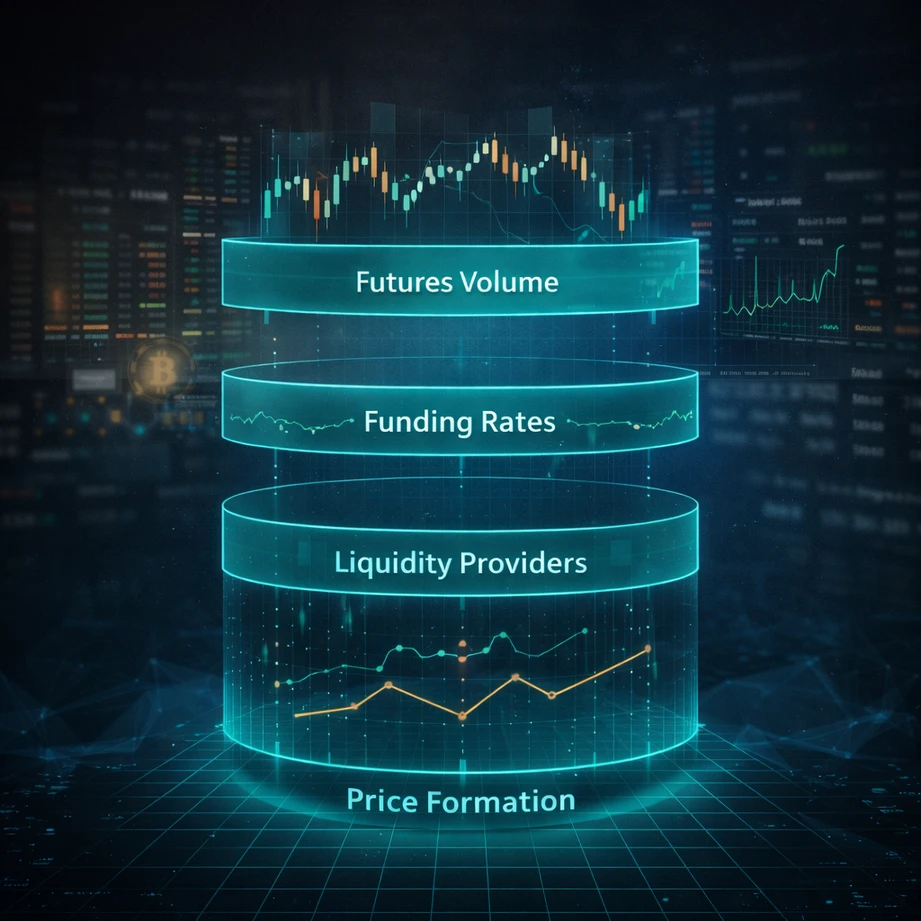
Over the past months, the structure of crypto markets has shifted in a way that strongly favors automated trading systems. Across major exchanges, futures volume has again overtaken spot volume, funding rates now drive short-term price movements, and spreads have tightened as professional liquidity providers have increased their presence.
This has turned crypto into a market where execution matters more than prediction — and that is exactly where AI crypto trading bots now dominate.
Crypto Has Entered a Machine-Driven Market Phase
Modern crypto markets are no longer driven primarily by investors buying and holding coins.
They are driven by derivatives, funding flows, and arbitrage.
Three structural changes now define price formation:
Futures now dominate price discovery
On major exchanges, perpetual futures account for the majority of volume. This means price is constantly being pulled by leverage, liquidations, and funding payments rather than long-term conviction.
Liquidity has become deeper but more fragmented
There is more liquidity than before, but it is spread across many venues, pairs, and contracts. Profitable trades increasingly exist in small, short-lived inefficiencies rather than large directional moves.
Spreads have compressed
Professional market makers and institutional trading firms now actively provide liquidity in crypto. This has reduced bid-ask spreads and made execution quality far more important.
Together, these changes reward traders who can operate inside the microstructure of the market — not those who try to outguess it.
Why Human Traders Lose in This Environment
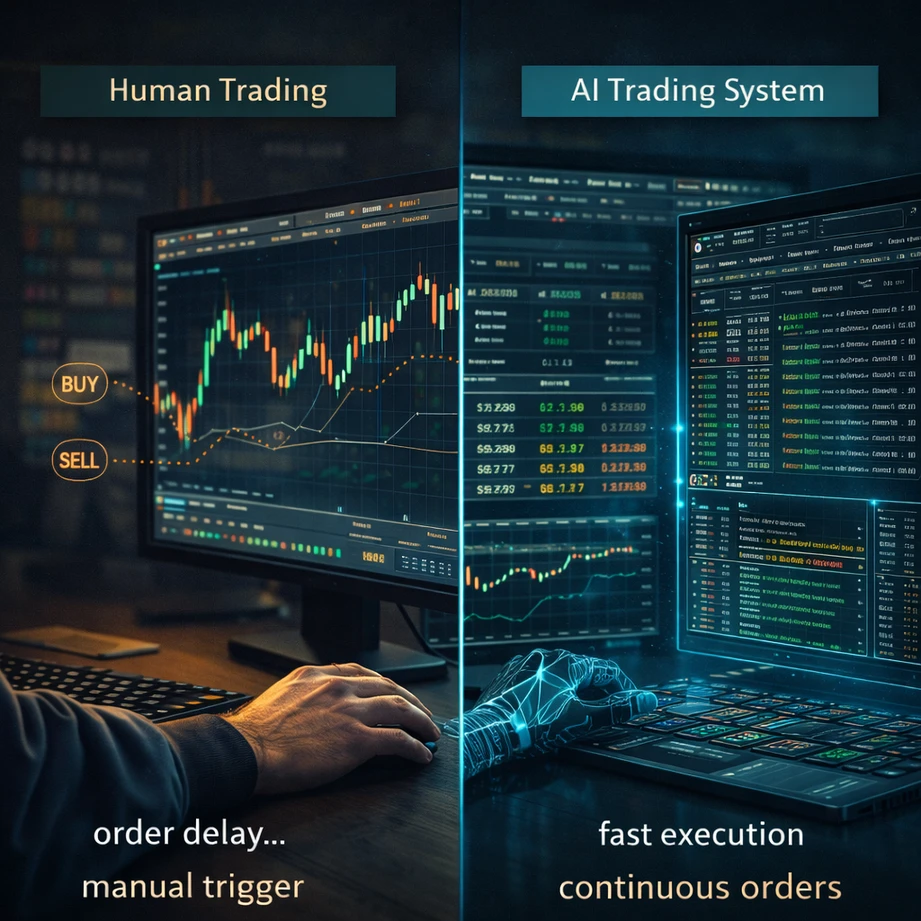
Manual traders are optimized for decision-making, not for execution.
They interpret charts.
They react to narratives.
They place orders one by one.
That worked when markets trended cleanly. It fails when profits come from dozens or hundreds of small trades that depend on timing, fees, and order placement.
In today’s crypto market, the key variables are:
- entry price relative to the order book
- maker vs taker fees
- slippage
- latency
- position sizing across multiple instruments
These are not things humans can manage efficiently.
This is why the performance gap between discretionary trading and automation keeps widening — a dynamic explained in detail in AI crypto trading vs manual trading.
AI crypto trading bots, by contrast, continuously monitor live order books, adjust to funding rates, rebalance positions, and place thousands of optimized orders without emotion, hesitation, or fatigue.
Why AI Trading Systems Thrive Where Humans Struggle
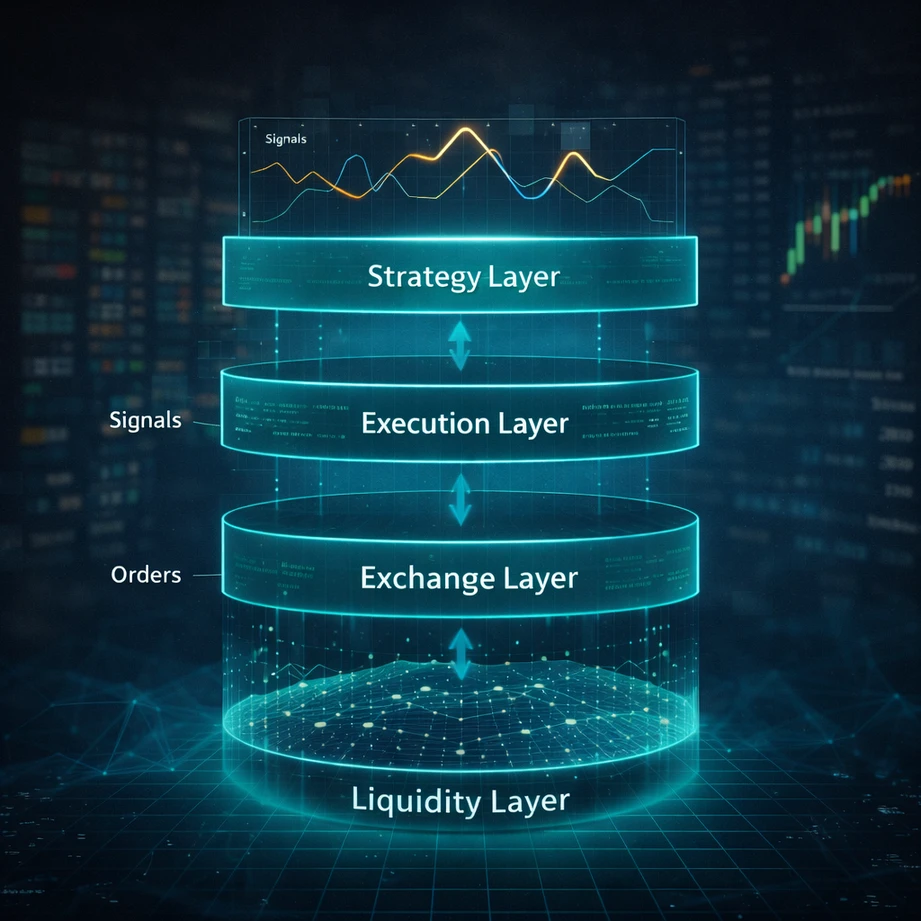
Modern AI trading platforms operate as full trading stacks, not simple bots.
They combine three layers:
Strategy layer
Defines what to trade, when to trade, and how risk is allocated.
Execution layer
Controls how orders are routed, filled, optimized, and adjusted to market conditions.
Exchange layer
Provides liquidity, fees, leverage, and the technical interface to the market.
In earlier crypto cycles, price trends were large enough that strategy alone mattered. Today, with tighter spreads and more competition, the execution layer determines profitability.
Small differences in fees, fill quality, and order timing now decide whether a strategy survives.
This is exactly the environment described in the AI crypto trading bots complete guide (2026), which breaks down how modern bot platforms are designed to exploit these micro-efficiencies at scale.
Why This Shift Is Happening Now
This transition is not theoretical — it is driven by real changes in crypto infrastructure.
Over the past year:
- exchanges have upgraded their trading engines and APIs
- futures markets have grown relative to spot
- market-making firms have increased liquidity provision
- fee competition has intensified
These changes have made crypto more efficient and more automated — just like equities and FX before it.
And in every efficient market in history, automated trading eventually dominates.
What This Means for AI Crypto Trading Bots
This new market regime strongly favors strategies such as:
- grid trading
- arbitrage
- market-making
- funding-rate strategies
- DCA and portfolio rebalancing
- futures-based systems
These strategies do not depend on predicting the next big move. They depend on executing thousands of small, statistically favorable trades inside a highly liquid, low-spread environment.
That is why AI crypto trading platforms are becoming more relevant again — not because traders have changed, but because the market has.
How Traders Should Adapt to This New Regime
Traders who want to remain competitive need to think less like speculators and more like system designers.
In practical terms, that means:
- using platforms that support futures and advanced order types
- prioritizing low-fee, high-liquidity exchanges
- focusing on execution quality rather than chart patterns
- deploying bots for grid, arbitrage, or rebalancing strategies
- avoiding emotional, manual over-trading
AI trading systems do not eliminate market risk — losses are always possible — but they dramatically reduce execution errors and emotional mistakes, which are now the biggest disadvantage for human traders.
If you want to operate inside this new machine-driven market, the fastest way to get started is to explore the best AI crypto trading bots of 2026, where the leading platforms and infrastructures are compared in detail.
A Structural Shift, Not a Temporary Trend
Crypto is entering the same phase that stocks and foreign exchange went through years ago: a transition from speculative retail trading to machine-driven market making.
In that environment, human intuition matters less.
Infrastructure, automation, and cost efficiency matter more.
AI crypto trading bots are not winning because they are smarter.
They are winning because the market is now built for machines.
And that shift is only beginning.
Market Data & Sources
This analysis is based on a combination of live market observation and publicly available trading infrastructure data, including:
- Futures volume, funding rates, and order book data from major crypto exchanges such as Binance, OKX, HTX, and Bybit
- Public API documentation, fee schedules, and execution models from Cryptohopper, 3Commas, and Bitsgap
- Exchange matching engine and liquidity provider disclosures
- Industry research on crypto market microstructure, algorithmic trading, and derivatives-driven price discovery
- Ongoing monitoring of real-time crypto futures markets and automated trading systems
This ensures the conclusions reflect how modern crypto markets actually operate — not theoretical models.
Update August 15, 2026: This article was refreshed to improve internal context and discovery signals.