Disclosure: We may earn a commission if you sign up through links on this page — at no extra cost to you. All opinions are independent and based on our evaluation framework.
Introduction — Why Exchanges Matter More Than Bots
Most people think AI trading performance depends on the bot.
In reality, it depends on where that bot executes.
Two traders can run the exact same AI strategy on the same platform — and get completely different results — simply because their bots are connected to different exchanges.
That is because modern AI trading is not just about signals or predictions.
It is about execution.
In professional AI trading systems, exchanges form the execution layer — the infrastructure where every decision becomes a real trade. This layer determines:
- how fast orders are filled
- how much slippage occurs
- how much you pay in fees
- and whether positions can be protected when markets become volatile
A sophisticated AI model running on slow, expensive, or unstable exchange infrastructure will lose.
A simpler strategy running on a fast, liquid, low-fee exchange can outperform it.
By 2026, crypto markets are dominated by:
- automated market makers
- institutional algorithms
- high-frequency trading systems
- and AI-driven bots
These participants operate on razor-thin margins. Small differences in latency, liquidity, or fee structure decide whether a strategy is profitable.
That is why professional AI traders choose their exchanges first — and their bots second.
The goal of this guide is not to promote a single platform.
It is to show you which exchanges actually allow AI trading systems and execution engines — including professional tools like Hummingbot — to perform in the real world.
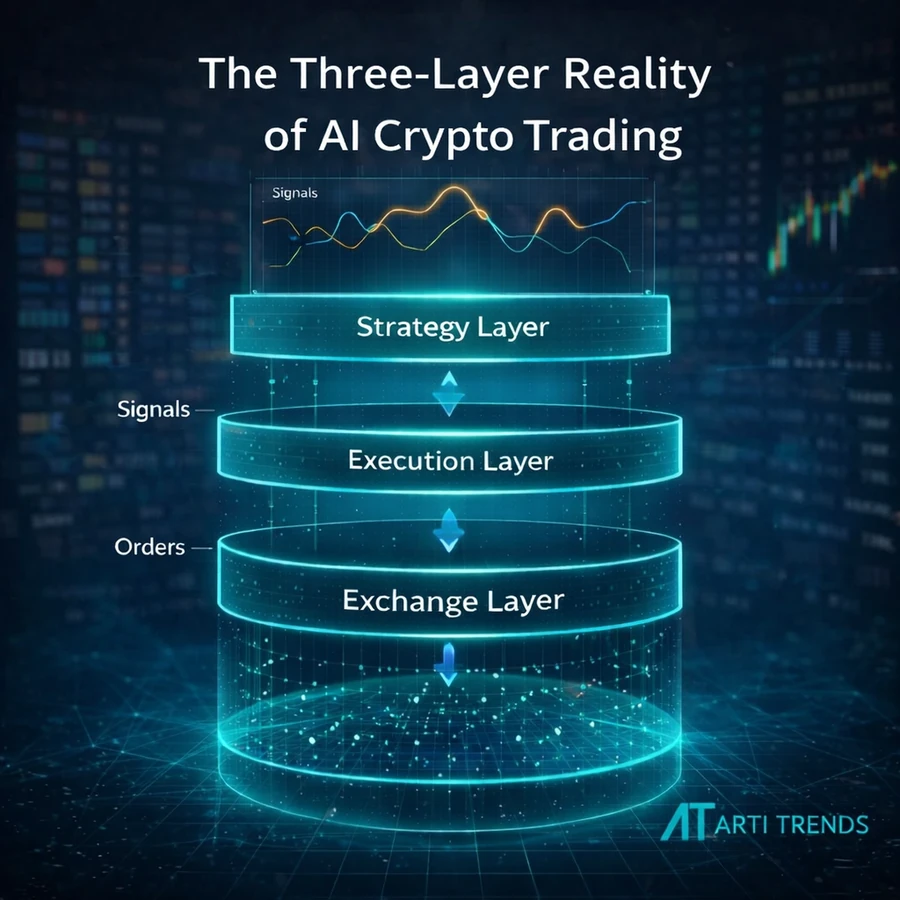
The Three-Layer AI Crypto Trading Stack
Professional AI crypto trading systems are built on three distinct layers.
Understanding these layers explains why exchanges matter more than most traders realize.
1. Strategy Layer
This is where trading logic is defined.
Indicators, signals, portfolio rules, and risk models live in the strategy layer.
Most retail-focused AI trading platforms operate here, offering visual strategy builders and preconfigured bots.
This layer decides what to trade and when — but not how well trades are executed.
2. Execution Layer
This is where strategies become real orders.
Execution engines handle order routing, latency, slippage, fee optimization, and fill quality.
Professional traders focus heavily on this layer because execution efficiency determines whether a strategy survives in real markets.
Open-source frameworks and professional trading infrastructure operate primarily at this level.
3. Exchange Layer
This is where crypto markets actually exist.
Order books, liquidity depth, matching engines, funding rates, and APIs all belong to the exchange layer.
It determines whether execution is fast, cheap, and reliable — or slow, expensive, and unstable.
No AI trading system can outperform the limits of the exchange it runs on.
Most retail traders focus only on the strategy layer.
Professional AI traders design and optimize all three.
This guide focuses on the exchange layer — the foundation that ultimately determines AI trading performance.
What Makes an Exchange AI-Ready?
Not every crypto exchange can support serious AI trading.
Most platforms are built for human traders: charts, buttons, and manual order placement.
AI systems require something very different.
They need an exchange that behaves like a financial execution engine.
These are the five properties that matter.
1. High-Performance APIs
AI bots do not trade through websites.
They trade through APIs.
The quality of an exchange’s API determines:
- how fast orders are sent
- how quickly fills are confirmed
- how reliably market data is received
Unstable or rate-limited APIs lead to:
- missed entries
- poor fills
- and broken strategies
This is why professional traders avoid exchanges with throttled or unreliable endpoints.
2. Deep, Continuous Liquidity
AI strategies depend on:
- large order books
- tight bid-ask spreads
- consistent volume
When liquidity is thin:
- prices move when orders hit the market
- slippage increases
- profitability disappears
High-liquidity exchanges allow AI systems to trade size without distorting the market.
3. Low and Predictable Fee Structure
AI bots trade frequently.
Even small fees compound rapidly.
Execution-grade exchanges offer:
- low maker and taker fees
- volume-based discounts
- transparent funding rates
This allows profitable strategies to stay profitable as trading volume scales.
4. Spot and Derivatives Markets
Professional AI trading uses multiple instruments:
- spot markets for accumulation
- futures for hedging, shorting, and leverage
Exchanges that only support spot trading limit what an AI system can do.
5. Reliability Under Market Stress
AI trading is most active when markets become chaotic.
During:
- crashes
- breakouts
- and liquidation cascades
the exchange must stay online.
If APIs fail or order matching slows down, bots cannot reduce risk or exit positions.
The best execution venues remain stable precisely when volatility spikes.
How AI Bots Interact With Exchanges
AI trading bots do not “trade” the way humans do.
They operate as automated execution engines connected directly to exchange infrastructure. Every trading decision becomes a series of API calls that route orders into live order books.
This is where small technical differences turn into large financial outcomes.
Order Routing
When an AI strategy decides to trade, the execution engine sends:
- limit orders
- market orders
- or post-only maker orders
to the exchange API.
High-quality exchanges allow bots to:
- choose optimal order types
- split large orders
- avoid unnecessary taker fees
- and provide liquidity as a maker
Poor exchanges force bots into expensive or inefficient execution, destroying edge.
Latency and Slippage
Latency is the time between sending an order and receiving a fill.
In fast-moving markets, even milliseconds matter.
On low-latency exchanges:
- bots get better prices
- arbitrage becomes viable
- trend entries are cleaner
On slow exchanges:
- prices move before orders fill
- slippage eats into profits
- and risk increases
This is why professional execution engines — including open-source frameworks like Hummingbot — are designed to work only with exchanges that provide stable, fast APIs.
Fees, Funding, and Execution Cost
For both spot and futures trading, AI bots must account for:
- maker vs taker fees
- funding rates
- liquidation mechanics
Different exchanges calculate and apply these costs differently. The same strategy can be profitable on OKX and unprofitable on another platform purely because of fee structure.
Execution engines are built to optimize for these variables, but only when the exchange supports them.
Risk Handling Under Volatility
When markets become volatile, execution quality becomes risk management.
Bots must be able to:
- cancel and replace orders
- reduce exposure
- hedge positions
- and exit losing trades
If APIs freeze or order matching slows down, risk controls fail.
This is why serious AI traders treat exchange reliability as part of their risk model.
Global Crypto Exchanges Where AI Trading Systems Actually Perform (2026)
Based on execution quality, API performance, fees, and real-world bot usage
These exchanges are not selected based on popularity or marketing.
They are used because their infrastructure allows AI trading systems to execute efficiently under real market conditions.
Professional execution venues combine:
- deep and continuous liquidity
- low and predictable fee structures
- high-performance, stable APIs
- clear tolerance for automated and algorithmic trading
In professional AI trading, exchanges are chosen for performance, not brand recognition.
HTX
HTX is one of the most widely used exchanges for AI-driven trading and professional execution engines.
It stands out for its combination of very low trading fees, deep spot and futures liquidity, and high-performance APIs designed to support automated trading at scale.
HTX is particularly suitable for:
- grid and market-making bots
- arbitrage strategies
- high-frequency execution
- professional frameworks such as Hummingbot
Because AI systems trade frequently, even small fee advantages compound into a meaningful edge over time. For many professional market-making and arbitrage systems, HTX functions as a cost-optimized execution venue rather than a retail-focused exchange.
Traders who want to deploy automated or AI-driven strategies can access HTX as an execution venue here.
For a deeper look at how AI trading systems and execution engines operate on HTX, see AI Trading Bots on HTX.
OKX
OKX is one of the most technically advanced crypto exchanges used in professional AI trading.
It offers deep liquidity across spot and derivatives, fast and stable APIs, and sophisticated margin and risk systems designed for high-volume automated execution.
OKX is commonly used by:
- institutional trading desks
- advanced AI bot operators
- traders running multi-strategy and futures-based systems
Its margin mechanics, funding rate structure, and API reliability under load make OKX especially effective for futures-driven AI trading, trend-following systems, and market-neutral execution.
Traders looking for a futures-capable exchange with strong API support can connect their AI trading systems to OKX here.
Binance
Binance remains the largest crypto exchange by global liquidity.
Its primary strengths are massive order books, tight spreads, a mature API ecosystem, and unmatched depth across major trading pairs.
Binance is frequently used for:
- spot accumulation strategies
- large-scale grid trading
- low-slippage execution on high-volume markets
For many AI trading systems, Binance functions primarily as a liquidity anchor, providing execution stability rather than advanced execution customization.
Access to Binance products and automated trading features varies by region and regulatory jurisdiction.
Bybit
Bybit is optimized for derivatives-focused execution.
It has built its reputation on fast order matching, competitive futures fees, and infrastructure designed around leveraged trading.
Bybit is widely used for:
- momentum-based AI strategies
- futures trading bots
- execution-driven automated systems
Its derivatives-first design and API performance make Bybit particularly suitable for futures-centric and momentum-driven AI trading systems.
Traders running leveraged or futures-based AI strategies can execute directly on Bybit here.
KuCoin
KuCoin is best known for its strong altcoin liquidity, wide token selection, and highly active trading communities.
It is often used for:
- AI grid bots
- altcoin arbitrage strategies
- high-volatility trading systems
The trade-off is higher operational and counterparty risk compared to larger, more regulated exchanges. As a result, KuCoin is typically used by AI traders seeking exposure to volatile or less liquid markets rather than as a primary execution venue.
Traders targeting high-volatility or niche markets can access KuCoin for automated trading here.
For European users, access to KuCoin’s global platform is currently restricted due to regulatory changes. KuCoin has announced that a dedicated EU platform is in preparation, operating as a separate legal entity and aligned with MiCA requirements.
At the time of writing, KuCoin EU is accepting registrations via a public waiting list, allowing European traders to receive updates and early access once the platform launches.
Availability & Regulation for European Traders
AI trading does not exist in a regulatory vacuum.
In Europe, crypto trading and automated execution are shaped by a combination of MiCA regulation, national financial authorities, and consumer protection rules. These frameworks directly affect how exchanges operate and which features are available to automated trading systems.
As a result, some global exchanges may:
- restrict leveraged or derivatives products
- limit API-based bot access
- or operate through offshore entities with varying compliance standards
None of this makes AI trading illegal. It does, however, mean that access, risk, and execution conditions vary significantly by platform and jurisdiction.
What This Means for EU Users
European traders should be aware that:
- futures and leveraged products may be restricted or unavailable
- certain exchanges limit or modify API-based automation
- some services operate outside the EU regulatory perimeter
Responsibility for regulatory compliance always lies with the user. For AI trading systems, these constraints are not theoretical — they directly affect whether strategies can be deployed consistently and at scale.
The Safer EU Approach to AI Trading
For European users, AI crypto trading is shaped by regulation just as much as by execution quality.
Within the EU, the most reliable foundations for AI-driven trading systems are exchanges that combine clear legal structures, strong KYC and compliance frameworks, and consistent API access suitable for automated execution. Regulatory continuity matters: even a well-designed AI system cannot operate effectively if access conditions change unexpectedly or automation features are restricted.
In practice, EU-based AI traders most often rely on platforms such as OKX, Kraken, and Coinbase Advanced. These exchanges operate within established European regulatory frameworks and provide dependable access to spot markets alongside API-based automation suitable for professional and semi-professional trading systems. While they may not always match the absolute liquidity depth of the largest global venues, they offer a high degree of operational consistency for EU-based traders.
Global platforms such as Binance remain important liquidity benchmarks in international crypto markets and are widely used by AI trading systems outside the EU. However, access to Binance products, derivatives, and automated trading features varies significantly by country and regulatory jurisdiction. As a result, Binance provides less consistent access for EU-based automated trading systems compared to exchanges with a more stable European operating structure.
Within this regulatory landscape, some European traders prioritize compliance and access stability over execution intensity. A separate role within the European ecosystem is therefore played by Bitvavo. As a Netherlands-based exchange, Bitvavo offers strong regulatory alignment, reliable fiat on- and off-ramps, and a straightforward spot-trading environment. It is commonly used for compliant asset exposure and long-term accumulation. While Bitvavo provides API access suitable for basic automation, it lacks the derivatives infrastructure, liquidity depth, and execution flexibility required by more advanced AI trading systems. As such, it functions best as a compliance-first spot venue, rather than a primary execution engine for professional AI bots.
For European AI traders, choosing an exchange is therefore not only a question of fees or liquidity, but of regulatory continuity, execution reliability, and automation access. In AI-driven markets, consistent access often matters as much as raw performance when deploying trading systems at scale.
Why This Matters for Bots
Even the best AI execution engine cannot trade effectively if:
- API access is restricted or inconsistent
- futures or derivatives trading is disabled
- liquidity is fragmented across markets
Choosing the right exchange is therefore as much a regulatory decision as it is a technical one. For AI-driven trading systems, execution reliability and access conditions ultimately define the limits of performance, regardless of how advanced the underlying strategy or model may be.
Fee Comparison — Why This Decides Your Profit
AI trading strategies live on small statistical edges.
When you trade hundreds or thousands of times per month, fees become one of the largest risk factors in your entire system.
Two traders running the same AI strategy can end up with completely different results simply because they pay different fees on different exchanges.
This is why professional AI traders obsess over execution cost.
Maker vs Taker Fees
Most exchanges charge:
- taker fees when you remove liquidity
- maker fees when you provide liquidity
AI systems that use:
- limit orders
- grid strategies
- or market-making
can operate primarily as makers — dramatically reducing execution cost.
Execution-grade exchanges such as HTX and OKX are popular among professional bots because they offer very competitive maker pricing for automated trading.
Futures Funding Rates
If you trade futures, you also pay or receive funding fees every few hours.
Some exchanges offer:
- lower funding
- better transparency
- more stable rate mechanics
Over time, this difference can decide whether a strategy is profitable.
Hidden Execution Costs
Beyond headline fees, exchanges also impose:
- liquidation fees
- withdrawal fees
- spread costs
- and execution slippage
AI systems amplify these hidden costs because they trade frequently.
This is why comparing exchanges only on advertised fees is misleading.
A full breakdown of how these costs interact in real AI trading systems is available in AI Trading Bot Fees Comparison.
Which Exchange Fits Which AI Strategy?
Not every exchange is suitable for every AI trading style.
Matching your strategy to the right execution venue is one of the fastest ways to improve performance — without changing your bot.
Grid Trading & Market Making
These strategies require:
- deep order books
- low maker fees
- fast, stable APIs
Best suited exchanges:
- HTX
- OKX
- Binance
These platforms allow bots and execution engines to place large numbers of small limit orders efficiently.
AI-Driven DCA & Spot Accumulation
These strategies need:
- strong spot liquidity
- low withdrawal costs
- high operational stability
Best suited exchanges:
- Binance
- OKX
- Kraken
- Coinbase Advanced
These venues are ideal for long-term accumulation bots.
Trend-Following & Futures Trading
These strategies depend on:
- fast execution
- deep futures liquidity
- reliable liquidation engines
Best suited exchanges:
- OKX
- Bybit
- HTX
These platforms are widely used by momentum-based AI trading systems.
Arbitrage & High-Frequency Bots
These require:
- ultra-fast APIs
- multiple active markets
- minimal latency
Best suited exchanges:
- HTX
- OKX
- KuCoin
These exchanges provide the execution infrastructure arbitrage engines such as Hummingbot rely on.
Choosing the right exchange for your strategy often matters more than choosing the strategy itself.
Exchange Risk & Security
Even the best AI trading strategy fails if the exchange itself is unsafe.
When you connect a trading bot or execution engine to an exchange, you are trusting that platform with:
- your orders
- your market data
- and indirect control over your capital
Professional traders always evaluate exchange risk as part of their trading system.
Custody & Withdrawal Control
Some exchanges:
- hold customer assets in centralized wallets
- impose withdrawal limits
- or delay transfers during market stress
This creates counterparty risk.
Execution-focused traders prefer exchanges that:
- allow fast withdrawals
- do not freeze accounts without cause
- and separate custody from trading access
API Security
AI bots trade using API keys.
Secure exchanges allow:
- trade-only permissions
- IP whitelisting
- withdrawal blocking
These controls prevent bots or third-party platforms from moving funds even if credentials are compromised.
Platform Stability
During crashes or volatility spikes, weak exchanges:
- go offline
- stop matching orders
- or delay liquidations
This is when most algorithmic losses occur.
The best execution venues stay operational when markets become chaotic.
Regulatory Standing
Exchanges with:
- clear legal entities
- compliance programs
- and regulatory oversight
are less likely to face:
- sudden shutdowns
- frozen accounts
- or legal action
For AI traders, regulatory stability is part of risk management.
Conclusion — Where Serious AI Traders Actually Trade
AI trading is not about finding the smartest bot.
It is about placing that bot on the right execution infrastructure.
In real markets, AI trading performance is determined by factors that sit below the strategy layer: API stability, liquidity depth, fee structure, and exchange reliability during periods of volatility. When these foundations fail, even the most advanced algorithm loses its edge.
The difference between profit and loss is therefore rarely the model itself — it is where that model runs.
For global AI traders, execution-focused venues such as HTX, OKX, Bybit, and KuCoin provide the infrastructure that professional trading systems require. These exchanges are chosen for performance, not brand recognition.
Platforms like Binance continue to function as global liquidity benchmarks, particularly for large spot markets. However, access to advanced products and automated trading features varies by region and regulatory jurisdiction, making execution consistency uneven for some traders.
For European AI traders, consistent access and regulatory continuity matter as much as raw execution speed. Exchanges with stable EU operating structures and reliable API support offer the most dependable foundation for deploying automated strategies. By contrast, platforms such as Bitvavo serve a different purpose — providing compliance-first spot access and fiat connectivity rather than high-intensity AI execution.
The core principle is simple:
Professional AI traders choose their exchange first — and their bot second.
If you want to see how leading AI trading platforms connect to these exchanges in practice, the AI Trading Bots Hub maps the full ecosystem from strategy design to execution. And if you are comparing real platforms based on execution quality, risk controls, and fees, the Best AI Crypto Trading Bots of 2026 guide shows which systems actually turn these exchanges into working AI trading engines.
In AI-driven markets
Where you trade is just as important as how you trade.
Explore the AI Trading Bots Hub
If you want to go deeper into how AI trading systems actually perform on real exchanges, these guides map the full execution stack — from strategy design to professional-grade order routing, fees, and risk control.
Learn the Foundations
AI Crypto Trading Bots: Complete Guide — The full framework behind AI-driven crypto trading, from strategies to execution
AI Crypto Trading Strategies (2026) — How trend-following, arbitrage, DCA, and portfolio bots are used in real markets
AI Crypto Trading Risks & Regulation — Legal, technical, and market risks every AI trader should understand
Choose the Right Execution & Platforms
Best AI Crypto Trading Bots of 2026 — Independent comparison of Cryptohopper, Bitsgap, 3Commas, and other leading AI trading platforms
AI Trading Bots on HTX — How low-fee, high-liquidity execution improves AI bot profitability
Specialized AI Trading Systems
AI Crypto Arbitrage Bots — How execution engines exploit price differences across exchanges
AI Futures Trading Bots — How AI systems trade leverage, trends, and perpetual contracts
AI Portfolio Trading Bots — How long-term AI systems manage diversified crypto portfolios
Together, these pages form the AI Trading Bots Hub inside Arti-Trends — designed to help you move from understanding AI-powered trading to executing real strategies on professional-grade crypto exchanges.