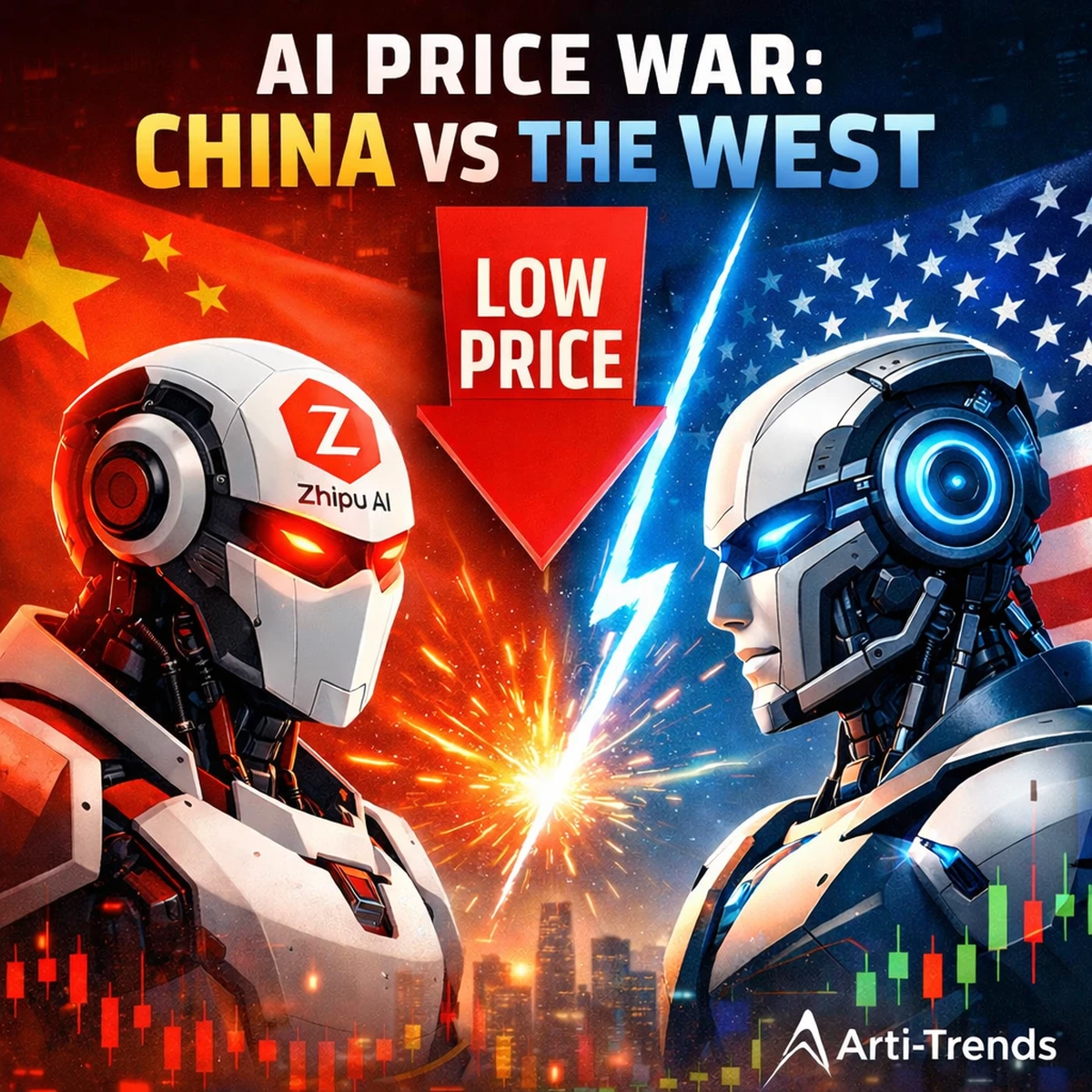
The next phase of AI competition may not be decided by smarter models — but by cheaper ones.
According to reporting by Bloomberg, Zhipu AI, one of China’s longest-standing OpenAI rivals, has warned that aggressive pricing will increasingly shape the global AI market. In other words, the race for AI dominance is moving from innovation to economics.
The warning itself is simple.
The consequences are not.
Zhipu is not describing a temporary price cut, but the start of AI’s margin compression phase — a shift where cost, scale, and efficiency begin to matter as much as raw model performance across the current state of the AI market.
Key Takeaways
- Chinese AI firms are preparing for sustained price competition, not temporary discounts.
- Pricing is becoming a strategic lever as model performance converges.
- Western AI companies face increasing pressure on margins and positioning.
- Open-source and hybrid deployments gain negotiating power.
- AI adoption accelerates — but profitability becomes harder to defend.
Why Pricing Is Becoming the Battleground
As AI models converge in quality, price becomes the differentiator.
For many buyers, the central question is no longer:
“Which model is the smartest?”
But:
“Which model is reliable, compliant, and affordable at scale?”
Zhipu’s comments reflect a maturing market reality. Lower inference and training costs reduce friction in deployment — especially for enterprises operating under strict budget constraints.
This is what margin compression looks like in practice:
innovation continues, but economic efficiency becomes the constraint.
China’s Structural Advantage in Cost Competition
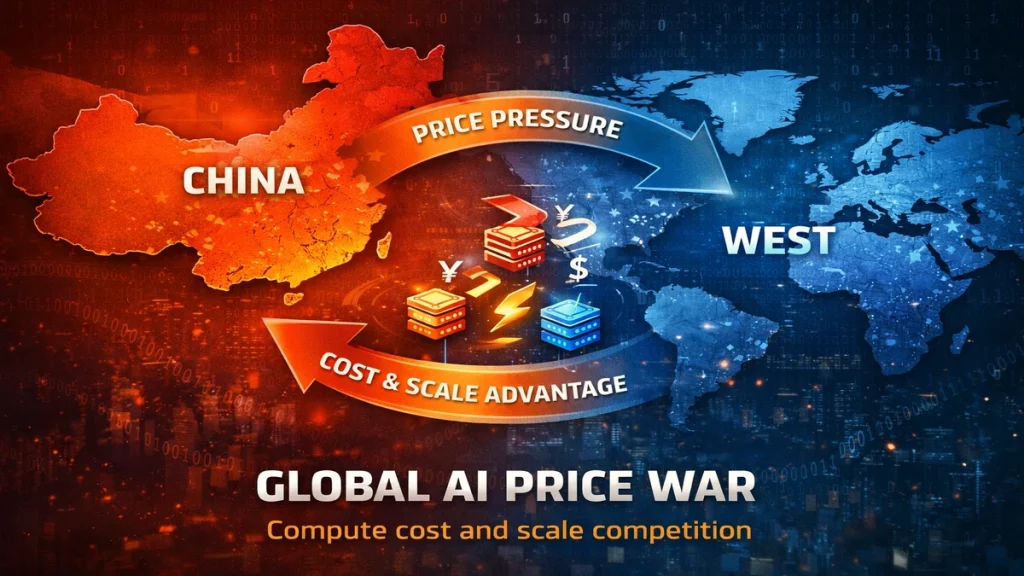
Chinese AI companies operate under a different economic logic than many Western peers.
They often benefit from:
- closer integration with domestic hardware supply chains
- large-scale infrastructure investment
- strategic tolerance for lower short-term profitability
This enables prolonged price pressure that is difficult to counter without scale.
In AI’s margin compression phase, cost structure becomes strategy.
What an AI Price War Means for Different Buyers
The effects of sustained price competition are uneven.
For startups:
Lower model costs reduce barriers to experimentation, but make differentiation harder as competitors gain access to similar capabilities.
For enterprises:
Pricing pressure improves negotiating leverage, but increases the importance of vendor stability, compliance, and long-term support — especially across the AI investment landscape.
For developers:
Cheap inference enables more ambitious applications, while pushing teams to optimize efficiency rather than model novelty.
For open-source teams:
Falling proprietary prices paradoxically strengthen open-source adoption by legitimizing hybrid and self-hosted deployments.
What This Means for Western AI Players
Western AI companies now face strategic trade-offs.
They can:
- cut prices to defend market share
- preserve margins and focus on premium segments
- differentiate through compliance, safety, and integration depth
Companies such as OpenAI and infrastructure providers like Nvidia occupy different positions in the stack — but neither is insulated from pricing pressure.
Margin compression does not eliminate innovation.
It reshapes where value is captured.
Beyond Cost: Why Price Alone Won’t Decide Winners
Price competition matters — but it is not decisive on its own.
Western enterprises must still weigh:
- regulatory alignment
- data protection
- geopolitical exposure
- long-term vendor stability
These AI regulation and compliance requirements give Western AI providers some insulation against low-cost competition — but not immunity.
Pricing pressure forces even premium vendors to justify their value more clearly.
Why This Matters Going Into 2026
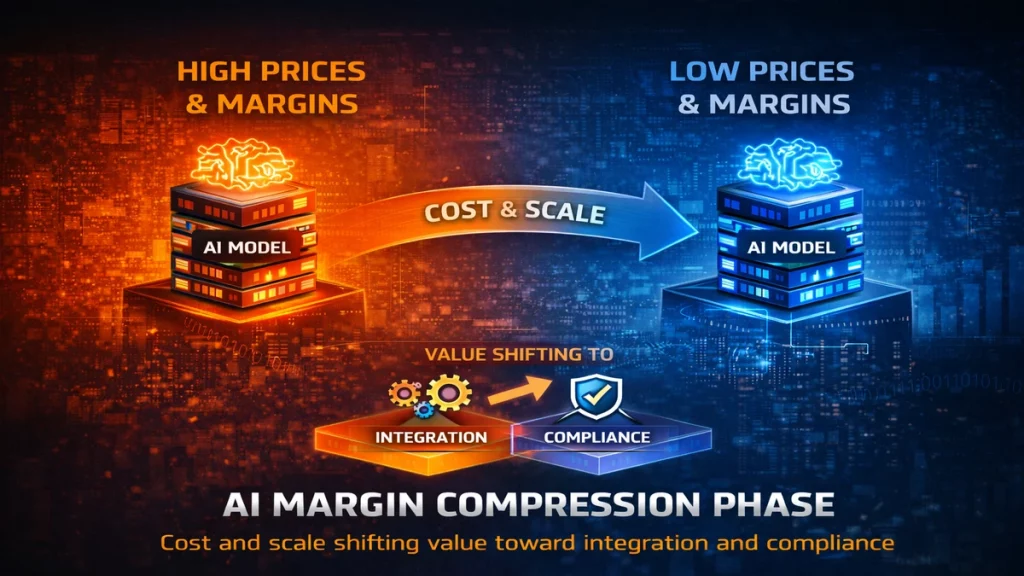
Zhipu’s warning suggests the AI market is entering a more mature phase.
The next wave of adoption will be shaped less by novelty and more by:
- total cost of ownership
- scalability under budget constraints
- alignment with regulation and infrastructure
An AI price war does not slow progress.
It signals that AI is becoming normalised economic infrastructure.
In AI’s margin compression phase, success will belong not to the cheapest model — but to the companies that balance cost, trust, and scale most effectively.
Sources
This article draws on reporting by Bloomberg and public statements from Chinese AI developers, with analysis focused on pricing dynamics, global competition, and enterprise adoption.
Update September 6, 2026: This article was refreshed to improve internal context and discovery signals.