Multimodal AI is no longer experimental.
With the release of Google’s Gemini 3, it is becoming the default design constraint for how AI-powered products are built.
According to reporting by Financial Times, Gemini 3 processes text, images, and video within a single reasoning framework — treating different input types not as extensions, but as native context.
That distinction is subtle, but consequential.
It reshapes how what artificial intelligence is actually translates into real software: shifting AI from isolated tools toward systems that understand intent, context, and interaction as a unified whole.
Notably, Google avoids framing Gemini 3 as a leap toward abstract AGI.
Instead, it presents the model as something more pragmatic — a production-ready AI engine designed to live quietly inside real products, not stand apart from them.
Key Takeaways
- Gemini 3 reasons across text, images, and video simultaneously within one model.
- Google positions multimodality as a product capability, not a demo feature.
- AI interfaces shift from prompt-driven to interaction-driven design.
- Competitive advantage moves from raw model intelligence to execution at scale.
- Gemini 3 reflects a more grounded, product-first path toward advanced AI.
Multimodal-by-Default AI: What Actually Changed
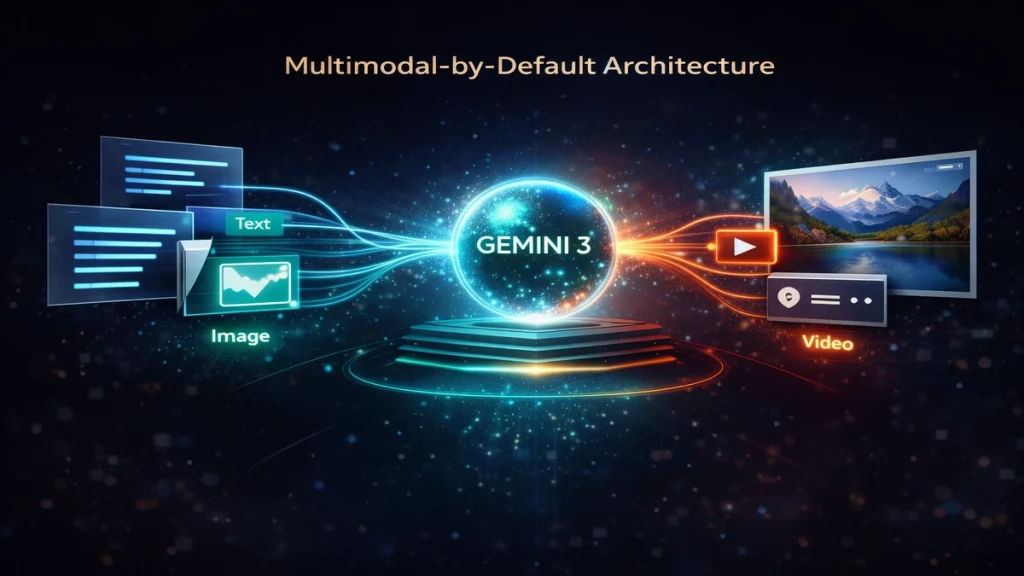
Earlier AI systems treated multimodality as an extension: a text model supplemented by separate vision or video modules.
Gemini 3 takes a fundamentally different approach — what can be described as multimodal-by-default AI.
In practice, this means:
- text, image, and video are processed in a shared reasoning space
- visual context is not translated into text first
- the model does not switch modes — it reasons continuously across inputs
This shift aligns with the broader evolution of multimodal AI, where understanding emerges from combined signals rather than isolated channels.
The result is not just better comprehension, but more coherent interaction — AI systems that respond to what users show, explain, and adjust in real time.
What Gemini 3 Enables That Was Hard Before
This architectural change unlocks product patterns that were previously fragile or impractical.
For example:
- Educational applications that explain diagrams while visually highlighting relevant sections during explanation.
- Productivity tools that reason over screenshots, documents, and chat context simultaneously, without forcing users into rigid workflows.
- Creative software where users sketch, describe, and refine ideas in one continuous interaction loop.
In these scenarios, AI is no longer a separate assistant.
It becomes a co-present layer inside the interface itself.
From Chatbots to Product Engines

What stands out in Google’s messaging around Gemini 3 is what it deliberately avoids.
There is little emphasis on:
- conversational novelty
- personality
- open-ended generality
Instead, the focus is on integration.
Gemini 3 is designed to sit quietly inside:
- productivity suites
- education platforms
- creative applications
- developer environments
AI becomes infrastructure — not a destination users open.
Google Versus the Competition: Where the Advantage Really Lies
Gemini 3 also clarifies how Google sees the competitive landscape.
While OpenAI continues to push model intelligence and Nvidia dominates AI infrastructure, Google’s core advantage lies elsewhere:
fast feedback loops through real products.
With Gemini embedded across Search, Workspace, Android, and developer tools, Google can:
- deploy multimodal AI at massive scale
- observe real-world usage patterns
- refine models through continuous product feedback
This ecosystem-level execution may prove more defensible than marginal gains in benchmark performance.
A More Realistic Trajectory Toward Advanced AI
One of the subtler signals in the Gemini 3 launch is Google’s tone.
Rather than accelerating AGI narratives, the company emphasizes:
- reliability
- controllability
- integration readiness
This reflects a broader industry shift toward incremental intelligence embedded into systems people already use, a direction closely aligned with the future of AI systems as they mature.
Gemini 3 embodies that philosophy.
Why Gemini 3 Matters Going Into 2026
Gemini 3 suggests that the next phase of AI competition will not be decided by who builds the smartest standalone model.
It will be decided by:
- how seamlessly AI integrates into products
- how naturally users can interact across modalities
- how quickly systems improve through real-world feedback
For builders, designers, and businesses, the implication is clear:
AI capability is converging — product execution is not.
Gemini 3 is Google’s bet that multimodal-by-default AI, deeply embedded into products, is how advanced AI actually reaches users.
Sources
This article draws on reporting by Financial Times and publicly available information surrounding Google’s Gemini 3 release, with analysis focused on multimodal architecture, product integration, and AI system design.