Generative AI is everywhere — it writes your emails, designs your images, brainstorms ideas, summarizes research, and even creates videos. But despite how familiar these tools feel, the underlying technology remains unclear for most people.
This guide breaks that mystery open.
If you’re new to AI, start with our cornerstone What Is Artificial Intelligence? to get a complete foundation. Then come back here to understand the creative side of modern AI systems.
You’ll learn what generative AI really is, how it works, why it’s transforming entire industries, and how to use it confidently in 2026 and beyond — with clarity over hype.
What Is Generative AI? (Simple Definition)
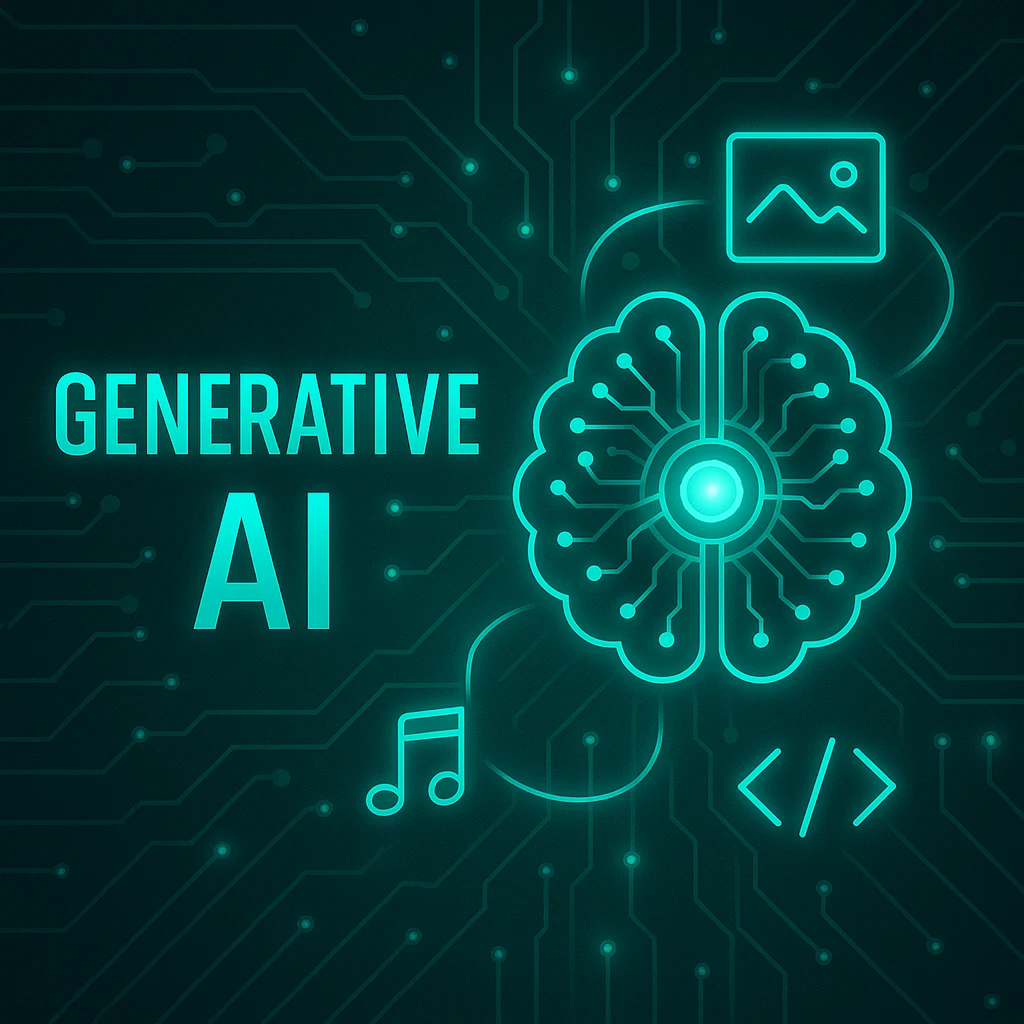
Generative AI is a type of artificial intelligence that can create new content — not just analyse or classify it.
Where traditional AI focuses on recognition and prediction (explained in our guide How Artificial Intelligence Works), generative AI produces something new: text, images, video, audio, code, and even ideas.
Predictive AI vs Generative AI
To understand the distinction clearly, read our breakdown of Machine Learning vs Artificial Intelligence — it helps position where generative models sit in the broader AI landscape.
Traditional AI answers:
- “Is this spam?”
- “What object is in this image?”
Generative AI answers:
- “Write me an email.”
- “Create a logo.”
- “Generate product descriptions.”
- “Summarize these 20 pages.”
Generative AI doesn’t copy/paste what it has seen. Instead, tools like LLMs (explained in Large Language Models (LLMs) Explained) learn deep patterns and relationships — allowing them to generate original outputs based on probability and structure.
Why It Matters in 2026
Generative AI has become the engine powering modern digital work. It compresses hours of effort into seconds and gives individuals capabilities that once required entire teams.
It’s woven into daily tools like:
Google Workspace, Microsoft 365, Adobe Creative Cloud, Notion, Canva, Figma, GitHub, and more.
If you want real-world examples, check our guide:
How AI Works in Real Life
Examples of Generative AI Tools You Already Know
- ChatGPT → text, reasoning, code
- Claude → long-form writing
- Google Gemini → multimodal analysis
- Midjourney → image generation
- DALL·E → design concepts
- Runway / Pika → video generation
- ElevenLabs → audio + voice cloning
Want to understand the underlying tech behind these tools?
Check Transformers Explained — the architecture enabling most modern generative models.
How Generative AI Works (A Beginner-Friendly Breakdown)
Generative AI may feel magical, but the mechanism behind it follows a clear, logical structure. Modern systems learn patterns from huge amounts of data, understand how information is connected, and then generate new content based on those learned patterns.
If you want the broader foundation first, start with How Artificial Intelligence Works — this chapter builds directly on that base.
Step 1 — Training on Massive Datasets
Generative AI models learn by analysing enormous amounts of real-world data:
text, images, audio, code, documents, diagrams, and conversations — billions of examples.
This learning process relies on machine learning, explained in Machine Learning vs Artificial Intelligence. During training, the system looks for patterns, relationships, structure, and probabilities.
A key clarification:
These models do not memorize content — they learn how content is formed.
Examples:
- A language model learns grammar, tone, structure, and meaning.
- An image model learns shapes, lighting, textures, and composition.
- A code model learns logic patterns, best practices, and structures.
This phase builds the foundation of generative intelligence.
Step 2 — The Neural Network Learns Structure, Context & Meaning
Once trained, the model uses a neural network to understand deeper relationships between concepts.
If you want to understand how these networks process information, explore Neural Networks Explained — it’s the perfect companion to this section.
Neural networks allow the model to:
- identify context
- interpret relationships between words, images, or sounds
- understand meaning beyond surface-level patterns
- handle long-range dependencies (e.g., entire paragraphs or sequences)
This entire process is powered by deep learning, covered in depth in Deep Learning Explained — Why It Powers Modern AI.
Deep learning enables multiple layers of understanding — from simple edges in images to fully coherent ideas in text.
Step 3 — Generating New Content Using Learned Patterns
Once the model has learned enough patterns, it can start generating completely new content.
Generative models work by predicting the next most likely piece of content based on everything they’ve learned:
- the next word
- the next sentence
- the next pixel
- the next frame in a video
- the next tone in audio
- the next line of code
The output feels creative, but it’s grounded in probability, pattern recognition, and structure — not randomness.
This capability is made possible by transformers, the breakthrough architecture behind ChatGPT, Claude, Gemini, Midjourney, and most modern generative systems.
If you want to understand why transformers became the foundation of modern AI, read Transformers Explained.
Why Deep Learning Matters for Generative AI
Deep learning gives generative systems three essential strengths:
1. Context Awareness
They understand longer sequences, not just short fragments of text or small image patches.
2. Creativity at Scale
They can generate unlimited variations of text, images, code, music, and video.
3. Multimodality
They can work across formats — text → image, image → text, audio → video, and more.
This foundation is powerful, but it also introduces limitations and risks.
For a deeper understanding, explore:
The Key Models Behind Generative AI
Generative AI isn’t powered by a single type of model. Instead, it’s a family of architectures, each designed to generate a different kind of content — text, images, audio, video, or code. The foundation of nearly all these systems comes from advances in deep learning and transformers, which you can explore in detail in Deep Learning Explained and Transformers Explained.
Below is a clear breakdown of the main model types, explained without hype or technical jargon.
Large Language Models (LLMs)
LLMs generate and understand text. They are trained on vast amounts of written content and learn structure, meaning, tone, and context.
These models power tools like ChatGPT, Claude, and Gemini.
To learn exactly how LLMs work — from token prediction to context windows — explore our dedicated guide:
Large Language Models (LLMs) Explained
What LLMs can generate:
- Emails
- Summaries
- Code
- Articles
- Customer support responses
- Explanations
- Product descriptions
- Ideas & recommendations
LLMs are the core engine behind generative text.
Diffusion Models (Image, Video & Creative Generation)
Diffusion models generate images, videos, and creative visuals. Instead of predicting the next word, they start from noise and gradually transform it into a coherent picture.
These models power tools like:
- Midjourney
- DALL·E
- Runway
- Stable Diffusion
- Pika Labs
What diffusion models can generate:
- Art and illustrations
- Logos and branding
- Realistic photos
- Motion graphics
- Short video clips
- Product renders
Diffusion models have become the creative backbone of the AI imagery boom.
Multimodal Generative Models
Multimodal models can process and generate multiple types of content simultaneously — text, images, audio, video, and even sensor data.
Modern multimodal systems include:
- GPT-4o
- Gemini 2.0
- Claude Opus / Claude 3.5 Sonnet
- OpenAI Sora (video)
- Google Lumiere
Capabilities include:
- Describing images
- Generating images from text
- Answering questions about video
- Translating between formats (e.g., speech → text → image)
- Real-time audio + visual reasoning
Multimodality is a major step toward the future of AI assistants — bridging perception, creativity, and reasoning.
Audio & Speech Models
These models generate or manipulate sound — synthetic voices, music, sound effects, and speech.
Examples include:
- ElevenLabs (voice synthesis & cloning)
- Suno & Udio (music generation)
- OpenAI Voice Engine
- Microsoft Vall-E
What audio models can generate:
- Human-like voices
- Voiceovers for videos
- Personalized speech styles
- Full songs
- Soundscapes & ambient audio
Audio models sit at the frontier of entertainment, accessibility, and creative industries.
Code Models (AI for Developers)
Code-generation systems can write, debug, translate, and optimize code in multiple programming languages.
Examples include:
- GitHub Copilot
- Claude Code
- Cursor
- Code Llama
These models accelerate software development by:
- Writing boilerplate code
- Helping with documentation
- Suggesting fixes
- Translating languages (e.g., Python → JavaScript)
- Refactoring existing code
Code models are rapidly becoming a core tool for developers, startups, and even non-technical creators.
What Generative AI Can Create (A Clear, Practical Overview)
Generative AI is not limited to text. Modern systems can create almost every type of digital content — from emails to full videos, from UI layouts to audio tracks, from product renderings to working code. This section gives you a clear, structured overview of what today’s models can generate and how people actually use them.
If you want to see how these outputs fit into real-world workflows, check How AI Works in Real Life.
Text Generation
Text is the foundation of generative AI. It’s also the most mature and widely used category.
AI can generate:
- Emails and messages
- Summaries and reports
- Blog articles and long-form content
- Product descriptions
- Step-by-step instructions
- Marketing copy
- Customer support replies
- Research analysis
- Ideas, outlines & brainstorm lists
Tools like ChatGPT, Claude, and Gemini dominate this category — all powered by the LLM technology explained in Large Language Models (LLMs) Explained.
Image Generation
Image models (often diffusion-based) turn text prompts into fully rendered visuals.
AI can generate:
- Art & illustrations
- Logos and brand concepts
- Product mockups
- Social media visuals
- Website graphics
- Portraits and character designs
- Landscapes
- Storyboards
- Concept art
Tools include Midjourney, DALL·E, Adobe Firefly, and Stable Diffusion.
If you want to understand the architecture behind these models, read Transformers Explained — many image systems now combine diffusion + transformer components.
Video Generation
Video generation is the newest and fastest-growing category — enabling short, high-quality clips created from only text or still images.
AI can generate:
- Cinematic shorts
- Product commercials
- Animations
- Social media clips
- Dynamic motion graphics
- Character-driven sequences
- Visual explanations
- Scene transitions
Leading tools include Runway, Pika Labs, and Google’s new Lumiere model.
The next wave — like OpenAI’s Sora — will push video generation into mainstream production workflows.
Audio & Music Generation
Audio models use AI to produce voices, sound effects, and full music compositions.
AI can generate:
- Human-like speech
- Voiceovers
- Multilingual narration
- Personalized voice clones
- Full songs
- Melodies and harmonies
- Atmospheric soundscapes
- Foley-style effects
Notable tools include ElevenLabs, Suno, Udio, and Microsoft’s emerging voice models.
Code Generation
Developers now rely on generative AI to speed up everything from prototyping to debugging.
AI can generate:
- Boilerplate code
- Full applications
- API integrations
- Testing suites
- Documentation
- Bug fixes
- Language translations (Python → JavaScript, etc.)
- Database queries
- Refactoring suggestions
If you want to understand why AI is so good at code, revisit the underlying mechanics in Neural Networks Explained — patterns and structure are exactly what programming languages are built on.
Multimodal Content
The most advanced systems can combine text, image, audio, and video generation inside one model.
Examples include GPT-4o, Gemini 2.0, Claude 3.5 Sonnet, and new research models.
Multimodal AI can generate:
- Images from text
- Text from images
- Video from images
- Audio from descriptions
- Explanations about videos
- Designs and diagrams
- UI layouts
- Presentation slides
Multimodality is the gateway to future AI assistants that can understand and manipulate any digital format — a trend explored deeper in The Future of AI Systems.
Real-World Use Cases of Generative AI (For Individuals & Businesses)
Generative AI is no longer a “future technology.” It’s a practical, everyday tool reshaping how people work, create, analyze, and make decisions. From solo entrepreneurs to global enterprises, generative systems are quietly becoming the default interface for productivity.
If you want a broader overview of how AI is used across industries, explore How AI Works in Real Life — this chapter zooms in specifically on the generative side.
Productivity & Work Automation
Generative AI dramatically reduces manual workloads by automating tasks that previously required hours of focus.
AI supports:
- writing emails and follow-ups
- taking meeting notes
- summarizing documents
- drafting reports, proposals, and briefs
- organizing research
- turning ideas into structured outlines
- creating checklists, plans, and strategies
Tools like ChatGPT, Claude, and Gemini are increasingly integrated into Notion, Google Workspace, Office 365, Slack, and project-management systems — making AI a built-in productivity layer.
Marketing & Content Creation
Marketing teams were among the first to adopt generative AI because it streamlines high-volume content work.
AI enables:
- SEO articles and blog posts
- ad copy and landing pages
- social media posts
- email campaigns
- audience research
- keyword clusters
- creative ideas and tone variations
- brand and product narratives
If you want to understand why LLMs excel at these tasks, check Large Language Models (LLMs) Explained — they’re the engines behind modern content automation.
Design, Branding & Creative Workflows
Generative image and video tools are reshaping the creative industry by giving individuals agency over complex visual work.
AI can generate:
- mood boards
- brand concepts and logos
- prototypes and UI mockups
- product visualizations
- ad creatives
- storyboards
- illustrations
- social media visuals
- video clips
This shift is powered by diffusion models and transformer-based image systems, explained in Transformers Explained.
Midjourney, DALL·E, Runway, Pika, and Adobe Firefly now appear in workflows for agencies, freelancers, and small businesses alike.
Data Analysis & Decision Support
Generative AI helps teams understand data, not just generate content.
AI can:
- analyze datasets
- identify trends
- summarize dashboards
- answer natural-language questions about data
- produce insights without manual querying
- translate findings into reports or presentations
This capability bridges the gap between technical data and day-to-day operations, making analytics more accessible to non-specialists.
Customer Support & AI Assistants
Many companies now deploy generative-AI-powered support systems to improve speed, accuracy, and personalization.
AI can:
- handle common customer questions
- help users troubleshoot issues
- draft human-review-ready replies
- personalize support responses
- escalate complex cases with context
- maintain consistent tone and reasoning
Generative AI also allows companies to build internal agents that manage tasks like onboarding, HR queries, and internal documentation.
Software Development & Engineering
Developers increasingly rely on generative AI to accelerate project delivery.
AI assists with:
- writing code
- debugging
- generating unit tests
- converting code between languages
- documenting APIs
- suggesting optimizations
- explaining unfamiliar codebases
To understand why neural networks are so effective at code, revisit Neural Networks Explained — programming languages are pattern-rich, making them perfect for generative learning.
Business Operations & Strategy
Executives and teams use generative AI to improve decision-making and operational efficiency.
AI helps with:
- forecasting
- market research
- competitive analysis
- risk assessment
- customer insights
- strategic planning
- scenario modelling
These tasks combine pattern recognition, reasoning, and structured generation — exactly what modern multimodal models excel at.
Limitations & Risks of Generative AI
Generative AI is powerful, but it isn’t flawless — and understanding its limitations is essential if you want to use it responsibly and effectively. These systems can produce impressive results, but they can also make mistakes, generate incorrect information, introduce bias, or behave unpredictably under certain conditions.
If you want a deeper technical and evidence-based analysis, explore:
Below is a clear, practical breakdown of the main limitations you should know.
Hallucinations (Confident but Incorrect Answers)
One of the biggest issues with generative AI is “hallucination” — when the model produces output that sounds correct but is factually wrong or entirely fabricated.
Examples include:
- incorrect citations
- invented statistics
- non-existent URLs
- fabricated legal cases
- fictional quotes
- inaccurate summaries
Why this happens:
LLMs predict the next most likely token based on patterns, not truth. They generate plausible text, not guaranteed facts. This limitation is universal across all major models, including GPT-4o, Claude, and Gemini.
For a full explanation of why these errors occur in neural networks, see Neural Networks Explained.
Bias & Fairness Issues
AI models learn from real-world data — including its flaws.
This means bias can appear in:
- tone of generated text
- choice of examples
- image generation (e.g., skewed representation)
- hiring or screening recommendations
- translations or interpretations
Models may unintentionally reflect stereotypes or imbalanced datasets.
This is why AI ethics — explained in (link naar jouw AI Ethics Explained-pagina) — is becoming increasingly important for AI developers and businesses.
Intellectual Property & Copyright Risks
Generative AI can unintentionally mimic styles, patterns, or structures from training data.
Risks include:
- images resembling copyrighted works
- text too similar to existing sources
- accidental reuse of phrasing
- blending multiple copyrighted elements
This area is evolving rapidly through legislation, which we cover in detail in AI Regulation (2025–2026).
Data Privacy & Security Concerns
Using sensitive, confidential, or personal information inside AI tools can create privacy risks.
Challenges include:
- accidental exposure through prompts
- unclear data retention policies
- potential training on user inputs
- insecure third-party plugins or agents
- lack of encryption in some systems
Enterprise-grade models are improving security, but careful handling of private data remains essential.
Reliability Under Pressure (Edge Cases & Failures)
Generative models struggle when tasks require:
- strict accuracy
- mathematical precision
- formal logic
- stable long-term reasoning
- exact compliance with instructions
- domain-specific expertise (law, medicine, finance)
These challenges are deeply rooted in how deep learning works — explained thoroughly in Limitations & Risks of Deep Learning.
Misuse Risks (Deepfakes, Spam, Manipulation)
Generative AI can be used both constructively and destructively.
Potential misuse includes:
- deepfake videos
- automated misinformation
- fake documents
- identity spoofing
- synthetic political content
- large-scale spam
- social-engineering attacks
Regulators worldwide are responding with new policies and frameworks.
You can explore the global landscape in AI Regulation (2025–2026).
Over-Reliance on AI (Skill Erosion)
As people outsource writing, analysis, and decision-making to AI, there is a growing risk of losing core skills:
- critical thinking
- research ability
- creativity
- communication
- problem-solving
AI should be used as a partner — not a replacement — for human agency.
The Future of Generative AI (2026–2030)
Generative AI is only at the beginning of its evolution. The tools we use today — from ChatGPT to Midjourney to Claude — will look primitive compared to what’s coming in the next five years. The shift won’t be defined by bigger models alone, but by smarter systems, real-time multimodal capabilities, on-device intelligence, and autonomous AI agents.
For a broader view on long-term AI evolution, explore The Future of AI Systems — this chapter focuses specifically on the generative side.
Below is what you can expect between 2026 and 2030.
Real-Time, Fully Multimodal AI
Today’s multimodal models can generate images, describe photos, analyze charts, and transcribe audio — but rarely at the same time, and not yet in real time.
By 2030, expect:
- instant text → video conversion
- video → explanation → scene editing
- hands-free conversations with AI assistants
- live analysis of environments via camera feed
- audio + visual + reasoning in a single unified flow
This is the path toward AI systems that work like human collaborators — fluent across every medium.
AI Agents That Take Action, Not Just Generate Output
The next frontier isn’t better generation — it’s autonomous action.
Generative AI will evolve into:
- agents that complete tasks end-to-end
- AI systems that manage your inbox
- agents that run research workflows
- automated marketing or coding assistants
- customer support agents that act, not just draft
- business operations agents (analysis → decisions → execution)
This shift connects directly with the risk and governance concerns covered in AI Risks Explained and AI Regulation (2025–2026).
On-Device Generative AI (No Cloud Required)
Models are shrinking while becoming more capable. Within a few years, phones, laptops, and wearables will run advanced generative AI locally.
Expect:
- instant offline AI assistants
- private, secure processing
- accelerated performance
- camera + sensor fusion for real-time analysis
- lower cost and energy usage
This makes generative AI more personal, private, and widely accessible.
Domain-Specific AI Models
Instead of one massive model for everything, we’ll see specialized generative systems for:
- healthcare
- finance
- cybersecurity
- engineering
- legal
- scientific research
- creative industries
- industrial automation
These models will outperform general-purpose LLMs in their niche and integrate directly into professional workflows.
Generative AI + Robotics
Combining generative reasoning with physical embodiment is one of the biggest transformations ahead.
Expect:
- AI-driven household robots
- warehouse, retail, and delivery automation
- robotic assistants in healthcare
- factory systems guided by generative reasoning
This future relies on the foundational technologies explained earlier in this guide — deep learning, transformers, and neural networks — now applied to the physical world.
Hyper-Personalized AI Experiences
Generative AI will adapt to users the same way humans adjust to friends or long-term colleagues.
Your AI assistant will learn:
- your communication style
- your preferences and interests
- your long-term projects
- your routines and habits
- how you think and make decisions
This will allow AI to anticipate needs and generate precisely what you want — before you ask.
Safer, More Regulated Systems
The next five years will also bring far stronger safety, governance, and transparency requirements.
Expect:
- watermarking for AI-generated content
- mandatory disclosure for AI media
- strict safety evaluations
- compliance frameworks for businesses
- model auditing and monitoring
- global alignment between the US, EU, and Asia
For a closer look at upcoming rules, read AI Regulation (2025–2026).
Beyond Generation — True Reasoning & System-Level Intelligence
Generative AI today is impressive — but largely reactive.
The next leap is reasoning:
- multi-step problem solving
- long-range planning
- strategic decision-making
- causal understanding
- autonomous improvement
- tool use and environment interaction
This transition paves the way toward more general intelligence, connecting back to the foundations in your What Is Artificial Intelligence? cornerstone.
Conclusion: Generative AI Is Reshaping How We Work, Create & Build
Generative AI is no longer an experimental tool or a niche technology. It has become a foundational layer of modern work — powering creativity, productivity, decision-making, and innovation across every industry.
What makes generative AI transformative isn’t that it can write text or generate images.
It’s that it changes the interface of work itself.
Instead of learning software, prompts become the new operating system.
Instead of doing every step manually, AI handles the heavy lifting.
Instead of depending on large teams, individuals gain superpowers.
Throughout this guide, you’ve seen how generative AI:
- learns patterns from data
- uses deep learning and neural networks to understand structure
- relies on transformers and LLMs to generate coherent, meaningful output
- powers real-world applications from marketing to coding
- accelerates work, creativity, and decision-making
- comes with limitations, risks, and ethical challenges
- is rapidly evolving toward agents, multimodality, and real-time intelligence
If you want to deepen your understanding of the full AI ecosystem, revisit the cornerstone What Is Artificial Intelligence?.
To explore the underlying technologies behind generative systems, check:
And if you want a clear view of what comes next — both in opportunity and governance — visit:
Generative AI is reshaping how we work, create, and build — and this is only the beginning.
The next wave will be more personal, more multimodal, more integrated, and far more capable.
The people and businesses that learn how to use generative AI today won’t just keep up —
they’ll lead the next decade of technological transformation.