Large Language Models — or LLMs — power the most advanced AI systems in the world. Tools like ChatGPT, Claude, Google Gemini, LLaMA, and Perplexity all run on these models, enabling them to write, summarize, translate, brainstorm, reason, code, and assist in real decision-making.
But the true value of LLMs goes far beyond text generation. They represent a new form of machine intelligence — systems trained on massive datasets that learn patterns, relationships, structure, and intent across billions of examples. Understanding how LLMs work isn’t just useful; it’s essential for anyone navigating the future of AI.
For a foundational introduction to artificial intelligence as a whole, start with our cornerstone guide What Artificial Intelligence Is. Then return here to explore how LLMs became the engine behind today’s AI revolution.
What Are Large Language Models? (A Simple Explanation)
A Large Language Model is an AI system trained to process and generate human language. It does not “think” like a human. Instead, it predicts the most likely next word, sentence, or instruction based on patterns learned during training.
LLMs are “large” because they contain billions — sometimes trillions — of parameters. These parameters are mathematical weights that store what the model learned from massive datasets.
In simple terms:
An LLM is a giant pattern-recognition engine for language.
It takes text input, processes context, and generates an output that appears intelligent.
This differs from traditional machine-learning models, which are typically smaller systems focused on narrow, single tasks. If you need a refresher, see Machine Learning vs Artificial Intelligence.
How LLMs Work (The Simple Breakdown)
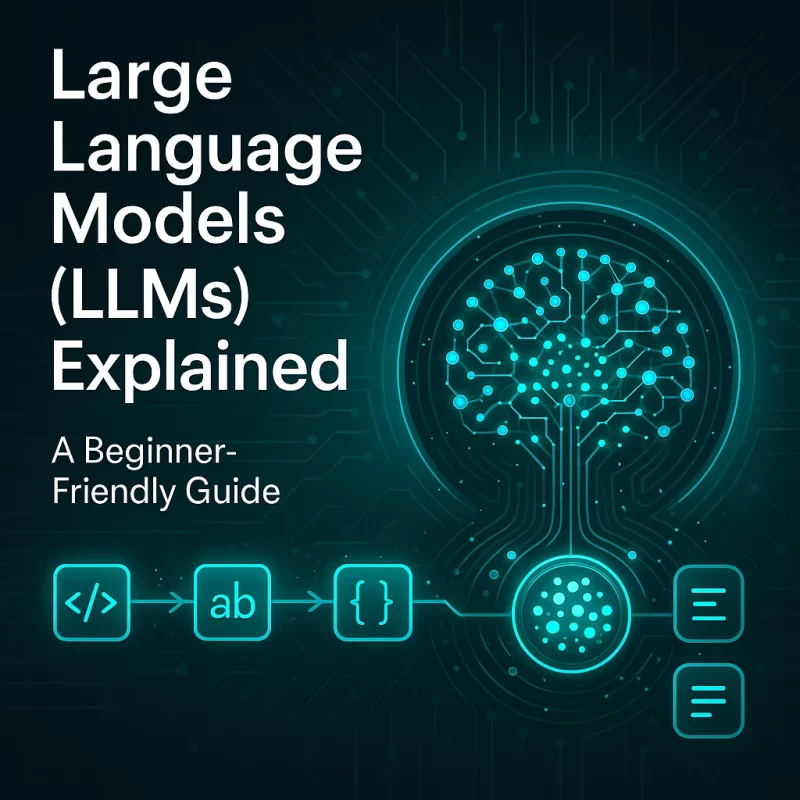
LLMs do not understand language the way humans do. They follow a structured pipeline:
1. You provide text (the prompt)
A question, request, instruction, description — anything.
2. The model converts the text into tokens
Tokens are units of meaning (words or sub-words).
3. Tokens become embeddings
Embeddings are numerical vectors that encode context and relationships.
4. Hidden layers analyze patterns
The model compares token relationships using what it learned during training.
5. The model predicts the next token
One token at a time — extremely fast.
6. It forms the final answer
This can be reasoning, explanation, code, structured lists, emails — anything.
Why does this feel intelligent?
Because LLMs have been trained on patterns from billions of text sequences across formats, languages, and domains. They don’t “understand” reality — but they are exceptionally good at modeling language.
For a broader explanation of how AI itself works, see How Artificial Intelligence Works.
The Architecture Behind LLMs — Transformers
The breakthrough behind modern LLMs is the transformer architecture, introduced in 2017.
Transformers solved a core problem: earlier neural networks (like RNNs and LSTMs) struggled with long-range context. Transformers introduced self-attention, enabling models to:
- determine which parts of the text matter most
- analyze relationships across long passages
- handle long context windows
- scale to billions of parameters
In simple terms:
Transformers don’t read text one word at a time like older models — they read everything simultaneously and decide where to “focus.”
This architecture powers almost every modern AI system.
For a deeper explanation, see How Transformers Work.
How LLMs Are Trained — Data, Tokens, Parameters & Compute
Training an LLM requires three core ingredients:
1. Massive datasets
Models are trained on a mix of:
- books
- scientific papers
- websites
- documentation
- code repositories
- multilingual texts
- curated instructions
- synthetic training data
These are tokenized into billions (or trillions) of training examples.
2. Billions of parameters
Parameters store pattern knowledge.
Popular models include:
- LLaMA 3 — up to 405B parameters
- GPT-4 family — trillion-scale (estimated)
- Claude 3 — advanced reasoning layers
More parameters = deeper pattern learning.
3. Immense compute
Training large models can take:
- thousands of GPUs
- months of compute
- petabytes of data movement
The training workflow includes:
Pretraining:
Predicting missing tokens on diverse texts to learn general knowledge.
Fine-tuning:
Adjusting the model for specialized abilities (coding, math, safety).
Instruction tuning:
Teaching the model to follow instructions conversationally.
Reinforcement learning (RLHF or variants):
Aligning outputs with human preferences or safety rules.
For more on data and tokens, see How AI Uses Data.
What LLMs Can Do — Practical Examples in 2026
LLMs now power thousands of real-world workflows:
1. Explain complex topics clearly
Great for learning, onboarding, and training.
2. Summarize long documents
Used in business, finance, legal work, and research.
3. Generate content
Blogs, outlines, marketing copy, creative writing.
4. Write and debug code
One of the fastest-growing use cases.
5. Translate languages
Often outperforming traditional translation systems.
6. Perform structured reasoning
From business cases to investment analysis.
7. Multimodal interaction
Many LLMs now handle:
- text
- images
- audio
- sometimes video
To see more applied examples, visit How AI Works in Real Life.
The Limitations of LLMs — Why They Make Mistakes
Despite their capabilities, LLMs have real limitations:
1. Hallucinations
LLMs may:
- invent facts
- generate false citations
- make confident errors
This occurs because LLMs generate patterns — not truths.
For details, see AI Risks Explained or AI Limitations & Reliability.
2. No real-world understanding
They simulate understanding but don’t possess it.
3. Bias from training data
LLMs inherit biases and structural patterns from datasets.
4. Struggles with long reasoning chains
This is improving with new architectures but remains difficult.
5. Limited memory
Context windows cap how much the model can process at once.
Understanding limitations is essential for reliable use.
The Future of Large Language Models
LLMs in 2026 are transitioning from text-based assistants to fully integrated cognitive systems.
1. Multimodal intelligence
LLMs that combine:
- text
- images
- audio
- video
- real-time tool execution
2. Smaller, efficient models
Running locally on:
- laptops
- smartphones
- edge devices
3. Agentic systems
LLMs that:
- plan tasks
- execute tools
- handle multi-step workflows
- revise answers
- operate autonomously under constraints
4. Hybrid reasoning
Combining LLMs with:
- search
- knowledge bases
- memory layers
- retrieval systems
- symbolic reasoning modules
To explore how these future systems work, see The Future of AI Systems.
Should You Trust LLMs? A Practical Perspective
LLMs are reliable when:
- tasks are structured
- patterns are consistent
- retrieval is available
- reasoning is short or medium in depth
Caution is required when:
- accuracy is critical
- outputs involve legal, financial, or medical context
- hallucinations would cause harm
- multi-step reasoning is needed without verification
The most effective approach is human-in-the-loop oversight paired with strong prompting and tool grounding.
Conclusion — LLMs Are the New Digital Infrastructure
Large Language Models have quietly shifted from experimental research projects into the foundational infrastructure of the modern internet. They power search engines, productivity tools, customer service systems, creative software, educational platforms, and even high-stakes enterprise workflows. In just a few years, LLMs have grown from niche curiosities into the cognitive layer that sits beneath everything we do digitally.
What makes LLMs transformative isn’t just their ability to generate text — it’s their ability to analyze, summarize, reason, translate, plan, iterate, and collaborate. They’re becoming multipurpose intelligence engines: systems that help professionals work faster, creators think bigger, entrepreneurs test ideas, and businesses operate with unprecedented efficiency.
At the same time, they’re becoming more multimodal, more agentic, more grounded in real-world data, and more deeply integrated into the tools people already use every day. The next generation of LLMs will not simply respond to prompts — they will take actions, manage workflows, recall preferences, analyze environments, and continually improve through feedback and retrieval.
Understanding how LLMs work is no longer a technical curiosity.
It’s a competitive skill — one that will define how individuals, teams, and entire industries adapt to the accelerating AI era.
The future belongs to those who know how to partner with these systems, not just use them.
LLMs are not replacing people. They are amplifying human capability, multiplying creativity, and unlocking new forms of productivity that were impossible just a few years ago.
This is the new digital infrastructure — and those who understand it will lead the next decade of innovation.
Continue Learning
To explore the foundations behind this article, start with:
- What Is Artificial Intelligence? — the full foundational overview that explains the core concepts behind modern AI.
- How Artificial Intelligence Works — a simple breakdown of how AI systems learn, make predictions, and improve through feedback loops.
- Machine Learning vs Artificial Intelligence — a clear comparison of where ML fits inside the broader AI field.
- Neural Networks Explained — an accessible guide to how layers, weights, and activations work inside AI systems.
- Deep Learning Explained — how deep neural networks and transformers power today’s breakthrough models.
- How Transformers Work — an intuitive guide to attention, tokens, embeddings, and modern AI architecture.
- How AI Uses Data — datasets, tokens, parameters, and why data quality determines model behaviour.
- How AI Works in Real Life — practical examples across business, healthcare, industry, and daily technology.
- AI Risks: Safety, Hallucinations & Misuse — a clear, evidence-based breakdown of risks, failure modes, and mitigation strategies.
- AI Regulation (2025–2026) — what upcoming global AI laws mean for developers, companies, and everyday users.
For broader exploration beyond this cluster, visit the AI Guides Hub, check real-world model benchmarks inside the AI Tools Hub, or follow the latest model releases and updates inside the AI News Hub.