Deep learning is the technology that transformed artificial intelligence from a theoretical discipline into a global force. It powers the language models that write and reason, the vision systems that analyze medical images, the multimodal assistants that understand text, images, and audio simultaneously, and the generative tools reshaping modern creativity.
If you use AI today — whether ChatGPT, Gemini, Midjourney, Tesla Autopilot, or simply your smartphone camera — you’ve already interacted with deep learning. It is the backbone of modern AI systems.
This guide gives you deep learning explained clearly, with a simple, intuitive breakdown of what deep learning is, how deep learning works, and why it has become the most influential branch of artificial intelligence. If you want foundational context first, explore What Artificial Intelligence Is or How Artificial Intelligence Works.
What Deep Learning Actually Is
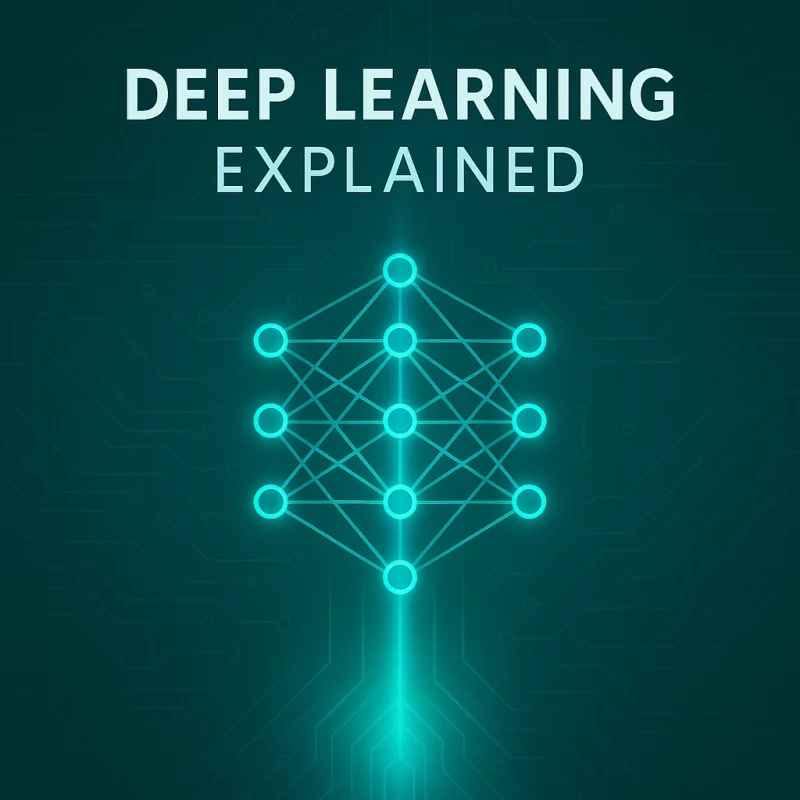
Deep learning is a subfield of machine learning that relies on large neural networks with many layers — sometimes dozens, sometimes hundreds — to learn patterns directly from data.
Where traditional ML depends on human-crafted rules and features:
• Traditional ML: humans decide which features matter
• Deep learning: the model learns useful features automatically
This ability to uncover increasingly abstract patterns at massive scale makes deep learning uniquely powerful. It allows AI systems to recognize objects, understand language, translate speech, analyze medical scans, generate images, and more — all without hand-built rules.
If you need a visual introduction to how these networks operate internally, start with Neural Networks Explained.
Why “Deep” Layers Matter
The “deep” in deep learning refers to the number of layers in the neural network. Each layer refines the input before passing it onward.
In images:
• early layers detect edges
• middle layers detect shapes
• deeper layers detect objects
• final layers interpret entire scenes
In language:
• character and token patterns
• words and short phrases
• grammar and syntax
• meaning, context, intent, reasoning
This hierarchical learning is the key to understanding deep learning neural networks explained — and why deep learning drives every major AI breakthrough.
How Deep Learning Works (Step-by-Step)
Deep learning models do not start out intelligent. They learn through a large-scale, iterative training process.
1. Data Is Fed Into the Model
Deep learning requires large, diverse datasets:
• text sequences
• images and video
• audio recordings
• multimodal datasets
The quality and scale of the dataset directly determine model performance.
2. Forward Propagation
The input flows through the network layer by layer, creating a prediction:
• “This is a dog.”
• “Next word: engineering.”
• “Summarize this paragraph.”
Nothing magical — just mathematics executed at scale.
3. Loss Calculation
The model compares its prediction to the correct answer.
Example:
• “That image was not a dog.”
• “That translation is inaccurate.”
• “This summary missed key details.”
The difference becomes the loss.
4. Backpropagation & Gradient Descent
This is the heart of deep learning:
• the error flows backwards
• each neuron learns how much it contributed
• weights are updated to reduce future mistakes
This loop repeats thousands or millions of times.
For a more accessible overview of this learning cycle, see How Artificial Intelligence Works.
5. Scaling Up With Compute
Modern deep learning requires enormous compute:
• GPU clusters
• TPU pods
• distributed training
• optimized tensor operations
Training massive foundation models like GPT-4, Gemini, or Claude takes:
• months of compute
• thousands of machines
• enormous datasets
Deep learning success depends on the combination of:
data → compute → optimization quality
The Main Architectures in Deep Learning
Deep learning is not a single model — it is an ecosystem of architectures built for different tasks.
Convolutional Neural Networks (CNNs)
Focused on vision.
CNNs detect hierarchical spatial patterns:
• edges
• textures
• shapes
• objects
Used in:
• medical imaging
• self-driving cars
• satellite imagery
• face recognition
• smartphone photo enhancement
CNNs ignited the deep learning revolution in 2012 through legendary ImageNet results.
Recurrent Neural Networks (RNNs)
Designed for sequence data:
• text
• speech
• time-series
Variants:
• LSTM
• GRU
Before transformers, RNNs were the gold standard in translation and speech.
Transformers (The Modern Standard)
Transformers reshaped AI by using self-attention to understand global context.
Transformers power:
• ChatGPT
• Google Gemini
• Claude
• CoPilot
• video understanding models
• agentic AI systems
If you want a simple, intuitive explanation of how this architecture works, explore our guide How Transformers Work — a beginner-friendly breakdown of attention, tokens, positional encoding, and modern transformer stacks.
For real-world implementations across healthcare, business, and everyday applications, see How AI Works in Real Life.
Diffusion Models
Diffusion models revolutionized generative visuals by learning to denoise random noise into meaningful images.
Used in:
• Midjourney
• DALL·E
• Runway Gen-3
• Stable Diffusion
Why they matter:
• exceptional image quality
• better textures
• more stable training
• fine creative control
Why Deep Learning Works So Well
There are four core reasons deep learning is uniquely powerful:
1. Automatic Feature Learning
Models learn features directly from data — no manual engineering needed.
2. Scale Produces Performance
Deep learning improves dramatically with:
• more data
• larger models
• more compute
This predictable scaling behavior is one of AI’s most important discoveries.
3. Cross-Domain Flexibility
Deep learning can work across:
• text
• images
• speech
• video
• multimodal tasks
4. Enables Creativity & Reasoning
Deep learning can:
• write
• translate
• summarize
• reason step-by-step
• generate art
• analyze audio
• compose music
It is not limited to classification — it enables creativity and intelligence.
Real-World Use Cases of Deep Learning
Deep learning is everywhere.
Healthcare
• tumor detection
• radiology diagnostics
• anomaly spotting
• drug discovery
• personalized health scoring
Business & Industry
• fraud detection
• customer analytics
• demand forecasting
• automated content creation
• workflow automation
Creativity & Media
• image generation
• video synthesis
• LLM-powered writing tools
• music generation
Robotics & Edge AI
• object tracking
• real-time perception
• autonomous navigation
• smart IoT devices
Deep Learning vs Traditional Machine Learning
They excel at different tasks.
Traditional ML is best for:
• small datasets
• explainable models
• structured data
• fast training
Deep Learning is best for:
• vision
• audio
• natural language
• generative tasks
• massive datasets
For broader context, see Machine Learning vs Artificial Intelligence.
Limitations of Deep Learning
Even the most advanced systems have weaknesses.
1. Data Hungry
Deep learning requires enormous datasets.
2. Lack of Explainability
Deep models behave like “black boxes.”
3. Bias & Fairness Issues
Models reflect the bias in their training data.
4. High Compute & Energy Cost
Training large models is extremely expensive.
For a broader ethical overview, explore The Benefits and Risks of Artificial Intelligence.
The Future of Deep Learning
Multimodal Intelligence
Unified models that understand text, images, audio, video, and sensor data.
Agentic AI
Systems that plan, sequence, and execute multi-step actions.
Neural-Symbolic Integration
Combining reasoning engines with neural networks.
On-Device AI
Advanced models running locally on phones and personal devices.
Key Takeaways
- Deep learning is the engine of modern AI
- It works through many layers of learned transformations
- Transformers and diffusion models drive today’s breakthroughs
- It requires massive data and compute
- Its future is multimodal, agentic, and distributed
Continue Learning
To explore the full picture of modern AI, continue with:
- What Is Artificial Intelligence? — the full foundational overview that explains the core concepts behind modern AI.
- How Artificial Intelligence Works — a simple breakdown of how AI systems learn, make predictions, and improve through feedback loops.
- Machine Learning vs Artificial Intelligence — a clear overview of how ML fits inside the broader AI landscape.
- Neural Networks Explained — a beginner-friendly visual guide to how layers, weights, and activations work.
- How AI Works in Real Life — practical examples from business, healthcare, productivity, and everyday apps.
- Best AI Tools for Productivity — curated tools that help you apply these AI principles in real workflows.
For broader exploration beyond this cluster, visit the AI Guides Hub, check real-world model benchmarks inside the AI Tools Hub, or follow the latest model releases and updates inside the AI News Hub.
Update September 8, 2026: This article was refreshed to improve internal context and discovery signals.