Machine learning vs AI is one of the most common — and most misunderstood — comparisons in modern technology.
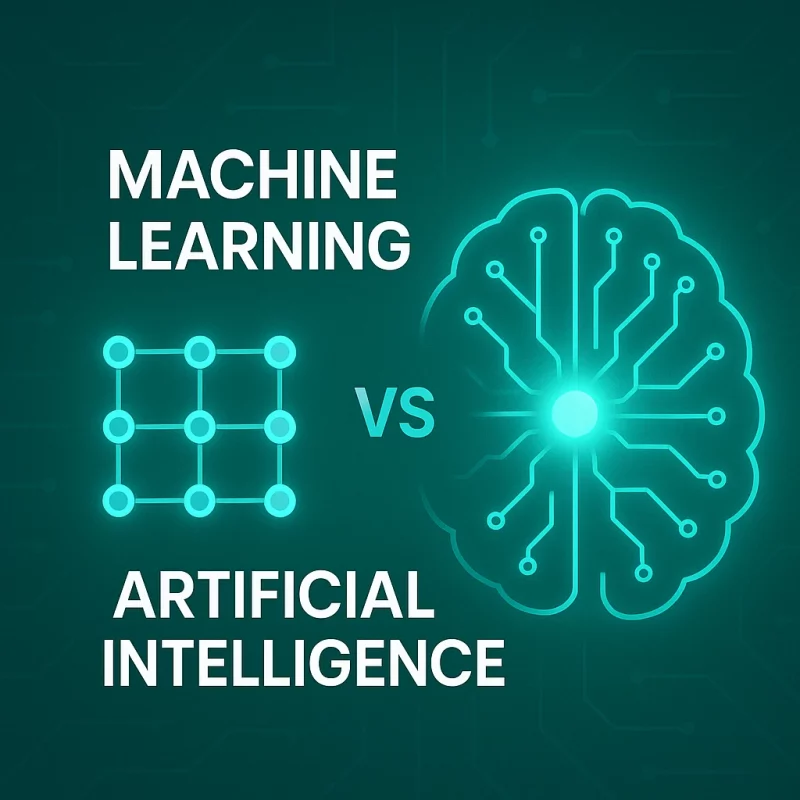
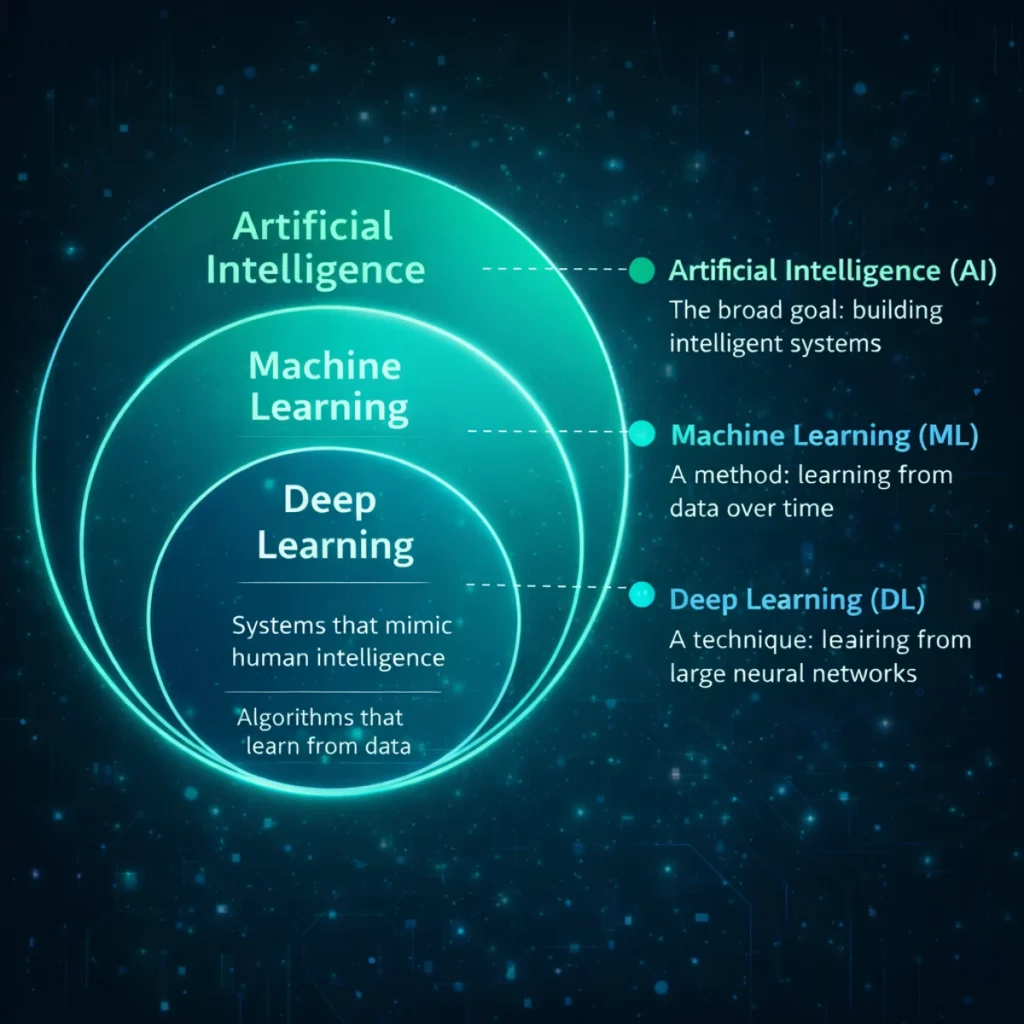
The difference is simple: artificial intelligence is the broader field of building systems that perform intelligent tasks, while machine learning is one approach within AI that trains models to learn patterns from data.
All machine learning belongs to artificial intelligence, but not every AI system uses machine learning.
This distinction matters because AI products can work in very different ways. Some follow fixed rules. Others learn statistical patterns from examples. Many modern systems combine machine learning, deep learning, software logic, tools, and human-defined safety controls.
This guide explains the difference between AI and machine learning, how both technologies work, where deep learning and generative AI fit, and when businesses should use rule-based, learning-based, or hybrid systems.
This article is part of the AI Explained Hub. For the complete conceptual foundation, start with What Is Artificial Intelligence? — The Ultimate Guide.
AI vs Machine Learning: Quick Comparison
The fastest way to understand the difference is to compare their scope, methods, data requirements, and applications.
| Aspect | Artificial intelligence | Machine learning |
|---|---|---|
| Definition | The broad field of creating systems that perform tasks associated with intelligent behavior | A branch of AI that trains models to learn patterns from data |
| Scope | Broad | Narrower and contained within AI |
| Main objective | Produce useful predictions, decisions, actions, recommendations, or generated content | Learn a model from examples that can predict, classify, rank, or generate |
| Requires training data | Not always | Usually |
| Can use fixed rules | Yes | Not as its main learning mechanism |
| Typical methods | Rules, search, planning, optimization, knowledge systems, machine learning | Regression, decision trees, clustering, neural networks, reinforcement learning |
| Examples | Expert systems, planning software, intelligent assistants, autonomous systems | Recommendations, forecasting, fraud detection, image recognition, language models |
| Main limitation | Depends on the methods used | Quality depends heavily on data, training, monitoring, and deployment conditions |
This hierarchy aligns with established terminology used by organizations such as NIST and the Google Machine Learning Glossary.
What Is Artificial Intelligence?
Artificial intelligence is the broad field of developing computer systems that can perform tasks involving prediction, reasoning, planning, language, perception, decision support, or content generation.
AI is not one model, algorithm, or product. It is an umbrella category containing several different approaches.
- Rule-based systems follow explicit logic written by humans.
- Search and planning systems evaluate possible actions to find a useful path or solution.
- Knowledge-based systems use structured facts and relationships to support decisions.
- Optimization systems select the best available outcome under defined constraints.
- Machine-learning systems learn patterns and model parameters from data.
- Hybrid systems combine learned models with rules, tools, databases, and human controls.
This means an AI system can behave intelligently without learning from data. A tax-rule engine, scheduling optimizer, classical planning system, or medical expert system may use human-defined logic rather than machine learning.
Modern AI products increasingly combine several approaches. A learned model may recognize an intent, while conventional software retrieves information, follows business rules, calls an external tool, and applies access restrictions.
For a deeper look at these components, read How Artificial Intelligence Works.
What Is Machine Learning?
Machine learning is a branch of artificial intelligence in which software models are trained on data to make useful predictions or generate outputs.
Instead of writing every decision rule manually, developers define a learning objective and provide examples. During training, an algorithm adjusts the model’s internal parameters to reduce errors or improve a defined performance measure.
Machine learning is especially useful when patterns are too complex, variable, or numerous to describe through hand-written rules.
The Three Main Types of Machine Learning
- Supervised learning: the model learns from examples that include a known target or label. Common uses include spam detection, forecasting, classification, and risk scoring.
- Unsupervised learning: the model searches for structure in data without predefined labels. Common uses include clustering, segmentation, and pattern discovery.
- Reinforcement learning: an agent learns which actions produce better outcomes through rewards, penalties, and repeated interaction with an environment.
Many everyday systems use machine learning, including recommendation engines, predictive maintenance, search ranking, speech recognition, fraud detection, translation, image classification, and generative AI models.
One important correction: a deployed machine-learning model does not necessarily keep learning automatically. Most models remain unchanged until they are monitored, updated, or retrained. Only dynamic or online-learning systems are trained frequently or continuously.
To understand how training examples influence model behavior, continue with How AI Uses Data.
How Machine Learning Works
A machine-learning system typically moves through a repeatable development lifecycle.
- Define the problem. Decide what the model should predict, classify, rank, detect, or generate.
- Collect and prepare data. Gather relevant examples, remove errors, structure inputs, and address missing or imbalanced data.
- Train the model. The learning algorithm adjusts model parameters to improve performance on the training objective.
- Validate the result. Test the model on unseen data to estimate how well it performs beyond its training examples.
- Deploy the model. Integrate it into an application, workflow, device, or decision-support system.
- Monitor and maintain it. Track accuracy, bias, failures, data changes, costs, latency, and unexpected behavior.
- Retrain, replace, or retire it. Update the system when performance declines or business conditions change.
The model does not need human-like understanding to be useful. It needs to perform its defined task accurately enough under the conditions in which it is deployed.
Where Deep Learning, Generative AI, and LLMs Fit
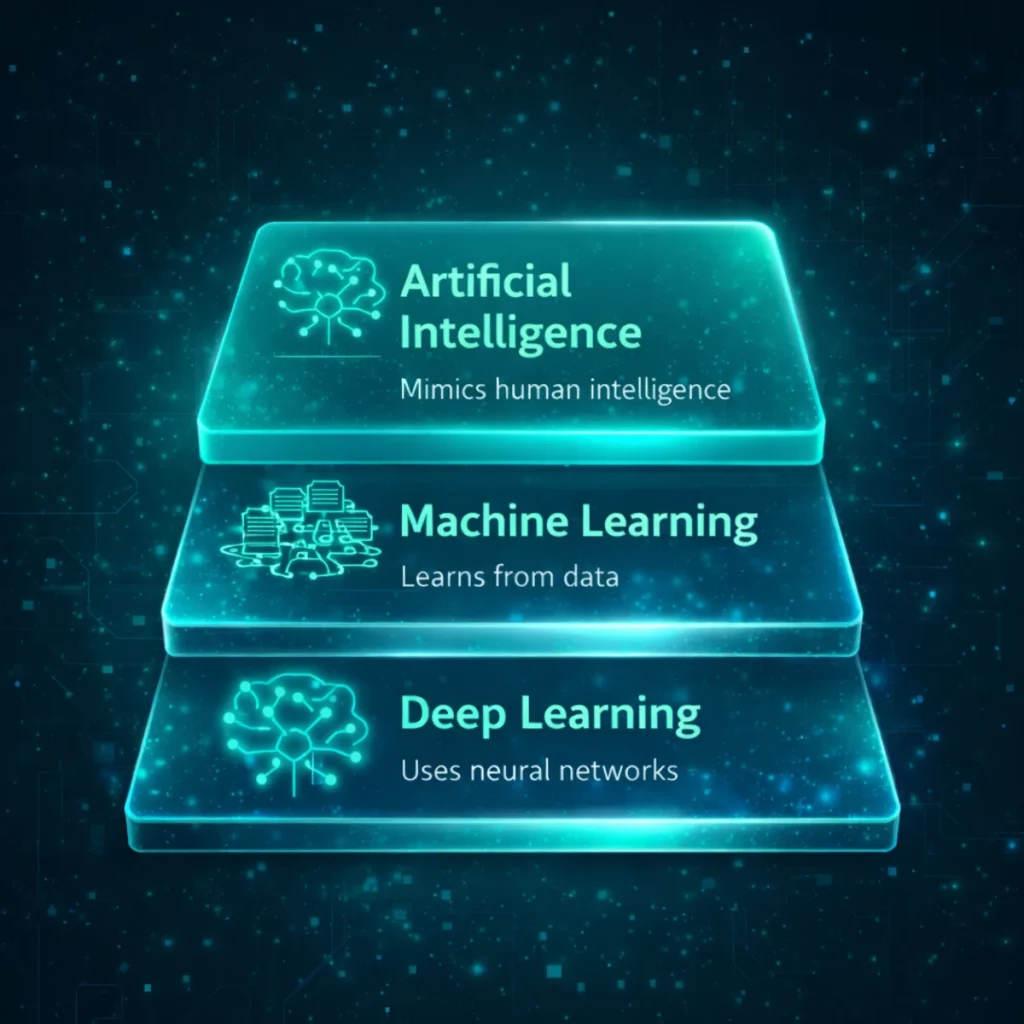
The relationship between AI, machine learning, neural networks, deep learning, and large language models is hierarchical — but generative AI overlaps several model categories.
| Term | How it fits | What it does |
|---|---|---|
| Artificial intelligence | The broadest field | Covers systems that perform intelligent tasks |
| Machine learning | A branch within AI | Learns useful models from data |
| Neural networks | A family of machine-learning architectures | Learn nonlinear relationships between inputs and outputs |
| Deep learning | A branch of machine learning using multilayer neural networks | Learns increasingly abstract representations from complex data |
| Large language models | Deep-learning models for language | Estimate and generate sequences of tokens using context |
| Generative AI | A category defined by what the system produces | Generates text, images, audio, video, code, or other new content |
Deep learning does not prove that a system understands information in the same way humans do. It learns numerical representations that allow it to identify, predict, or generate complex patterns across language, images, audio, video, and other data.
Large language models are deep-learning language models trained on large collections of text and other data. They generate responses by modeling relationships between tokens and context, rather than retrieving a prewritten answer from a database.
Explore the technical layers in Neural Networks Explained and Deep Learning Explained.
Rule-Based AI vs Machine Learning vs Hybrid Systems
The practical question is not whether AI or machine learning is “better.” The better question is which approach fits the problem.
| Approach | Best used when | Main strength | Main weakness |
|---|---|---|---|
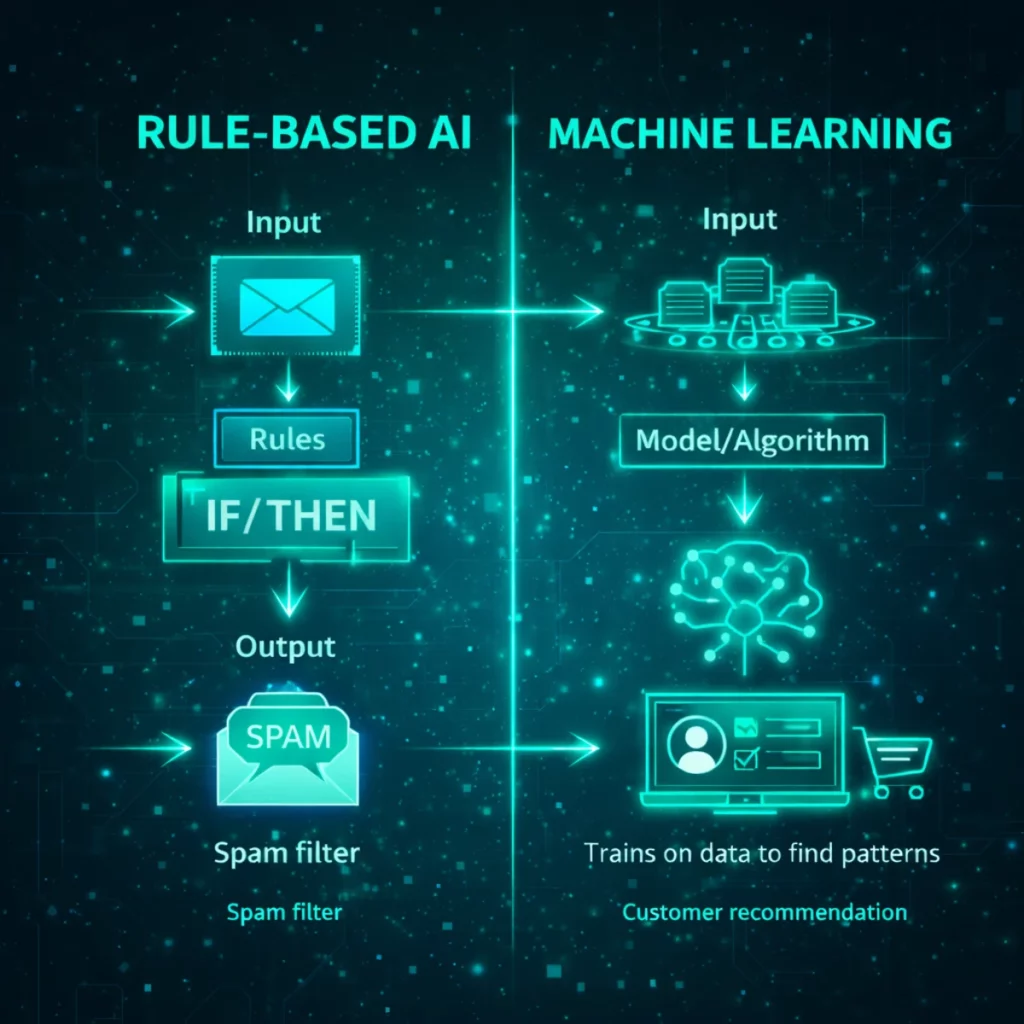
| Rule-based AI | The logic is stable, explicit, and must be traceable | Predictable and easy to audit | Becomes rigid when situations are complex or ambiguous |
| Machine learning | Useful patterns exist in sufficiently representative data | Can handle complexity that is difficult to encode manually | Can fail when data is biased, incomplete, or different from production conditions |
| Hybrid system | Learned predictions need business logic, tools, controls, or safety constraints | Combines flexibility with control | More components must be tested, integrated, and governed |
When Rule-Based AI Is a Strong Choice
Rules work well for tax calculations, approval thresholds, access controls, compliance checks, deterministic workflows, and situations where every decision must follow an explicit policy.
When Machine Learning Is a Strong Choice
Machine learning is useful for recommendations, demand forecasting, anomaly detection, speech recognition, personalization, image analysis, predictive maintenance, and other problems involving complex statistical patterns.
Why Many Real Systems Are Hybrid
Production AI systems often combine multiple technologies:
- A fraud platform may use an ML model to calculate risk and fixed rules to block prohibited transactions.
- A voice assistant may use deep learning for speech recognition, another model for intent classification, and conventional software to perform the requested action.
- An autonomous vehicle may combine perception models, movement prediction, route planning, control software, maps, and hard safety constraints.
- A business chatbot may use an LLM for language, retrieval for company knowledge, tools for actions, and access rules for security.
The model is only one part of the complete system. Data pipelines, software logic, interfaces, monitoring, governance, and human oversight are equally important.
Limitations of AI and Machine Learning
AI systems can be powerful without being universally intelligent or reliable. Their limitations depend on how they are designed.
Limitations of Rule-Based Systems
- They struggle with ambiguity and unexpected situations.
- Large rule libraries become difficult to maintain.
- They cannot automatically discover new patterns from examples.
Limitations of Machine-Learning Systems
- Training data may be incomplete, outdated, imbalanced, or biased.
- A model may perform poorly when real-world data differs from its training environment.
- Some models are difficult to explain or audit.
- High benchmark performance does not guarantee reliable production behavior.
- Models require monitoring, maintenance, security, and sometimes retraining.
Generative models introduce additional risks such as hallucinated information, inconsistent answers, prompt sensitivity, copyright concerns, and convincing but incorrect output.
Learn how to evaluate these risks in AI Limitations and Reliability.
Why the Difference Matters for Work and Business
Understanding the difference between AI and machine learning helps you evaluate technology more realistically.
| Audience | Why the distinction matters |
|---|---|
| Professionals | It helps you understand what a tool can learn, where it may fail, and how much human review it needs. |
| Businesses | It affects data requirements, development costs, explainability, monitoring, governance, and maintenance. |
| Founders | It prevents machine learning from being added where a simpler rules-based workflow would be cheaper and more reliable. |
| Creators and marketers | It explains why generative tools produce variable output and why prompting, context, verification, and editing matter. |
| Decision-makers | It helps separate genuine AI capabilities from vague marketing language. |
A good implementation starts with the problem, not the buzzword. Sometimes the answer is a machine-learning model. Sometimes it is a rule, search function, database query, workflow automation, or hybrid combination.
To move from concepts to practical applications, explore the AI Tools Hub.
Frequently Asked Questions
What is the main difference between AI and machine learning?
Artificial intelligence is the broad field of building systems that perform intelligent tasks. Machine learning is a branch within AI that trains models to learn patterns from data. AI can use machine learning, fixed rules, planning, optimization, or a combination of methods.
Is machine learning the same as AI?
No. Machine learning is part of AI, but AI is broader. All machine-learning systems belong to the AI field, while some AI systems operate through rules, search, planning, or other non-learning techniques.
Is ChatGPT AI, machine learning, or deep learning?
ChatGPT is an AI application built around large language models. Those language models use deep-learning neural networks, making them part of machine learning and therefore part of the broader AI field.
Does every AI system need training data?
No. Machine-learning systems normally require training data, but rule-based AI can operate using logic and knowledge written directly by humans. Hybrid systems may use both learned models and explicit rules.
Do machine-learning models keep learning after deployment?
Not necessarily. Many deployed models remain fixed until they are deliberately retrained or updated. Online-learning systems can be updated frequently or continuously, but this requires a specifically designed training and monitoring process.
What is the difference between machine learning and deep learning?
Deep learning is a branch of machine learning that uses neural networks with multiple layers. It is especially effective for complex data such as language, images, audio, and video, but often requires substantial data, computing resources, and careful evaluation.
Which is better: AI or machine learning?
They are not competing alternatives. AI is the broader field, while machine learning is one method used to build AI systems. The best technical approach depends on the problem, available data, reliability requirements, budget, and need for explainability.
Conclusion: AI Is the Field, Machine Learning Is an Approach
The difference between machine learning and AI becomes clear once you stop treating them as equal technologies.
Artificial intelligence is the broad field. It includes systems that use rules, search, planning, optimization, machine learning, and hybrid architectures to perform intelligent tasks.
Machine learning is one approach inside AI. It trains models to learn useful patterns from data instead of requiring humans to describe every rule manually.
Deep learning, large language models, and most modern generative AI systems sit deeper inside this ecosystem. They are powerful, but they remain components of larger systems that also depend on software, data, tools, controls, monitoring, and human judgment.
Understanding these layers helps you choose better tools, ask better questions, set realistic expectations, and design AI systems that are useful rather than merely impressive.
Continue exploring the foundations in the AI Explained Hub, or move from theory to application through the AI Tools Hub.
{ “@context”: “https://schema.org”, “@type”: “FAQPage”, “mainEntity”: [ { “@type”: “Question”, “name”: “What is the main difference between AI and machine learning?”, “acceptedAnswer”: { “@type”: “Answer”, “text”: “Artificial intelligence is the broad field of building systems that perform intelligent tasks. Machine learning is a branch within AI that trains models to learn patterns from data.” } }, { “@type”: “Question”, “name”: “Is machine learning the same as AI?”, “acceptedAnswer”: { “@type”: “Answer”, “text”: “No. Machine learning is part of AI, but AI is broader. Some AI systems use rules, search, planning, optimization, or other non-learning techniques.” } }, { “@type”: “Question”, “name”: “Is ChatGPT AI, machine learning, or deep learning?”, “acceptedAnswer”: { “@type”: “Answer”, “text”: “ChatGPT is an AI application built around large language models. Those models use deep-learning neural networks, making them part of machine learning and therefore part of AI.” } }, { “@type”: “Question”, “name”: “Does every AI system need training data?”, “acceptedAnswer”: { “@type”: “Answer”, “text”: “No. Machine-learning systems normally require training data, while rule-based AI can operate using logic and knowledge written directly by humans.” } }, { “@type”: “Question”, “name”: “Do machine-learning models keep learning after deployment?”, “acceptedAnswer”: { “@type”: “Answer”, “text”: “Not necessarily. Many deployed models remain fixed until deliberately retrained or updated. Online-learning systems can be updated frequently or continuously.” } }, { “@type”: “Question”, “name”: “What is the difference between machine learning and deep learning?”, “acceptedAnswer”: { “@type”: “Answer”, “text”: “Deep learning is a branch of machine learning that uses multilayer neural networks and is especially effective for complex data such as language, images, audio, and video.” } }, { “@type”: “Question”, “name”: “Which is better: AI or machine learning?”, “acceptedAnswer”: { “@type”: “Answer”, “text”: “They are not competing alternatives. AI is the broader field, while machine learning is one method used to build AI systems. The best approach depends on the problem and its requirements.” } } ] }Update September 5, 2026: This article was refreshed to improve internal context and discovery signals.