Artificial intelligence has quietly become part of everyday life. It’s in your phone when facial recognition unlocks the screen, in your car when navigation predicts traffic, and in your apps when recommendations match your tastes with surprising accuracy. Yet while AI surrounds us, most people still don’t understand how artificial intelligence actually works beneath the surface.
This guide is part of the AI Explained Hub and builds on our cornerstone What Is Artificial Intelligence? guide. Here, we focus on the engine behind modern AI — how models learn from data, how they make predictions, and why they can be powerful without being intelligent in the human sense.
You’ll learn how AI learns, how it turns data into decisions, where it shows up in real systems, and where its limitations stil matters
What AI Actually Does: Learning Patterns, Not Thinking
Despite the name, artificial intelligence does not think the way humans do.
It does not understand meaning, form opinions, or reason from lived experience — a distinction explored in What Is Artificial Intelligence?.
What AI does is something far more specific — and far more powerful in certain contexts.
AI systems learn statistical patterns from data and use those patterns to make predictions or generate outputs.
When a model is trained on large collections of images, text, or other examples, it gradually learns which features tend to appear together. Over time, it builds an internal representation of relationships — not in concepts or ideas, but in numbers and probabilities.
That is why AI can recognize faces, translate languages, generate text, detect fraud, and forecast outcomes — even though it never truly understands what it is doing.
AI feels intelligent because it operates at massive scale, processing patterns far beyond what a human brain could track.
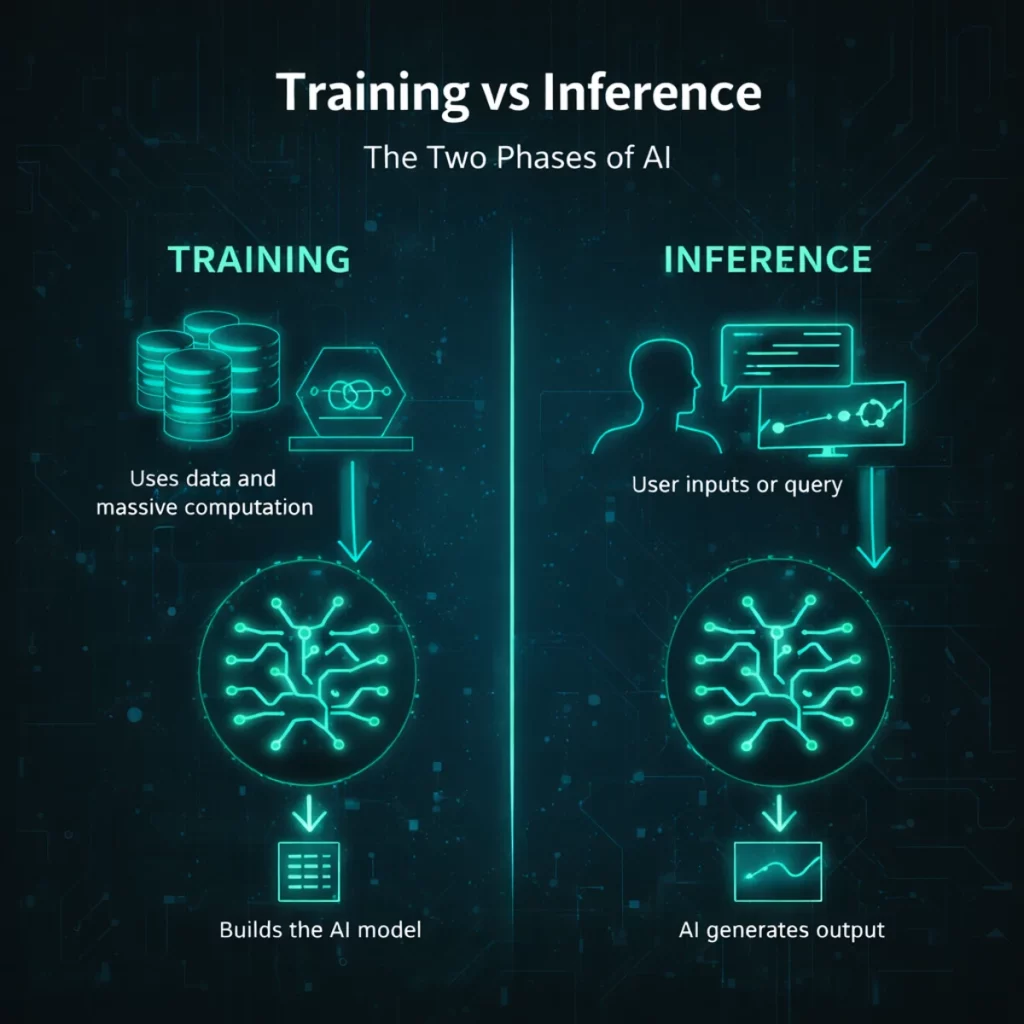
Training vs Inference — The Two Phases of AI
Every modern AI system operates in two distinct phases.
Training
During training, the model is exposed to large datasets and adjusts millions or billions of internal parameters to minimize errors. This learning process is powered by neural networks, which you can explore in Neural Networks Explained.
Training is computationally expensive and usually happens in data centers over long periods of time.
Inference
During inference, the trained model applies what it learned to new input — a question, an image, a piece of text — and produces a prediction or response.
This is the phase users interact with.
When you use a chatbot or unlock your phone with face recognition, the system is not learning in that moment. It is using patterns learned earlier.
AI does not retrain itself every time you use it.
It predicts based on what it already learned.
The Core AI Learning Loopnder the hood, almost all AI systems follow the same fundamental cycle:
Data → Model → Prediction → Feedback
Data provides examples.
The model stores learned patterns.
Predictions produce outputs.
Feedback measures errors and improves the model during training.
This loop is what allows AI systems to become more accurate over time — without ever developing human-like understanding. For a deeper look at how training data shapes these models, see How AI Uses Data.
Why This Makes AI Both Powerful and Limited
Because AI is built on pattern recognition, it excels at finding subtle correlations, scaling across massive datasets, and performing complex tasks consistently.
But it also has clear limits.
AI struggles with context, common sense, moral judgment, and situations that fall outside its training data. It does not reason or understand — it predicts.
That single fact explains both AI’s extraordinary power and its real-world limitations.
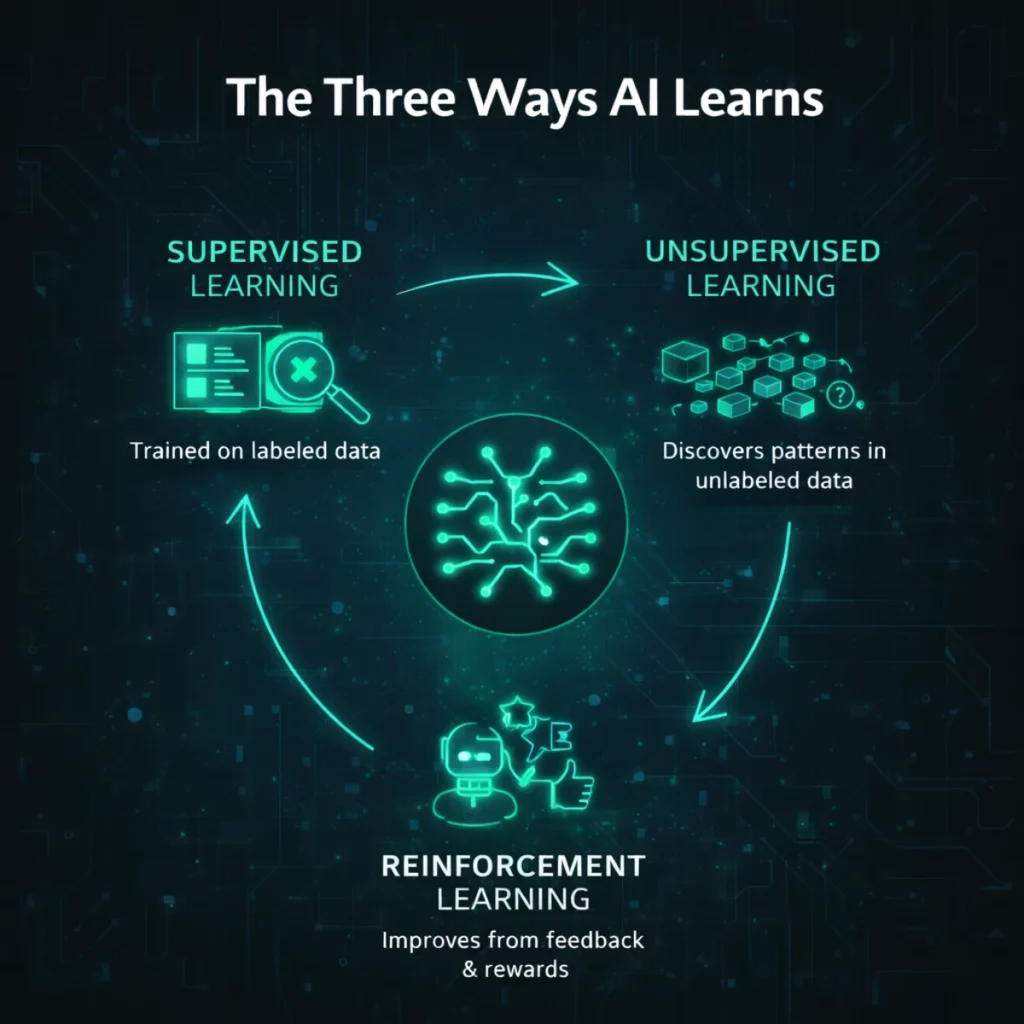
The Three Ways AI Learns
All modern AI systems learn through data — but they do not all learn in the same way.
Depending on the problem, models use different training strategies to discover patterns — an important distinction explained further in Machine Learning vs Artificial Intelligence.
These three learning methods form the foundation of nearly every AI system you encounter today.
1) Supervised Learning
Supervised learning is the most common way AI systems are trained.
In this approach, the model is given examples where both the input and the correct output are known.
For example:
- images labeled “cat” or “dog”
- emails labeled “spam” or “not spam”
- medical scans labeled “healthy” or “abnormal”
The model compares its predictions to the correct answers and adjusts its internal parameters to reduce errors.
Over time, it becomes better at mapping input to output.
This is similar to teaching with flashcards:
show an example, give the answer, repeat until the pattern sticks.
Most real-world AI — from recommendation systems to image recognition — relies heavily on supervised learning.
2) Unsupervised Learning
Unsupervised learning works differently.
Here, the AI is given data without labels or correct answers.
Instead of being told what to look for, the model searches for structure on its own.
It might:
- group customers with similar behavior
- detect unusual activity in financial data
- find themes in large collections of text
Unsupervised learning is useful when humans don’t know in advance what patterns exist.
It helps reveal hidden structure inside large, complex datasets.
3) Reinforcement Learning
Reinforcement learning is based on trial and error.
The AI takes actions, receives feedback in the form of rewards or penalties, and gradually learns which actions lead to better outcomes.
Examples include:
- game-playing systems learning to win
- robots learning to move efficiently
- trading or pricing systems adjusting strategy over time
Instead of learning from fixed examples, the model learns from experience — constantly refining its behavior.
How These Methods Work Together
In practice, many modern AI systems combine these approaches.
A self-driving car, for example, might use:
- supervised learning to recognize objects
- unsupervised learning to discover patterns in traffic behavior
- reinforcement learning to improve driving strategy
Behind all of these methods are neural networks — layered systems that store learned patterns and transform data into predictions, explained in Neural Networks Explained.
These three learning styles are simply different ways of feeding experience into those networks.
Why This Matters
Understanding these learning methods explains why AI behaves the way it does.
AI does not gain knowledge by reading or reasoning like humans.
It gains ability by adjusting itself based on examples, structure, and feedback.
That is why:
- AI can be extremely accurate in narrow tasks
- yet still fail in unfamiliar or ambiguous situations
How a model was trained shapes what it can and cannot do.
Machine Learning: The Core Engine Behind AI
Machine learning is the technology that turns data into working intelligence.
Instead of relying on hand-written rules, machine-learning systems learn how inputs and outputs relate by analyzing large amounts of data. These learned relationships allow the model to make predictions about new, unseen cases.
This is why machine learning sits at the heart of almost every modern AI system — from search engines and recommendation algorithms to medical diagnostics and autonomous vehicles.
To understand where machine learning fits inside the broader AI landscape, see Machine Learning vs Artificial Intelligence.
How Machine Learning Works in Practice
In practical terms, a machine-learning system learns by adjusting internal parameters so that its predictions become more accurate over time.
Here is what that looks like:
A model is given examples
It produces an output
The output is compared to the correct answer
Errors are measured
The model updates itself to reduce those errors
This process repeats thousands or millions of times until the model becomes reliable.
This training process is driven by mathematical optimization and neural networks, which are explained in Neural Networks Explained.
Why Machine Learning Is So Powerful
Machine learning succeeds where traditional software fails.
Traditional programs follow fixed rules:
“If X happens, do Y.”
Machine learning systems instead learn rules from data.
That allows them to:
- adapt to changing conditions
- handle messy, real-world information
- find patterns humans would miss
- scale to massive datasets
This is why machine learning powers:
- fraud detection
- voice recognition
- product recommendations
- search ranking
- medical image analysis
Machine Learning vs Traditional Software
Traditional software must be explicitly told how to handle every case.
Machine learning systems learn general patterns from examples, which allows them to respond intelligently to new situations they have never seen before.
This is what enables:
- spam filters to catch new types of spam
- recommendation engines to adapt to changing user behavior
- AI systems to perform tasks that cannot be written as simple rules
Machine learning does not give computers understanding — it gives them statistical competence.
How Machine Learning Connects to Deep Learning
Machine learning is the broad field.
Deep learning is a specialized approach inside it.
When machine-learning models use deep neural networks with many layers, they become capable of processing complex data such as images, speech, and language.
That is what powers modern systems like:
- speech recognition
- computer vision
- large language models
We explore this in detail in the next section on Deep Learning Explained.
Why This Matters
Understanding machine learning explains why AI systems:
- improve with more data
- can fail when data is biased
- struggle outside their training domain
AI does not get smarter through reasoning — it gets better through learning from examples.
That is the engine behind everything modern AI can do.
Where AI Shows Up in Real Life
Artificial intelligence is not confined to labs or research papers.
It operates quietly behind almost every modern digital experience — turning data into decisions in real time.
In everyday technology
- Smartphone cameras that adjust lighting, focus, and noise automatically
- Predictive keyboards that learn your writing style
- Navigation apps that select the fastest routes
- Streaming platforms that personalize recommendations
In business and work
- AI systems that draft emails, reports, and summaries
- Models that forecast customer behavior and demand
- Automation tools that reduce repetitive and administrative tasks
In healthcare
- AI models that analyze X-rays, CT scans, and MRI images
- Early anomaly detection and risk prediction
- More consistent diagnostic support for clinicians
These applications change rapidly, but the underlying mechanism stays the same:
AI learns patterns from data and uses them to make predictions or guide decisions.
For practical examples across industries, see How AI Works in Real Life.
What AI Can and Cannot Do
Artificial intelligence is powerful — but it is not magic.
Understanding what AI can do well — and where it fails — is essential for using it responsibly.
Where AI excels
- detecting complex patterns in large datasets
- processing enormous volumes of information
- generating variations, suggestions, and drafts
- analyzing images, audio, and text at scale
Where AI struggles
- understanding nuance, emotion, or human intent
- making ethical or moral judgments
- adapting to unpredictable real-world situations
- avoiding bias when trained on biased data
These limitations explain why human oversight remains critical in any serious AI deployment.
For a deeper, evidence-based breakdown, see AI Limitations & Reliability.
For the broader safety and misuse landscape, explore AI Risks: Safety, Hallucinations & Misuse.
And to understand how governments are responding, read AI Regulation (2025–2026).
The Four-Step Learning Cycle
All modern AI systems follow the same fundamental loop:
Data → Model → Prediction → Feedback
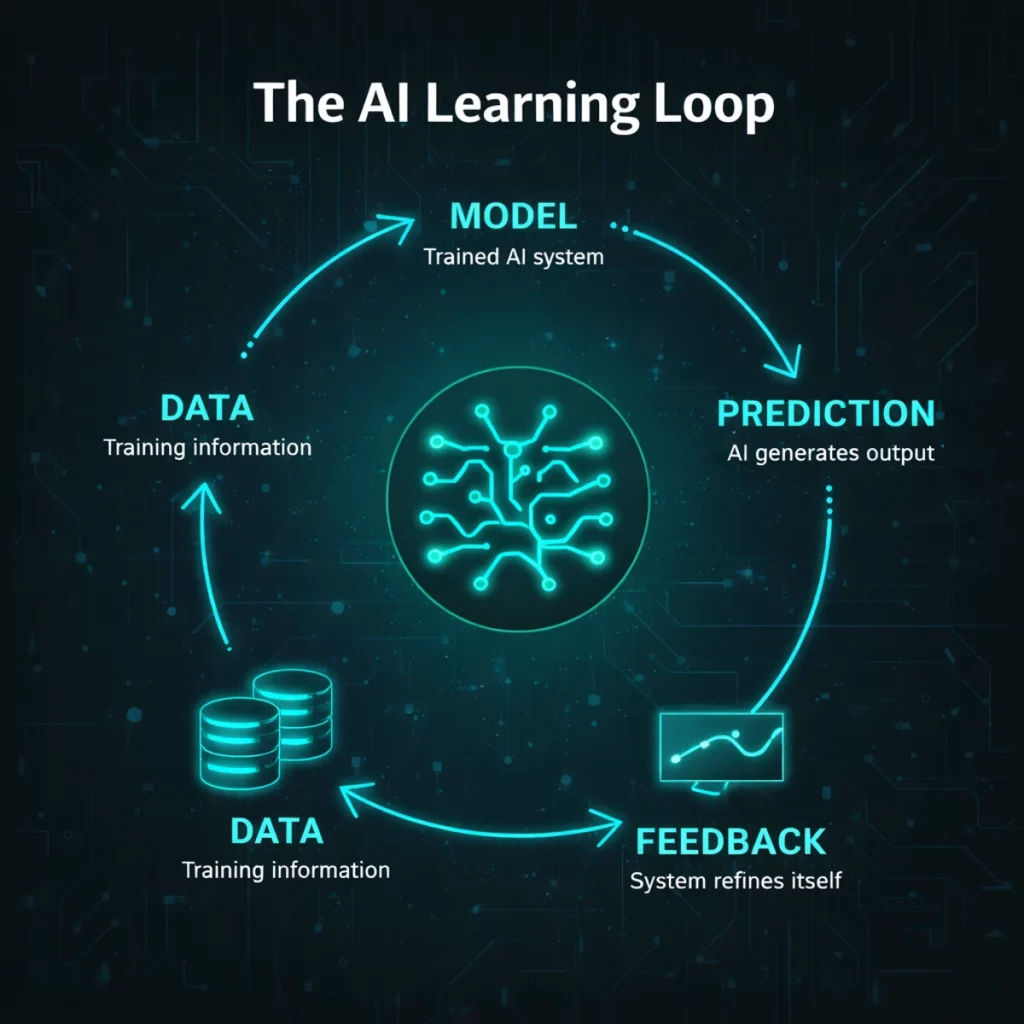
- Collect data
Examples such as text, images, audio, or user behavior provide the raw material for learning. - Train the model
The system adjusts its internal parameters to discover patterns in the data. - Predict or generate
The trained model applies what it has learned to new input, producing outputs such as classifications, recommendations, or generated text. - Receive feedback and improve
Errors are measured and used to refine the model during training, making future predictions more accurate.
This cycle explains why AI improves with experience — even though it never truly understands what it is doing.
For a forward-looking view of how this learning loop evolves into more autonomous systems, see The Future of AI Systems.
Conclusion: How AI Really Works
Artificial intelligence is not a form of digital thinking — it is a system for learning patterns from data and turning those patterns into predictions.
That single idea explains both its power and its limits.
This guide is part of the AI Explained Hub, a knowledge framework designed to help you understand artificial intelligence beyond surface-level tools and hype. Within this hub, each article connects the technical foundations of AI to its real-world impact, risks, and opportunities.
AI can recognize faces, generate language, detect anomalies, and automate complex workflows because it has absorbed vast statistical relationships from data. But it cannot understand meaning, values, or intent the way humans do. It predicts — it does not comprehend.
Once you grasp this, AI becomes much easier to use well.
You stop treating it like a mind and start using it as what it truly is: a powerful pattern-recognition engine that amplifies human decision-making, creativity, and productivity when guided correctly.
This mental model is the foundation for responsible, effective, and strategic use of artificial intelligence — in business, in creative work, and in everyday life.
Key Takeaways
- AI recognizes patterns — it does not think or understand like humans do.
- Machine learning forms the foundation of nearly all modern AI systems.
- Deep learning enables breakthroughs in vision, speech, and language.
- Natural Language Processing allows machines to interpret and generate human language.
- AI is already embedded across everyday technology and business.
- Understanding how AI works makes you a more capable and strategic user.
Continue Learning in the AI Explained Hub
To deepen your understanding of artificial intelligence, continue exploring the AI Explained Hub, where these closely connected guides build a complete learning path:
- What Is Artificial Intelligence? — the complete foundational overview
- Machine Learning vs Artificial Intelligence — how ML fits into the broader AI landscape
- Neural Networks Explained — how layers, weights, and activations power modern models
- How AI Works in Real Life — practical examples across industries
- AI Tools for Productivity — applying these principles in real workflows
For broader exploration, you can also visit the AI Guides Hub, compare real-world models inside the AI Tools Hub, or follow the latest releases and benchmarks in the AI News Hub.
Update August 6, 2026: This article was refreshed to improve internal context and discovery signals.