Artificial intelligence has become one of the most powerful tools in modern organizations. Yet most leaders still use it primarily for writing tasks — missing its real leverage: structured thinking, strategic analysis, and high-level decision support.
This is where AI prompts for business become a true competitive advantage.
This guide builds on the Arti-Trends Prompt Writing Cluster, where we first established the fundamentals in AI Prompt Writing Guide 2026, then explored role-based reasoning in Act as… Prompts: How Roles Transform AI Output, structured thinking models in AI Prompt Frameworks Explained: The 4C Model and Beyond, example-driven control in Few-Shot vs Zero-Shot Prompting, and step-by-step reasoning in Chain-of-Thought Prompting.
When designed correctly, business-focused prompts allow executives, founders, and teams to use AI not as a content generator, but as a strategic thinking partner. Instead of producing surface-level output, AI can help organizations:
– analyze complex situations
– compare strategic options
– identify risks and blind spots
– evaluate markets and business models
– streamline operations
– plan initiatives
– make higher-quality decisions, faster
The effectiveness of AI prompts for business does not depend on the model alone. It depends on how clearly intent, structure, constraints, and reasoning are embedded into the prompt itself.
This guide shows how to use AI as a high-level operator — with practical templates, frameworks, and real-world prompt systems designed specifically for business strategy, execution, and decision-making.
This article builds on the Arti-Trends Prompt Writing Cluster, including:
AI Prompt Writing Guide
Act as… Prompts
AI Prompt Frameworks (4C Model)
Few-Shot vs Zero-Shot Prompting
Chain-of-Thought Prompting
Together, these guides form a complete foundation for high-performance AI prompts for business.
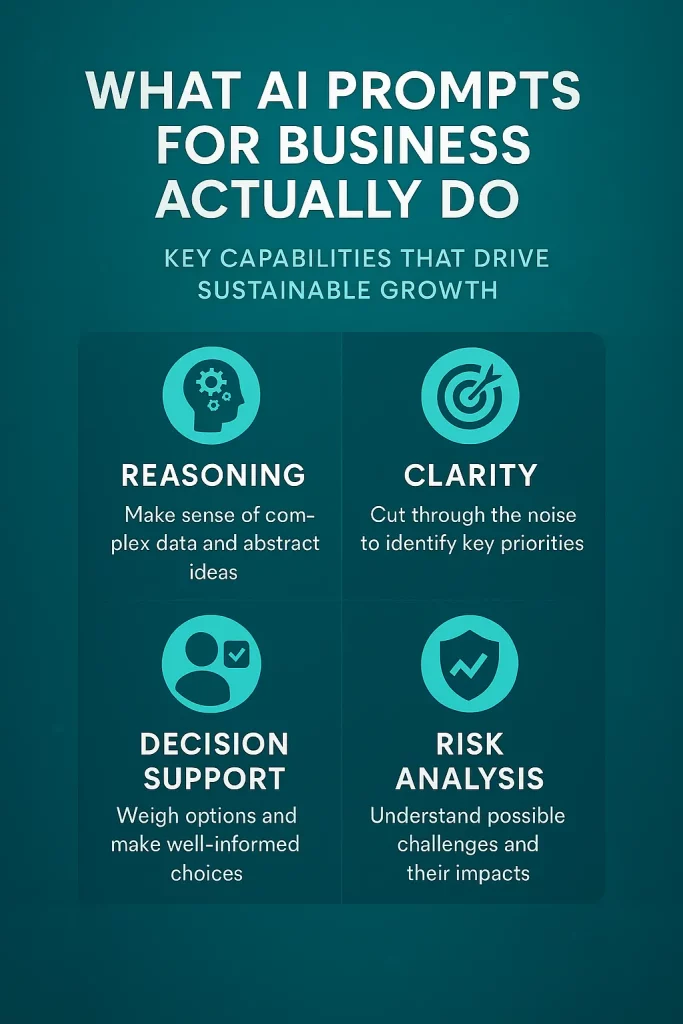
Why AI Prompts for Business Are Becoming a Strategic Advantage
High-level business work is rarely about clear answers.
It’s about navigating ambiguity, weighing trade-offs, and making decisions with incomplete information.
This is exactly where AI prompts for business unlock a measurable advantage.
When leaders move beyond generic prompting and adopt structured business prompts, AI stops being a writing assistant and starts functioning as a strategic thinking partner.
Leaders who master business prompting can:
Turn complexity into structured insight
By using Chain-of-Thought Prompting, AI breaks complex situations into clear, logical, and actionable reasoning steps — making ambiguity manageable instead of overwhelming.
Move from idea → analysis → decision in minutes
Instead of hours of whiteboarding, scattered notes, or unstructured discussion, AI becomes a real-time analyst that accelerates strategic thinking without replacing judgment.
Reduce blind spots and hidden risks
By prompting AI to challenge assumptions, surface risks, or adopt opposing perspectives, leaders uncover weaknesses and second-order effects that are easy to miss in human-only decision loops.
Improve execution and organizational alignment
When teams work from shared prompt templates and reasoning structures, decisions become easier to explain, align, and execute.
Consistent AI prompts for business function as shared mental models — not just instructions.
Scale senior-level strategic thinking
Prompt templates allow organizations to replicate high-quality reasoning across teams, roles, and functions.
Instead of relying on a small number of senior decision-makers, structured prompts distribute strategic clarity throughout the organization.
The strategic shift
AI does not replace leadership.
But leaders who understand how to design strong business prompts gain a decisive advantage:
faster analysis
clearer reasoning
better alignment
more deliberate execution
In modern organizations, the quality of decisions increasingly reflects the quality of the prompts behind them.
From Advantage to Execution: What Actually Makes Business Prompts Work?
Understanding why AI prompts for business create an advantage is only the first step.
The real leverage comes from knowing how to design prompts that consistently produce strategic, decision-grade output — not generic advice.
Not every prompt delivers insight.
In practice, effective AI prompts for business follow a clear internal architecture that guides how the model reasons, evaluates options, and structures conclusions.
Across executive teams, consultants, and operators, the strongest business prompts consistently share the same foundational components.
That structure is what turns AI from a general assistant into a reliable strategic partner.
Let’s break down what makes AI prompts for business effective — and how each element contributes to clearer thinking, better decisions, and more predictable outcomes.
What Makes AI Prompts for Business Effective?
High-quality AI prompts for business are not about clever wording.
They are about structured thinking translated into clear instructions.
Across strategy, operations, finance, and leadership use cases, effective business prompting consistently relies on five core components.
A) Clear Context
AI cannot produce meaningful strategic output without understanding the environment it operates in.
Strong business prompts explicitly define:
- the business model
- the objective or decision to be made
- constraints (time, budget, resources, risk tolerance)
- assumptions
- available data or inputs
Without context, AI guesses.
With context, AI reasons.
This foundational principle aligns directly with the structure outlined in AI Prompt Writing Guide.
B) A Defined Role
Role prompting determines how the AI thinks — not just what it produces.
By assigning a professional role, you activate domain-specific reasoning patterns:
- strategist
- CFO
- CMO
- operator
- consultant
- analyst
Each role changes vocabulary, depth, priorities, and decision logic.
The full role-based prompting system is explained in Act as… Prompts.
C) Logical Structure (Frameworks)
Business decisions require comparison, trade-offs, and prioritization.
Frameworks provide the scaffolding that makes this possible.
Well-designed AI prompts for business often rely on established structures such as:
- SWOT analysis
- Porter’s Five Forces
- Cost–Value or Impact–Effort matrices
- the 4C Model
Frameworks make AI prompts more consistent, comparable, and decision-ready by enforcing structured reasoning — an approach explained in AI Prompt Frameworks Explained: The 4C Model and Beyond.
D) Examples (Few-Shot)
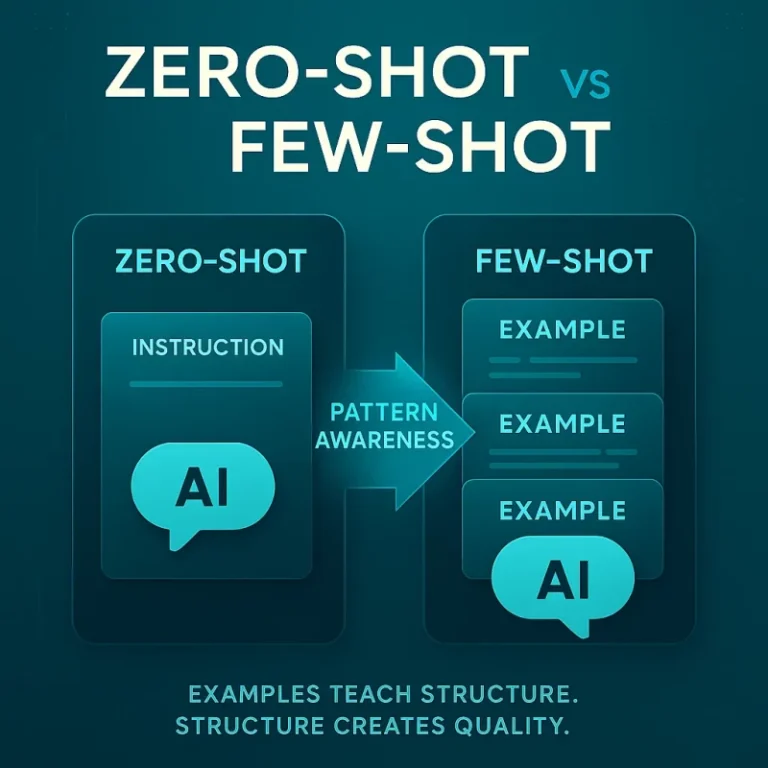
When output quality, formatting, or reasoning consistency matters, instructions alone are often not enough.
Providing examples teaches the model how to think and respond.
Few-shot prompting improves:
- structural consistency
- tone alignment
- reasoning patterns
- output reliability
This technique is covered in depth in Few-Shot vs Zero-Shot Prompting.
E) Step-by-Step Thinking (Chain-of-Thought)
Strategic tasks break down when AI jumps directly to conclusions.
Chain-of-Thought prompting forces the model to reason explicitly, step by step — turning shallow answers into analytical logic.
This approach reduces hallucinations, improves transparency, and strengthens decision quality.
The method is explained in Chain-of-Thought Prompting.
Why This Matters
When these five components work together, AI stops behaving like a generic assistant and starts functioning as a structured strategic partner.
This is the difference between using AI for output — and using it for thinking.
High-Impact AI Prompts for Business
Below are prompt systems used by top executives, consultants, and operators.
Each example demonstrates practical ai prompts for business in real work scenarios.
A) Strategy & Market Analysis
1. Market Landscape Assessment
Act as a senior business strategist.
Analyze our market using step-by-step reasoning.
Include:
- market size
- customer segments
- emerging trends
- threats & opportunities
- competitive landscape
Finish with a strategic recommendation.
2. Strategic Priorities Identification
Identify our top 3 strategic priorities.
For each:
- impact
- effort
- resources required
- risks
- expected ROI
These are classic ai prompts for business that produce clear direction.
B) Decision-Making Prompts
1. Compare Strategic Options
Compare Option A and Option B using:
- Impact
- Cost
- Effort
- Time-to-value
- Risk
- Long-term alignment
Provide a recommendation with reasoning.
2. Stress-Test the Decision
Challenge this decision using a devil’s advocate perspective.
What assumptions are wrong?
What risks are overlooked?
What data is missing?
This integrates techniques from
Prompt Mistakes & How to Fix Them.
C) Business Model Optimisation
1. 4C Business Model Breakdown
Break down our business model using the 4C framework:
Context
Constraints
Criteria
Command
Propose improvements for pricing, retention, and positioning.
From
AI Prompt Frameworks: The 4C Model.
2. Competitive Advantage Map
Explain our competitive advantage.
Then provide:
- 3 positioning angles
- 3 messaging pillars
- 1 long-term differentiation path
These are high-leverage ai prompts for business that support product, growth, and GTM teams.
D) Operations & Execution
1. SOP Creation
Act as an operations manager.
Create a clear SOP including:
- purpose
- prerequisites
- workflow steps
- quality checks
- failure points
2. Role Onboarding Plan
Create a 30/60/90 day plan for a new [role],
aligned with KPIs and business objectives.
E) Finance & KPI Analysis
1. ROI Breakdown
Analyze the ROI of this initiative.
Include:
- cost components
- value creation
- risk-adjusted ROI
- best/expected/worst-case outcomes
2. KPI Dashboard
Design a KPI framework including:
- input metrics
- output metrics
- leading indicators
- lagging indicators
Explain why each metric matters.
These two are essential ai prompts for business in finance and operations.
These examples build on the structural techniques explained in Prompt Templates for Marketers and Creators, where reusable business-ready prompt systems are broken down step by step.
Advanced Business Prompting Techniques
These techniques amplify the value of your ai prompts for business.
Devil’s Advocate Prompt
Act as a competitor.
Explain how you would outsmart or outposition our company.
Reveal weaknesses in our strategy.
These stress-testing techniques align closely with the diagnostic approach explained in Common Prompt Writing Mistakes (and How to Fix Them).
Failure Mode Prompt
If this project failed, what were the 5 most likely reasons?
Provide mitigation steps.
Second-Order Consequences Prompt
List the second- and third-order consequences of this decision
across operations, customers, finance, and team alignment.
High-Value Templates (Copy & Paste)
These templates combine the best cluster techniques (Role Prompts, 4C, Templates, Chain-of-Thought).
Strategy Template
Act as a senior strategist.
Analyze the situation using:
Context
Drivers
Constraints
Opportunities
Risks
Recommendation
Explain your reasoning step-by-step.
Operating Plan Template
Create a 12-week operating plan.
Include:
- milestones
- weekly tasks
- KPIs
- dependencies
- risks
Executive Summary Template
Turn this into an executive brief:
1. Situation
2. Insight
3. Recommended action
4. Risks
5. Next steps
Tools That Enhance AI Prompts for Business
For full analysis, see
Top AI Prompt Tools 2026.
Great tools for business use cases:
- Jasper — executive-ready strategy output
- Claude — deep reasoning & long context
- Notion AI — planning, docs, workflow
- PromptPerfect — optimizing complex prompts
- OpenAI Prompt Studio — structured business workflows
- TypingMind — internal prompt libraries
These tools amplify your ai prompts for business dramatically.
When NOT to Use AI for Business
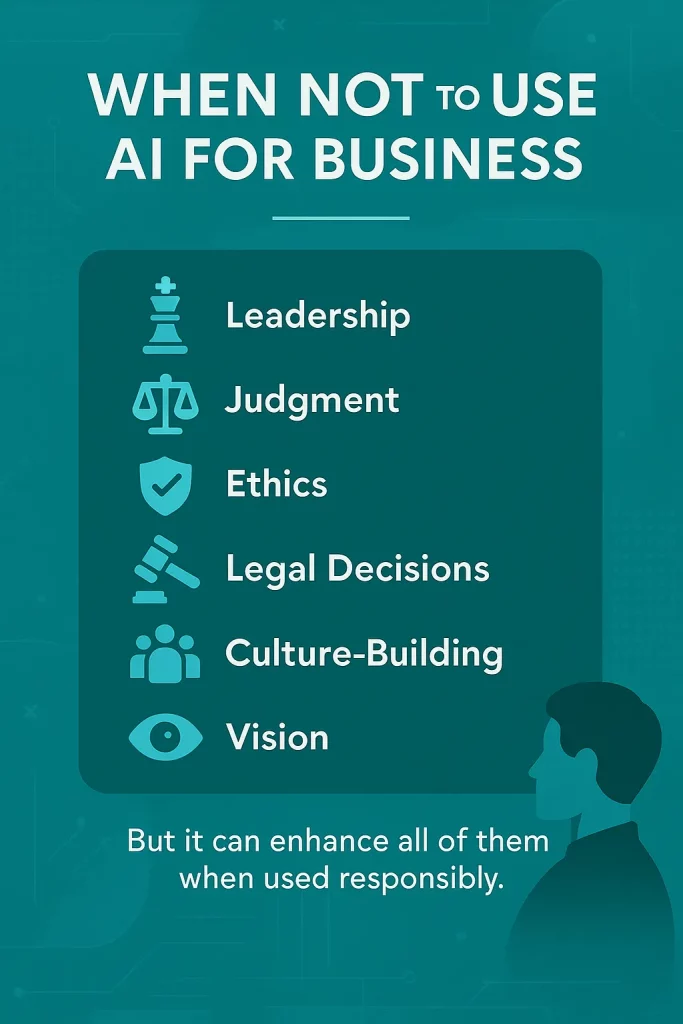
AI can strengthen decision-making, accelerate analysis, and help teams execute with more clarity.
But even the best ai prompts for business cannot replace the human responsibilities at the core of leadership.
There are several situations where human judgment must remain the primary driver.
1. Leadership & Vision
AI can suggest paths, but only leaders define direction.
Vision requires intuition, experience, emotional intelligence, and an understanding of context that no model can fully replicate. AI can support the thinking process, but it cannot decide who you want to become as a company.
2. Judgment in High-Stakes Decisions
Mergers, acquisitions, layoffs, restructuring, major investments — these decisions involve moral, human, and long-term trade-offs that must be made by people, not models.
AI can outline risks and scenarios, but the responsibility ultimately lies with leadership.
3. Ethics & Governance
AI has no inherent values.
It can’t understand fairness, morality, or the real-world consequences of its recommendations. It can only follow patterns. Ethical decisions — especially those involving customers, employees, or data — must be grounded in human principles.
4. Legal, HR & Compliance
Anything with legal exposure (terminations, contracts, disciplinary decisions, data policies, compliance risk) should always pass through human review.
AI can draft documents or explain implications, but it must never be the final authority.
5. Culture-Building & People Management
Company culture is built through relationships, trust, communication, and shared experience. AI can help structure feedback or create onboarding materials, but it cannot build belonging, psychological safety, or team identity.
6. Sensitive Human Context
Personal conflict, wellbeing, interpersonal tensions, or team disputes need empathy — something that cannot be automated.
AI may offer options but cannot perceive tone, history, or emotional nuance in a meaningful way.
In short:
AI is a multiplier, not a substitute.
It can analyze the data, reveal blind spots, and structure decisions — but leaders still make the call.
Used responsibly, AI strengthens your judgment.
Used blindly, it can amplify mistakes just as fast.
Conclusion — AI as a Strategic Partner, Not a Tool
AI becomes truly valuable in business when it moves beyond drafting text and starts supporting thinking, planning, and decision-making. That shift doesn’t come from better models alone — it comes from better prompts.
Well-designed AI prompts for business turn ambiguity into structure, surface risks earlier, and make complex trade-offs explicit. They allow leaders and teams to reason through strategy, operations, finance, and execution with greater speed and clarity — while keeping human judgment firmly in control.
When you combine:
- clear context
- defined professional roles
- structured frameworks
- few-shot examples
- and step-by-step reasoning
AI stops behaving like a reactive assistant and starts functioning as a reliable strategic partner — one that scales high-level thinking across teams without replacing leadership responsibility.
The competitive advantage isn’t using AI more often.
It’s using AI more deliberately.
To explore the full set of prompt guides, frameworks, templates, and real-world business use cases, visit the AI Prompts Hub.
To understand how structured prompting evolves into agentic and autonomous systems, explore The Future of AI Workflows: From Prompts to Autonomous Systems.
Used responsibly, AI doesn’t make decisions for leaders.
It helps leaders make better ones.
Related Reading from the Prompt Cluster
If you want to deepen your understanding of strategic prompting and decision-making with AI, these guides expand on the core concepts introduced in this article:
AI Prompt Writing Guide 2026 — The complete foundation for modern prompting, covering structure, clarity, and human–AI collaboration.
How to Write Better ChatGPT Prompts (with Examples) — Practical, copy-and-paste examples that show how small prompt changes dramatically improve output quality.
AI Prompt Frameworks Explained: The 4C Model and Beyond — Learn how structured frameworks reduce ambiguity and make AI reasoning more consistent and reliable.
Act as a… Prompts: How Roles Transform AI Output — How assigning AI a professional role sharpens tone, reasoning depth, and domain expertise.
Few-Shot vs Zero-Shot Prompting: When to Use Which — Understand how examples teach patterns, structure, and reasoning alignment.
Chain-of-Thought Prompting: Make AI Think Step-by-Step — A deep dive into reasoning-based prompting for complex analysis and decision-making.
Prompt Templates for Marketers and Creators — Reusable prompt systems that turn strategic intent into consistent, high-quality output.
Common Prompt Writing Mistakes (and How to Fix Them) — A diagnostic guide to identifying weak prompts and correcting structural flaws.
Top AI Prompt Tools to Boost Productivity in 2026 — Platforms and tools that support structured prompting, testing, and iteration.
The Future of AI Workflows: From Prompts to Autonomous Systems — A strategic look at how structured prompting evolves into agentic and autonomous AI workflows.