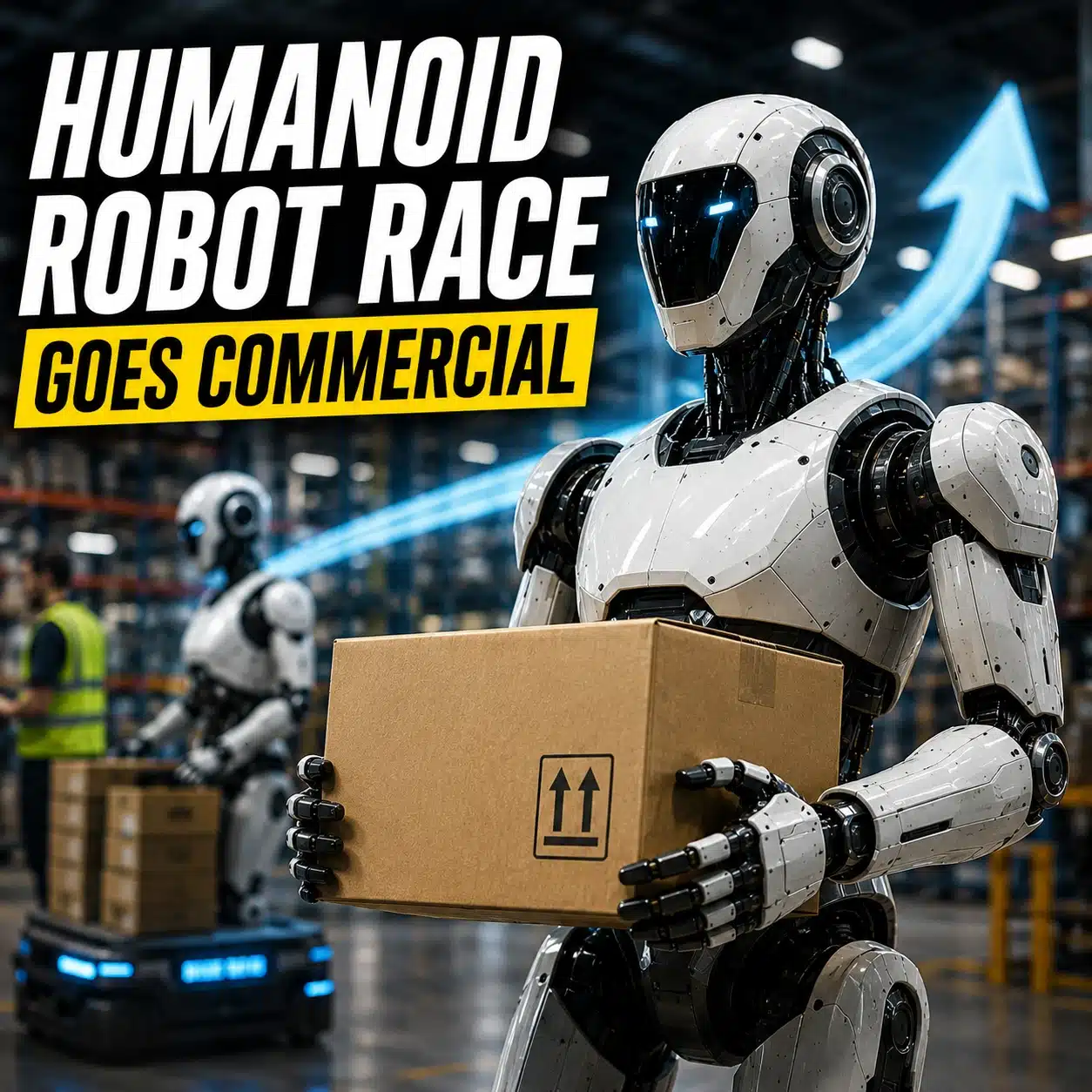
The humanoid robot race has moved out of labs and into commercial pilots, and that shift will change how factories, warehouses, and service teams are staffed and automated. After years of prototypes and demo videos, a cluster of startups, established industrial robotics firms, and systems integrators are now deploying humanoid platforms for tasks that require humanlike movement, dexterity, or presence. This transition matters because it forces organizations to build new operational processes, safety regimes, and total-cost models around robots that look and act like people.
Key Takeaways
- Core shift: Humanoid robots are moving from R&D showcases to commercial pilots across logistics, manufacturing, and facilities services.
- Why now: Improvements in actuators, perception stacks, and modular software make humanoid platforms more practical for real tasks.
- Impact: Buyers will need new procurement criteria—safety, interoperability, lifecycle costs, and staffing changes matter more than raw capability.
- What to watch: Safety standards, supply-chain scale, and software ecosystems that integrate humanoids into existing automation stacks.
Bottom line: The race is less about a single breakthrough and more about systems integration—hardware, control software, and enterprise workflows are now the battleground.
The humanoid robot race: What just happened
Several vendors have transitioned from controlled demonstrations to structured commercial pilots, placing humanoid platforms into real operational environments. Pilot deployments are focused on predictable, repetitive, or physically awkward tasks where a humanlike form factor offers a clear advantage—think aisle picking where upright posture and arm range simplify integration with existing shelves, or reception and inspection tasks that require navigating human-oriented spaces. These pilots are telling buyers and integrators how much adaptation, training, and process redesign are required before wide-scale rollouts are viable.
Why this matters now
Three converging pressures made this pivot timely: incremental maturity of motion and sensing stacks, falling unit and development costs for key components, and growing enterprise demand for automation that fits human workflows rather than forcing environments to change. Organizations that need flexible, mobile manipulators are actively experimenting with humanoid designs because traditional fixed robots or wheeled mobile manipulators often require costly retrofits to spaces built for humans. The result: buyers prefer solutions that integrate with current layouts and staff, accelerating demand for humanoid pilots.
What this changes in practice
Moving from demos to pilots alters how teams purchase, deploy, and operate robotics. Practical changes include:
- Procurement shifts: Contracts will emphasize uptime, maintainability, and safety certification over headline specs. Vendors will be evaluated for integration toolkits and support services, not just hardware.
- Ops and staffing: Facilities will create hybrid teams—robot operators, maintenance technicians, and human coworkers trained for shared tasks—rather than separate automation silos.
- Safety and compliance: Facilities need updated risk assessments, human-robot interaction protocols, and possibly new insurance and permitting approaches before scaling.
- Software ecosystems: Integration middleware, fleet management, and domain-specific apps become critical. Buyers will favor platforms that plug into existing Warehouse Management Systems, MES, or facilities management tools.
- Cost modeling: Total cost of ownership calculations must include software subscriptions, trained staff, safety upgrades, and spare-parts logistics—upfront hardware price is only one line item.
Insight: The commercial race is not a pure technology sprint; it’s a systems contest where integration partners and support ecosystems will decide which humanoid platforms succeed.
The bigger shift behind this
The move toward humanoid robots reflects a larger market evolution from isolated automation islands to versatile, people-friendly robotic systems. Enterprises are no longer satisfied with automation that demands wholesale environmental redesign. Instead, they want adaptable agents that can learn tasks, navigate human spaces, and be repurposed across workflows. This trend is tied to broader advances in edge compute, simulation-driven training, and modular actuation that reduce the engineering cost of new use cases. It also brings the regulatory and social dimensions of robotics—safety, worker displacement, and public perception—into immediate focus.
Arti-Trends perspective
Smart buyers should treat current humanoid pilots as exploratory investments, not plug-and-play replacements. Prioritize projects with clear metrics for success, short feedback loops, and plans for staff transition. For vendors, the path to market looks less like selling a robot and more like selling a managed system: reliability SLAs, local service networks, and developer ecosystems will be competitive differentiators. Investors should watch which suppliers solve scale manufacturing and spare-parts provisioning—those supply-chain plays may matter more than headline AI performance.
What to watch next
Conclusion
The humanoid robot race has entered a decisive phase: capability improvements are now paired with real-world pilots that reveal the non-technical work required to adopt these systems. Organizations interested in humanoids should start with tightly scoped pilots, invest in integration and safety planning, and treat vendors as long-term systems partners. The winners will be those who can combine reliable hardware, repeatable software stacks, and service-driven delivery at scale.
FAQ
- Will humanoid robots replace workers? Not immediately. Early deployments complement human teams for repetitive or ergonomically challenging tasks; widespread displacement would require large-scale cost advantages and social-policy changes that are not yet present.
- Are humanoid robots safer than traditional robots? Safety depends on system design and operational controls. Humanoid form factors make some interactions more intuitive, but they also require rigorous human-robot interaction protocols and updated risk assessments.
- What should enterprises pilot first? Start with narrow, measurable tasks where humanlike posture or reach simplifies integration—inventory pick-and-place in human-centric environments is a common example.
- How should vendors position their offerings? Vendors should package hardware with integration services, SDKs, and lifecycle support—commercial buyers value predictable uptime and clear support contracts over speculative capability roadmaps.