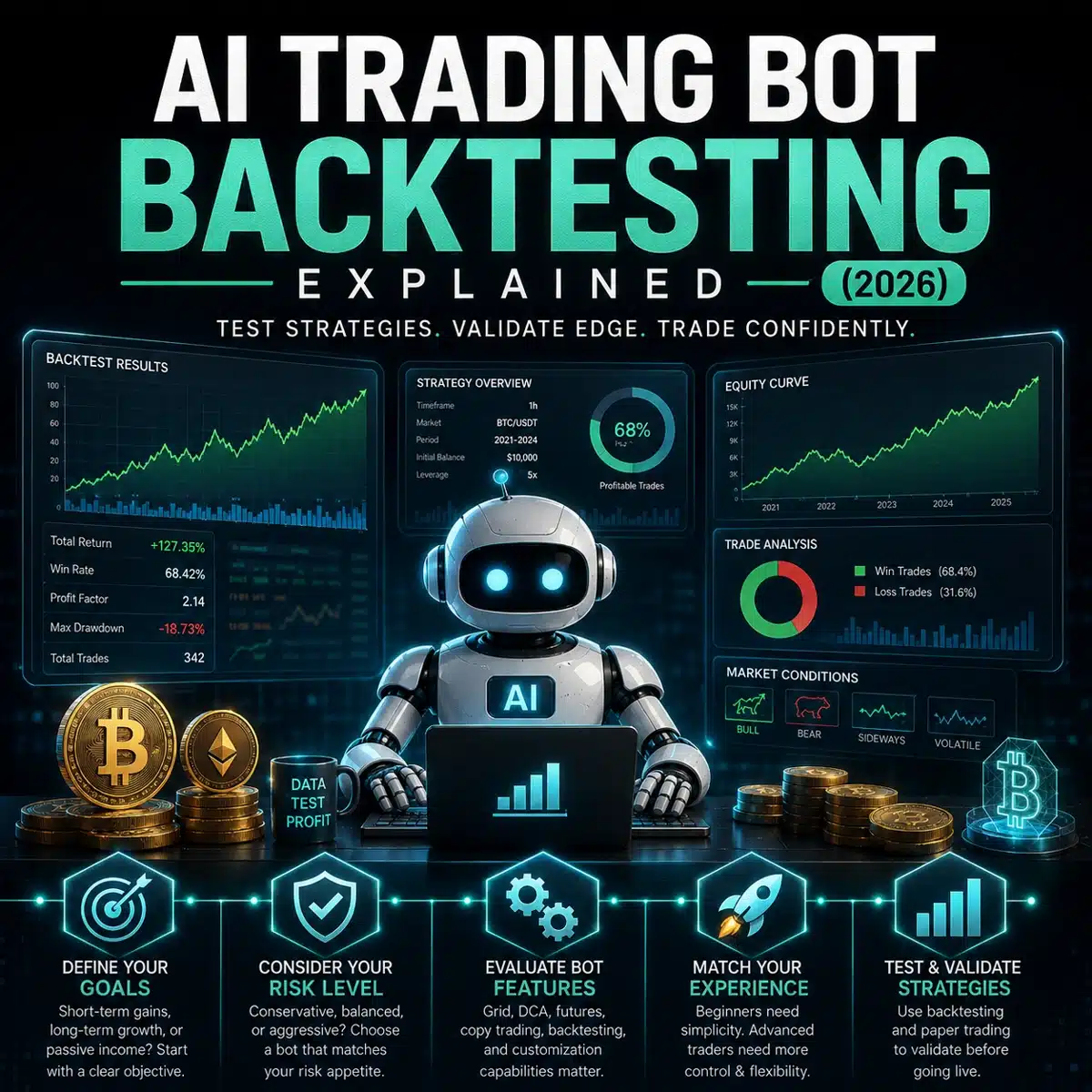
AI trading bot backtesting has become one of the most misunderstood concepts in automated crypto trading. Many traders assume a profitable backtest automatically means a profitable strategy. In reality, most AI trading systems fail not because the bot stops working — but because traders misunderstand what historical testing actually proves.
Backtesting is not about predicting the future. It is about measuring how a strategy would have behaved under previous market conditions while identifying weaknesses, hidden risks, and structural flaws before real capital is deployed.
As the AI crypto trading market becomes increasingly competitive, serious traders are shifting away from hype-driven automation toward data-driven validation frameworks. That makes backtesting one of the most important layers in modern algorithmic trading.
This guide explains how AI trading bots use historical simulations, why most retail traders misuse backtesting tools, and how professional traders validate crypto trading strategies before moving into live execution.
What Is AI Trading Bot Backtesting?
AI trading bot backtesting is the process of testing an automated trading strategy against historical market data to evaluate how the system would have performed under previous market conditions.
Instead of risking real capital immediately, traders simulate trades using past crypto price movements, technical indicators, execution logic, and risk-management rules.
Modern AI crypto trading bots can backtest:
- Grid trading strategies
- DCA systems
- Trend-following models
- Arbitrage setups
- Futures leverage systems
- Portfolio allocation strategies
- Signal-based AI execution models
The goal is not simply maximizing returns. Professional traders use backtesting to understand:
- drawdown exposure
- risk consistency
- market sensitivity
- strategy robustness
- execution behavior
- failure conditions
The purpose of backtesting is not proving a strategy works. It is discovering how and when it fails.
Why Backtesting Matters in Automated Crypto Trading
Crypto markets are highly volatile, fragmented, and structurally different from traditional financial markets. Strategies that appear profitable during strong market conditions can collapse when volatility regimes change.
Backtesting helps traders reduce uncertainty before deploying capital into live trading environments.
Within modern AI crypto trading strategies, backtesting is commonly used for:
- evaluating risk-adjusted returns
- testing strategy consistency
- optimizing trade frequency
- measuring maximum drawdowns
- validating leverage exposure
- testing market-condition sensitivity
- comparing execution models
Without proper backtesting, most automated trading systems become little more than speculation wrapped in automation.
How AI Trading Bot Backtesting Actually Works
Historical Market Data
Every backtest starts with historical exchange data.
This often includes:
- OHLCV candles
- volume data
- order-book information
- futures funding data
- liquidity conditions
- spread information
The quality of exchange data heavily influences the reliability of the simulation. Poor historical data can produce unrealistic results that fail immediately in live markets.
This is one reason why exchange infrastructure matters when choosing trading platforms. Traders using low-quality exchanges often experience large discrepancies between simulated and live performance. For a deeper breakdown, see Best Crypto Exchanges for AI Trading.
Strategy Logic Simulation
Once historical data is loaded, the bot applies trading rules across previous market conditions.
Examples include:
- moving-average crossovers
- RSI triggers
- trend filters
- grid spacing logic
- DCA averaging rules
- take-profit conditions
- stop-loss automation
Platforms like 3Commas, Cryptohopper, and Hummingbot all provide different levels of backtesting flexibility depending on trader experience and strategy complexity.
Execution Modeling
Professional backtesting goes beyond simple trade simulations.
Advanced testing frameworks also account for:
- trading fees
- slippage
- market spread
- API latency
- partial fills
- liquidity limitations
Ignoring execution friction is one of the biggest reasons why retail backtests produce unrealistic results. Fee structures alone can completely change profitability over time, especially for high-frequency systems. Related analysis can be found in AI Trading Bot Fees Comparison.
Performance Metrics
After the simulation finishes, traders analyze strategy performance metrics.
- win rate
- profit factor
- Sharpe ratio
- maximum drawdown
- risk-adjusted return
- trade frequency
- expectancy
Importantly, high win rates alone do not indicate strong systems. Some dangerous strategies generate impressive historical win percentages while hiding catastrophic downside risk.
The Biggest Backtesting Mistakes Most Traders Make
Overfitting
Overfitting happens when traders optimize strategies too aggressively around historical data.
The system becomes perfectly adapted to past market conditions — but loses the ability to perform under new environments.
The more perfect a backtest looks, the more suspicious traders should become.
Overfitted systems often collapse during live deployment because markets constantly evolve.
Ignoring Fees and Slippage
Many beginner traders forget that exchanges take a percentage of every trade.
High-frequency bots may execute hundreds or thousands of trades monthly. Even small fee structures can destroy long-term profitability.
This becomes even more important in AI futures trading bots, where leverage amplifies both gains and transaction costs.
Testing Only Bull Markets
One of the most common retail mistakes is testing strategies exclusively during strong bullish periods.
A strategy that performs well during aggressive crypto rallies may completely fail during:
- sideways markets
- high-volatility conditions
- liquidity contractions
- bear markets
- flash crashes
Professional traders test systems across multiple market cycles before allocating meaningful capital.
Unrealistic Position Sizing
Compounding assumptions can create unrealistic portfolio growth projections.
Many retail backtests assume:
- infinite liquidity
- perfect execution
- constant leverage
- zero emotional intervention
- full capital reinvestment
Real markets rarely behave this cleanly.
Paper Trading vs Backtesting: What’s the Difference?
| Feature | Backtesting | Paper Trading |
|---|---|---|
| Uses historical data | Yes | No |
| Uses live market conditions | No | Yes |
| Execution realism | Medium | Higher |
| Emotional pressure | None | Limited |
| Speed of testing | Fast | Slow |
Backtesting validates strategy logic using historical data. Paper trading validates execution behavior under live market conditions.
Professional traders usually combine both approaches before deploying live capital.
Why Most AI Trading Strategies Fail in Live Markets
Most AI trading strategies eventually fail because markets constantly change.
Common reasons include:
- changing volatility regimes
- exchange infrastructure problems
- liquidity shifts
- latency spikes
- market manipulation
- crowded strategies
- over-optimization
Even advanced AI crypto arbitrage bots can lose effectiveness once market inefficiencies disappear or execution competition increases.
This is also why AI crypto trading risks extend beyond simple price volatility. Infrastructure quality, market structure, and execution behavior all influence real-world performance.
Best AI Trading Bot Backtesting Tools (2026)
3Commas
3Commas remains one of the strongest retail-focused backtesting environments for crypto futures traders.
Best for:
- futures automation
- visual strategy testing
- multi-exchange deployment
- intermediate traders
Cryptohopper
Cryptohopper provides beginner-friendly strategy testing with template-based automation.
Best for:
- new traders
- signal integration
- strategy marketplaces
- simplified optimization
Hummingbot
Hummingbot is designed for advanced traders building quantitative or market-making systems.
Best for:
- professional traders
- custom strategies
- API-level optimization
- advanced backtesting workflows
Coinrule
Coinrule focuses on rule-based automation and simplified testing for non-technical traders.
Best for:
- beginners
- rule-based strategies
- simple automation
- risk-controlled workflows
How Professional Traders Validate AI Trading Strategies
Professional trading firms rarely rely on a single backtest.
Instead, validation typically follows multiple stages:
- historical backtesting
- walk-forward analysis
- paper trading
- small-capital deployment
- live stress testing
- portfolio correlation analysis
Institutional traders understand that no strategy remains permanently profitable. The goal is building adaptable systems capable of surviving changing market structures.
How to Backtest an AI Trading Bot Step by Step
Step 1 — Define the Strategy
Choose clear entry and exit rules before testing anything.
Step 2 — Choose Reliable Exchange Data
Use high-quality historical data from reputable exchanges.
Step 3 — Include Fees and Slippage
Always simulate realistic execution costs.
Step 4 — Analyze Drawdowns
Large drawdowns often matter more than raw profitability.
Step 5 — Stress-Test the Parameters
Test the strategy across multiple market environments instead of optimizing around a single period.
Step 6 — Move to Paper Trading
Before risking real capital, validate execution behavior under live market conditions.
For traders building complete automation workflows, the AI Crypto Trading Setup Guide explains how exchange APIs, risk settings, and infrastructure layers fit together.
Final Verdict: Is Backtesting Enough?
Backtesting remains one of the most important foundations in automated crypto trading — but it is not a guarantee of future profitability.
The strongest traders use backtesting as part of a broader validation framework that includes risk management, paper trading, infrastructure analysis, and adaptive execution models.
As AI trading systems continue evolving, the difference between profitable automation and dangerous over-optimization will increasingly come down to how traders validate strategies before deploying capital.
The goal of backtesting is not finding certainty. It is reducing uncertainty.