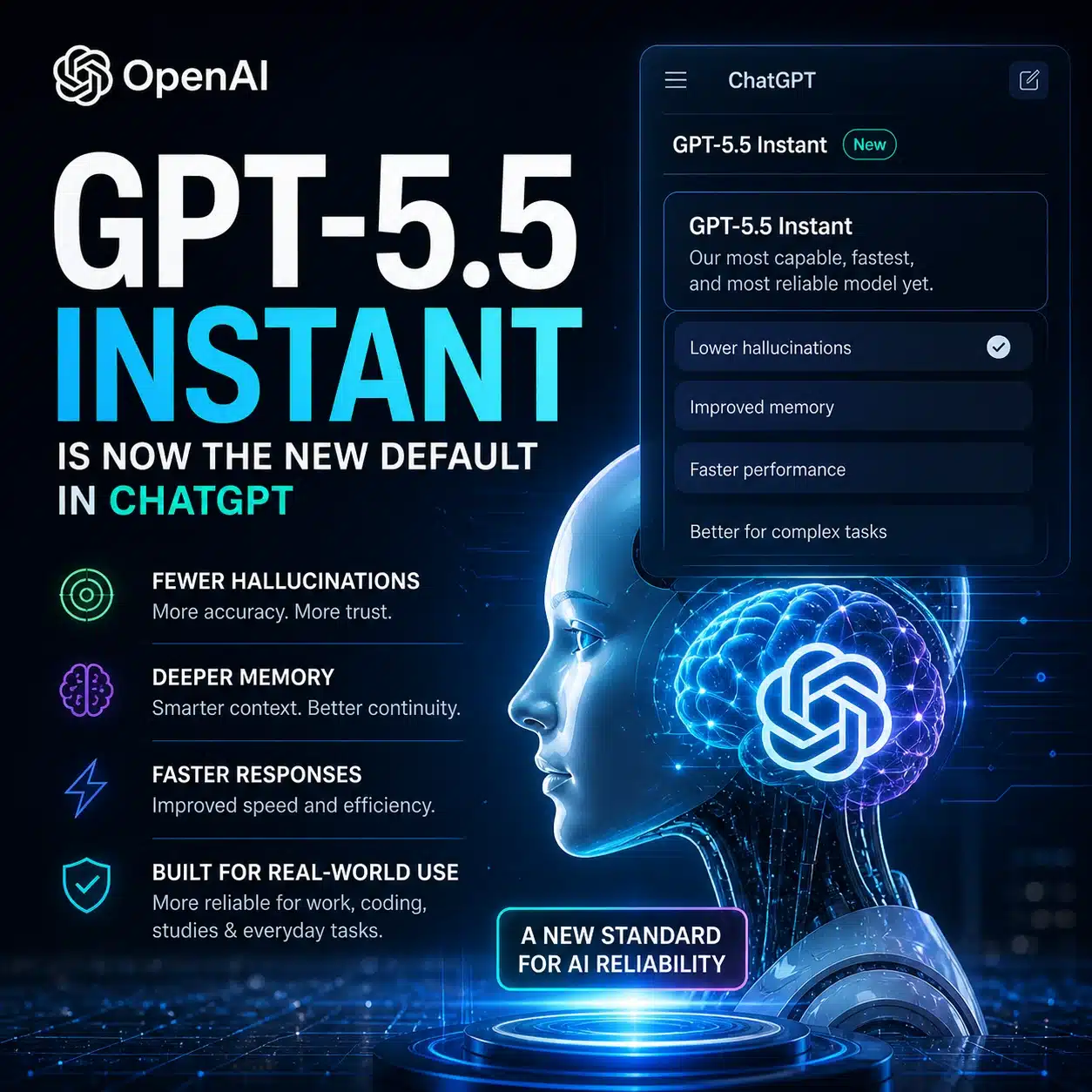
OpenAI has switched ChatGPT’s default model to GPT-5.5 Instant, a release positioned around fewer hallucinations, deeper conversational memory, and faster reply performance. The change is not just a model swap — it signals a strategic shift toward reliability and workflow readiness across millions of users who immediately inherit different behavior and output quality. GPT-5.5 Instant aims to make interactions more consistent and trustworthy, which directly addresses a core barrier to broader enterprise and creator adoption: confidence in AI outputs.
Key Takeaways
- Core shift: OpenAI is prioritizing trust and stability over raw benchmark leadership by making GPT-5.5 Instant the default ChatGPT model.
- Why now: Reducing hallucinations and improving memory are necessary steps to push AI from experimentation to production across businesses and creators.
- Impact: Users should expect more consistent conversations, quicker replies, and fewer unpredictable outputs — improving workflow integration and retention.
- What to watch: Competitors’ reliability moves, enterprise adoption signals, and new memory or API primitives that change how apps persist context.
Bottom line: This rollout reframes competition — AI success will increasingly be measured by trust, stability, and integration, not just benchmark scores.
What just happened
OpenAI has rolled out GPT-5.5 Instant as the default model behind ChatGPT for general users. The model is described as delivering lower hallucination rates, improved memory consistency across sessions, and faster response latency compared with prior defaults. The update applies immediately to ChatGPT users and influences how the assistant behaves across prompts, follow-ups, and multi-turn conversations. Early messaging around the release frames it as an optimization for production-facing experiences rather than a headline-grabbing jump in raw capability.
Why this matters now
The timing matters because default model changes affect millions of active users and a large ecosystem of apps, plugins, and workflows built on ChatGPT behavior. Enterprises evaluating AI for customer support, document summarization, coding assistants, and regulated domains have repeatedly singled out hallucinations and inconsistent memory as deployment blockers. By prioritizing reliability now, OpenAI is signaling a move to capture mainstream, production use cases where predictability and trust determine adoption and retention. That also forces competitors to reframe product roadmaps toward stability and real-world utility.
What this changes in practice
- Daily users will notice fewer non-sequiturs and more consistent follow-up behavior in extended chats, which reduces time spent verifying simple factual outputs.
- Creators and knowledge workers get more reliable draft outputs and persistent context, making long-form collaboration, iterative editing, and tutoring workflows smoother.
- Developers and product teams can expect a steadier foundation for building customer-facing features — fewer ad hoc guardrails and user friction from hallucinations — but should still validate mission-critical outputs.
- Enterprises assessing procurement risk can treat this as a signal that vendors will increasingly prioritize trust metrics (hallucination rate, memory fidelity, latency) in SLAs and integration tooling.
- For researchers and model evaluators, the rollout emphasizes operational metrics — latency, context management, and consistency — over headline model size or benchmark ranks.
For readers who want a primer on foundational AI concepts behind these changes, see the AI explained hub for background on model behavior and memory primitives.
Insight: The industry pivot from “smarter” to “steadier” is subtle but decisive — most mainstream value comes when models stop surprising you, not just when they pass a tougher benchmark.
The bigger shift behind this
This rollout reflects a larger industry transition: vendors are moving from a benchmark-and-capability race into a reliability-and-integration era. That shift combines several trends — larger context windows and memory systems, more targeted fine-tuning to reduce hallucinations, infrastructure investments to cut latency, and product work to support persistent, verifiable outputs. The market is maturing: customers now demand API stability, auditability, and predictable behavior over incremental capability gains that are hard to control in production settings.
Arti-Trends perspective
Smart readers should see GPT-5.5 Instant’s default placement as a signal about where value accrues in 2026. The battle for mindshare will increasingly center on trust: how often an AI is right, how consistently it recalls user context, and how fast it integrates into workflows. Vendors that prioritize those operational metrics — and offer clear ways to measure and enforce them — will win enterprise budgets and creator loyalty. That doesn’t make capability irrelevant, but it does change investment calculus: monitor reliability roadmaps as closely as model-family announcements.
What to watch next
Conclusion
OpenAI’s decision to make GPT-5.5 Instant the ChatGPT default is more consequential than a typical model refresh. It reframes product competition around trust and integration, and it materially improves the baseline experience millions rely on. For teams deploying AI, the practical implication is to prioritize tests and controls for hallucination and memory fidelity — because reliability, not raw capability, will dictate whether AI becomes a predictable tool or an intermittent liability.
FAQ
- What is GPT-5.5 Instant and how is it different?
GPT-5.5 Instant is the model OpenAI has set as ChatGPT’s default. It emphasizes lower hallucination rates, more consistent conversational memory, and faster response times compared with previous defaults. Expect steadier multi-turn behavior rather than radical new capabilities.
- Will my existing ChatGPT conversations change?
Yes — conversation behavior and follow-ups may be more consistent and factual under the new default. However, outputs can still vary; you should re-test mission-critical prompts and workflows after the change.
- Does this mean hallucinations are solved?
No. The rate and severity of hallucinations appear reduced, but they are not eliminated. Organizations should maintain verification steps for high-risk outputs and apply domain-specific checks where accuracy matters.
- How should developers respond?
Validate end-to-end flows with the new default, add monitoring for factuality and drift, and consider integrating memory and verification hooks into your product to leverage improved consistency safely.