Artificial Intelligence (AI) Is Rewriting the DNA of YouTube
Once a simple platform for video sharing, YouTube has evolved into an intelligent, self-learning ecosystem — capable of understanding what you want to watch, when, and even why.
From automated subtitles and real-time translations to predictive algorithms and generative content, AI now powers almost every feature of the world’s biggest video platform.
But what does this mean for creators, marketers, and brands who rely on YouTube as a core content channel?
This article explores how AI shapes YouTube’s future — and how you can leverage that shift to strengthen your strategy, improve discoverability, and future-proof your channel.
🧩 The Evolution of YouTube’s AI — From Algorithm to Ecosystem
When YouTube first introduced algorithmic recommendations, the system was relatively simple — based on clicks, views, and keywords. But as machine learning matured, YouTube’s engineers realized something deeper: human attention isn’t logical; it’s emotional, contextual, and ever-changing.
This insight transformed YouTube’s algorithm into a self-learning ecosystem, powered by reinforcement learning. AI models now train continuously on billions of data points — what you skip, what you replay, which thumbnails attract a hover pause, and even how long you linger on a comment thread.
Behind the scenes, multiple neural networks collaborate:
- Candidate generation networks that predict which videos you might enjoy next.
- Ranking models that decide the exact order of recommendations.
- Contextual models that adjust results based on location, device, and time of day.
The result? A system that doesn’t just show you videos — it curates experiences.
Understanding this evolution helps creators design content that resonates with both people and algorithms.
🧠 The Role of AI on YouTube — Beyond Recommendations
YouTube’s AI has moved far beyond recommending similar videos.
Today, deep learning models analyze millions of signals per second to predict user intent and personalize the viewing experience.
Key ways AI drives YouTube:
- Smarter recommendations: AI models analyze watch history, session length, and engagement signals to anticipate preferences.
- Automated captioning and translation: Advanced speech recognition delivers instant subtitles across 100+ languages, making videos globally accessible.
- Content moderation: AI scans billions of videos to detect policy violations, spam, and misinformation.
- Creative tools: Features like Dream Screen and YouTube Create offer AI-powered backgrounds, edits, and voice-overs — lowering the entry barrier for creators.
In short: AI is the invisible producer behind the scenes, shaping how every video is discovered, presented, and consumed.
⚙️ How YouTube’s AI Understands Viewer Behavior
Unlike traditional algorithms, YouTube’s AI doesn’t rely solely on clicks or keywords.
It decodes behavioral intent through complex neural networks that track:
- Watch time per segment — not just total views.
- Engagement loops — likes, comments, and shares.
- Drop-off moments — identifying exactly where users lose interest.
- Contextual signals — device type, time of day, previous searches, even interaction with Shorts or Live.
This behavioral modeling allows AI to predict which content will maximize satisfaction — YouTube’s ultimate goal.
For creators, that means optimizing for depth of engagement, not vanity metrics.
💡 Strategy insight:
Use retention graphs in YouTube Studio to refine your pacing. If 40% of your viewers drop off before the first minute, your hook isn’t strong enough — rewrite the intro, test thumbnails, and compare performance using TubeBuddy’s AI split testing.
🎥 AI Tools Empowering Creators in 2026
Artificial intelligence is reshaping the creative workflow. The best creators no longer compete on production speed — they compete on strategic integration of AI tools.
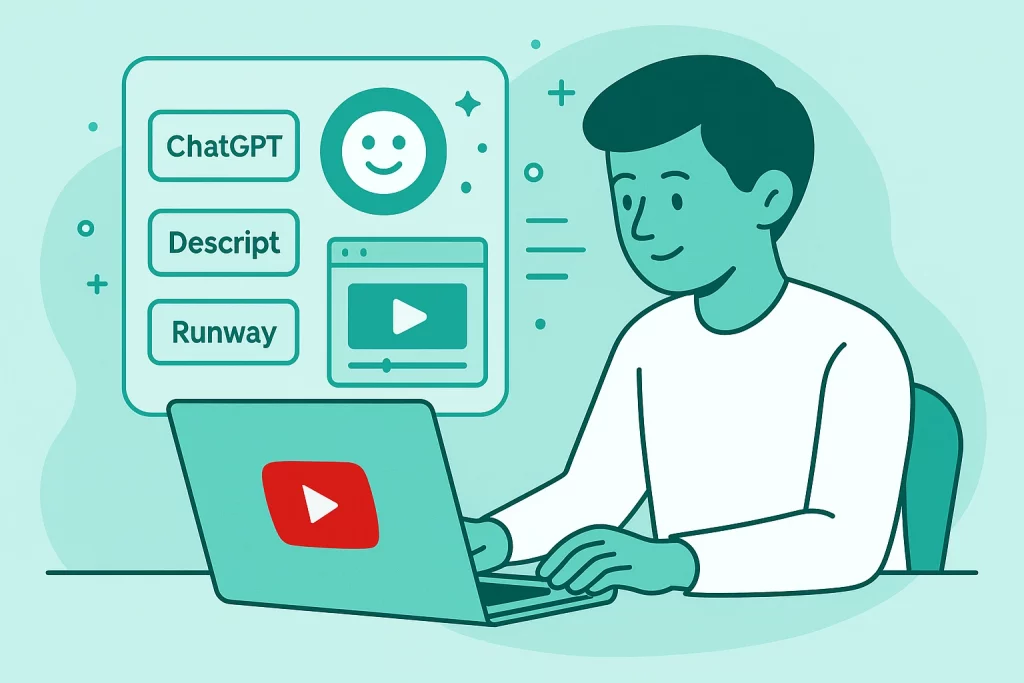
Must-use AI tools for YouTube creators:
- YouTube Create — Simplifies editing, subtitles, and voice-overs using AI automation.
- Descript — Edit audio and video via text; clone your voice for consistent branding.
- Runway ML — Generate cinematic effects, remove backgrounds, or expand frames with AI.
- Pika Labs — Turn text prompts into short, animated video scenes.
- ChatGPT + Gemini — Draft SEO-optimized scripts, tags, and content outlines.
- ElevenLabs — Realistic AI voiceovers for multilingual content.
- OpusClip — Automatically creates viral short clips from long videos.
💡 Smart workflow example:
Use ChatGPT to generate 10 title ideas → Test them with TubeBuddy’s predictive analytics → Edit the final video in Descript → Generate Shorts in OpusClip → Schedule posts using YouTube Studio’s AI insights.
🔍 AI and SEO — A New Era of Video Search Optimization
The way YouTube “reads” content has changed.
Its AI systems no longer depend solely on metadata — they analyze semantics, visuals, and voice to determine context and relevance.
What matters for SEO in 2025:
- Natural, conversational titles and descriptions — written for humans but structured for AI comprehension.
- Complete transcripts — automatic subtitles double as SEO text.
- Visual analysis — AI understands objects, faces, and logos appearing in your videos.
- Voice intent recognition — ranking increasingly depends on spoken keywords, not just typed tags.
- Thumbnail relevance — AI now evaluates imagery for emotional and contextual fit.
💡 Optimization tip:
Include your focus keyword naturally within the first 15 seconds of your spoken intro. YouTube’s voice-to-text AI captures that and indexes it — boosting discoverability for voice search queries.
⚖️ Ethics and Transparency — Navigating AI Disclosure Rules
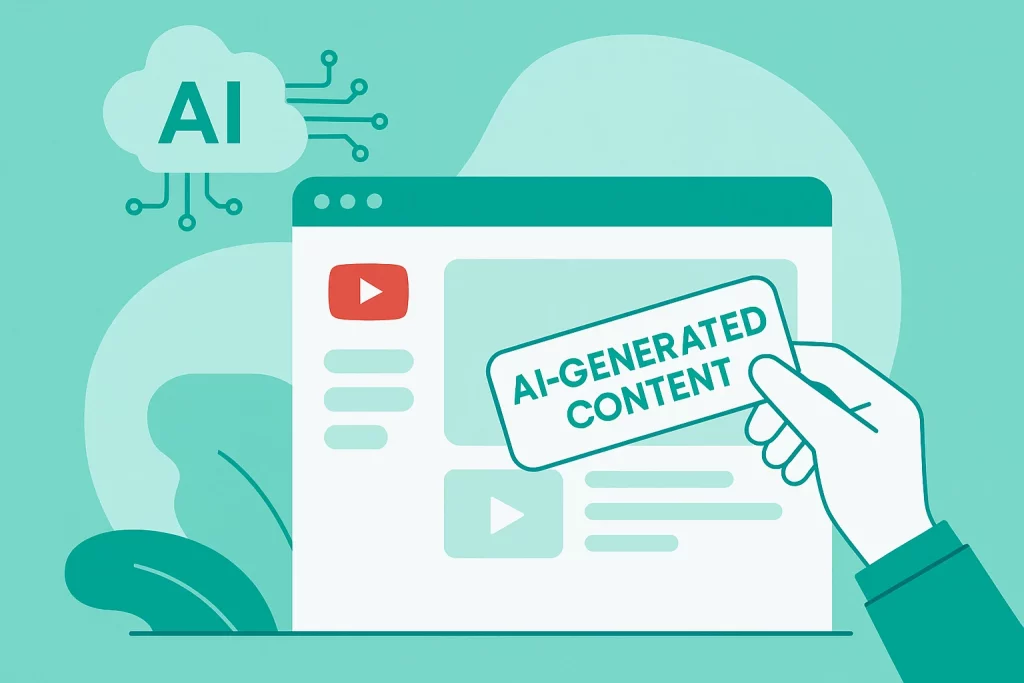
From 2025 onward, YouTube will enforce new transparency guidelines requiring creators to label AI-generated or synthetic content.
That includes:
- Deepfake humans or AI-simulated likenesses
- Synthetic voices or cloned narrators
- AI-generated imagery presented as real
While some see this as restrictive, it’s actually a strategic opportunity. Transparent creators are rewarded with higher trust metrics, potentially influencing recommendation weight and viewer retention.
💡 Pro Tip:
Include a brief “AI-assisted creation” note in your description or outro. It signals honesty — and aligns with Google’s E-E-A-T (Experience, Expertise, Authoritativeness, Trustworthiness) standards for ranking quality.
📈 Strategic Implications — How AI Shapes Content Planning
AI doesn’t just automate; it informs creative strategy.
Here’s how to adapt:
- Use predictive analytics from YouTube Studio to identify rising topics before they trend.
- Experiment with AI-assisted storytelling: let AI outline the structure while you refine emotional tone.
- Diversify formats: combine Shorts, long-form, and livestreams to feed YouTube’s AI with multi-signal engagement.
- Leverage personalization data: analyze “when your viewers are online” to post at optimal times.
- Integrate SEO + retention: craft titles that appeal to AI (data-driven) and humans (emotion-driven).
Example: Instead of “AI Tools Review”, use “How I Doubled My Views with These 3 AI Tools for YouTube.”
Building a Sustainable AI-Driven Content Strategy
AI gives creators access to more data than ever — but data without direction can lead to burnout and inconsistency.
To build a long-term, sustainable system:
- Plan in AI-assisted cycles: use Notion AI or ClickUp AI to analyze which formats perform best each quarter.
- Humanize your analytics: interpret numbers through storytelling — ask why a certain video performed well, not just how much.
- Diversify your creative inputs: let AI handle structure, but use audience comments and real-world trends for inspiration.
- Collaborate with AI as a team: share insights with editors and marketers to align creativity and data.
The best creators treat AI as a creative coach, not a replacement — a way to improve clarity, focus, and consistency.
🚀 The Future of YouTube and AI — What’s Next
YouTube’s roadmap shows a shift toward adaptive, personalized experiences:
- Real-time translation using your own cloned voice.
- Auto-generated highlights and key moments for Shorts.
- Dynamic home feeds that adapt to user mood, intent, or attention span.
- AI collaboration tools — imagine co-creating with an AI editor that suggests music, effects, or pacing changes based on analytics.
This transformation means creators will move from being video producers to data-driven storytellers.
The ones who thrive will master both — creative intuition and algorithmic intelligence.
🔮 Future Trends — What’s Coming Beyond 2025
YouTube’s relationship with AI is only just beginning. By 2030, expect:
- Generative storytelling: AI will help creators turn text prompts into cinematic scripts with scene pacing and tone suggestions.
- Adaptive videos: content will automatically change music or visuals based on viewer emotion, detected via devices or engagement data.
- Interactive learning: educational channels will feature real-time AI tutors inside the video.
- Ethical personalization: users will control how AI shapes their feed — switching between “explore”, “focus”, or “learn” modes.
These shifts show YouTube evolving into an interactive intelligence layer of the web — where every viewer’s experience becomes uniquely crafted by AI.
💬 Conclusion
AI has redefined what it means to succeed on YouTube. The algorithms are smarter, the tools are faster, and the audience is more selective.
To grow, creators must blend AI-powered analytics with authentic human storytelling. Use AI not to replace creativity — but to enhance clarity, speed, and strategy.
Those who understand how YouTube’s AI thinks will dominate the next generation of video content.